
Updated:
A Florida minor child power of attorney is a parental authority document. Fla. Stat. § 709.2105 requires two subscribing witnesses and acknowledgment before a notary or under s. 695.03. This page gives parents and guardians the template, filling steps and signing rules.

Build Your Document
Answer a few simple questions to make your document in minutes
Save and Print
Save progress and finish on any device, download and print anytime
Sign and Use
Your valid, lawyer-approved document is ready
A Florida minor child power of attorney is a signed document in which a parent or guardian names another adult, called the agent or attorney-in-fact, to act on behalf of a child. The authority the agent holds is what the form gives, and option 1 names medical treatment and schooling decisions. For medical care, the conditions in Fla. Stat. § 743.0645(2)(a) apply, as listed under the medical section below.
The FormsPal template on this page names an agent to act on behalf of your child, for example while you travel or work away from home. You can fill it in online or download the PDF and complete it by hand. Here is what the template covers from start to finish:
Those are the parts this page walks through. Fla. Stat. § 709.2105 also requires two subscribing witnesses, as the signing section below explains.
This form is one of our power of attorney templates. If you need other state-specific documents, check out all Florida POA forms on our site.
The table below sums up the Florida minor child power of attorney form and the Florida sections cited on this page.
| Document Name | Florida Minor Child Power of Attorney Form |
| Other Name | Florida Parental Power of Attorney |
| Relevant Laws | Fla. Stat. § 709.2105 (agent and signing), Fla. Stat. § 709.2109 (when it ends), Fla. Stat. § 743.0645(2)(a) (medical consent for a minor) |
| Duration | The start and end dates you enter on the form |
| Avg. Time to Fill Out | 15 minutes |
| # of Fillable Fields | 44 |
| Available Formats | Adobe PDF |
Keep the phone number and address of your attorney-in-fact with your copy of the form. Add the school and doctor contact details for your children too, so they are easy to find.
A power of attorney for the care of a minor child fits when a trusted adult will look after your child while you are away, for instance on a long trip or a work assignment. The person named then acts within the powers the form gives. Medical consent under Fla. Stat. § 743.0645(2)(a) applies only on the conditions listed in the medical section below, and this page cites no rule on what a school must accept, so ask the school what it needs.
These situations are a common reason to prepare the form ahead of time:
The agent must be a natural person who is 18 years of age or older or a financial institution that has trust powers, has a place of business in this state, and is authorized to conduct trust business in this state, Fla. Stat. § 709.2105.
Pick someone who knows your child's routine, doctor and school, and who agrees to serve. Then name a second person as the successor, so the form still has an agent if the first one cannot serve.
A different route fits when the child's care needs more than a signed form, or when the medical side is the only concern.
Under Fla. Stat. § 743.0645(2)(a), a person who possesses a power of attorney to provide medical consent for a minor is in the first group of people who may consent, in the order of priority that section lists.
The section applies only when all of these conditions are met:
A power of attorney executed after July 1, 2001, to provide medical consent for a minor includes the power to consent to medically necessary surgical and general anesthesia services for the minor, unless the individual executing it excludes those services, Fla. Stat. § 743.0645(2)(a).
Option 1 on this template names medical treatment among the powers it gives.
Fla. Stat. § 743.0645(2)(a) lists a health care surrogate designated under s. 765.2035 after September 30, 2015, in the same group as the person holding a power of attorney. That designation is a separate document from this template, so choosing one does not change what you fill in here.
The steps below follow the FormsPal template this page hands out, which you can fill in online or download as a PDF. Work through its seven parts in order, from the parent or guardian and the child to the notary page. Have the full names and addresses of everyone named on the form ready before you start.
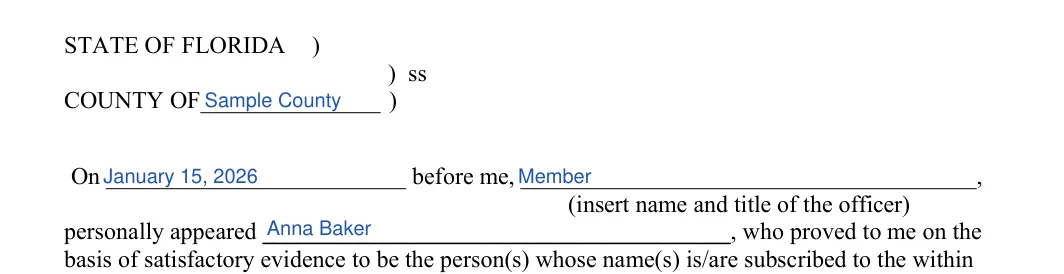
The screenshots under each step show the FormsPal Florida Minor Child Power of Attorney template filled with sample entries in blue, so you can see where each answer goes. The names, addresses, dates and amounts are examples only.
Parent or Guardian and the Minor Child
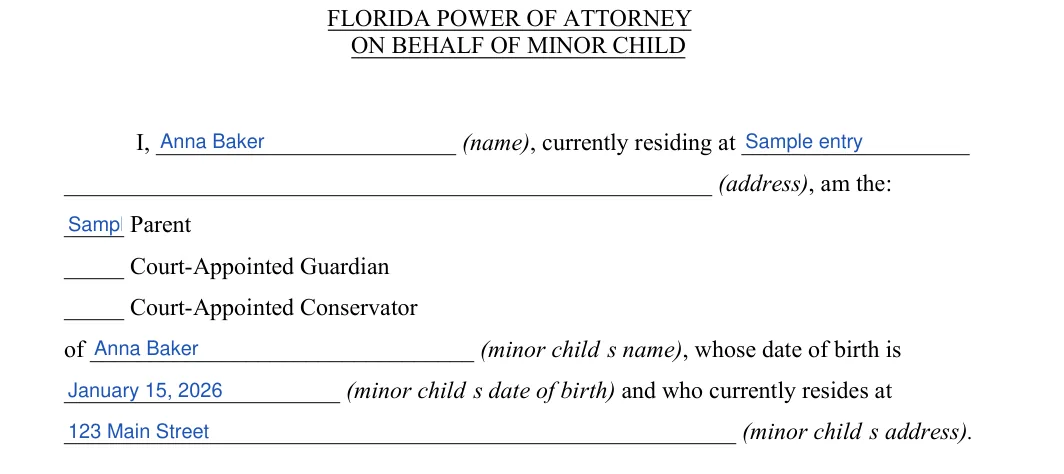
Enter your name and current address, then initial the line that matches your role. The form lists parent, guardian and conservator. Add the child's name, date of birth and address.
Second Parent or Guardian and the Agent
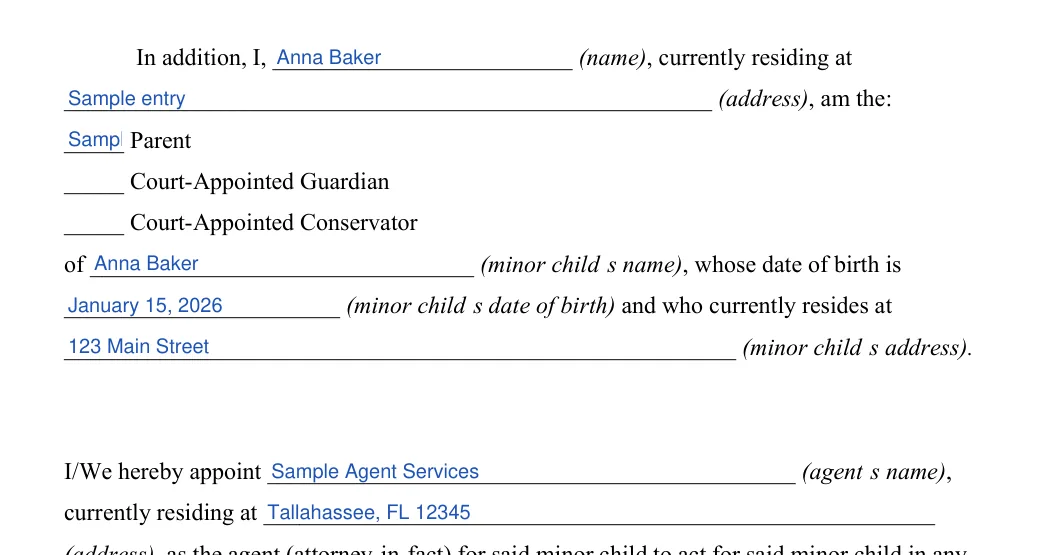
Complete the additional statement only if there is more than one parent, guardian or conservator. It repeats the same lines for the second person. Then enter the name and address of the agent, who is also called the attorney-in-fact.
Powers and Successor Attorney-in-Fact
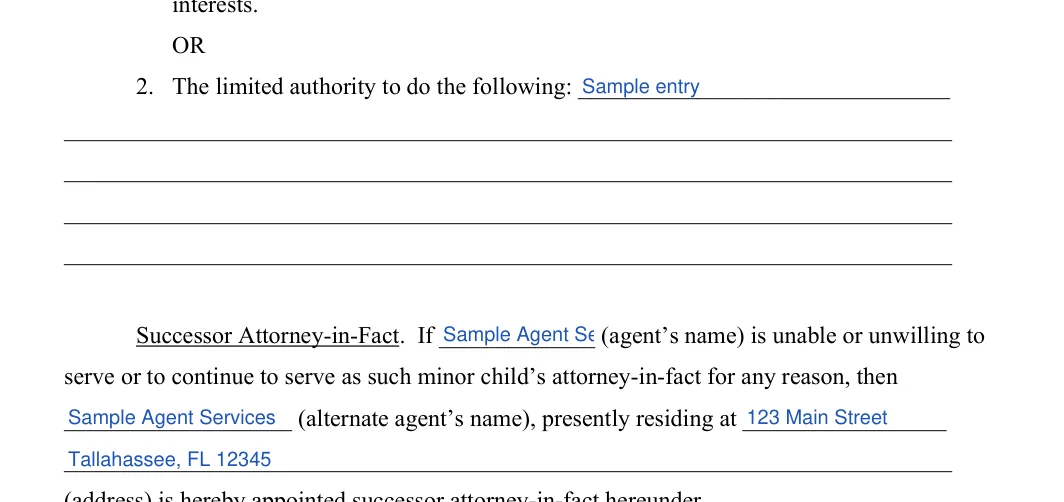
Choose option 1 for all the authority printed on the form, or option 2 and write the limited authority on the lines provided. Then enter the name and address of the alternate, who is the backup if the first one cannot serve.
Effective Date
Enter the date the power of attorney starts and the date it continues until.

Signature and Printed Name
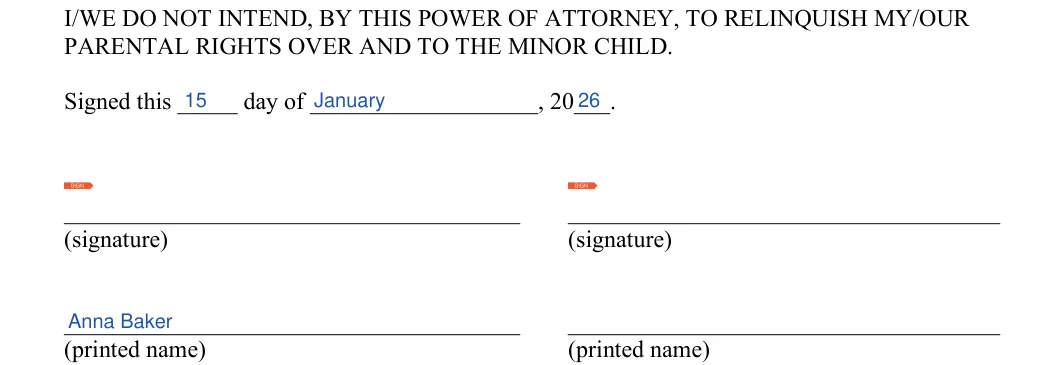
Read the statement about parental rights above the signature lines. Then enter the day, month and year, sign on the signature line and print your name below it. A second parent or guardian uses the second line. Two subscribing witnesses must sign as well, Fla. Stat. § 709.2105.
Acknowledgment: County, Date and Officer
Page 3 is the acknowledgment that Fla. Stat. § 709.2105 calls for, and the notary or other officer completes it. Its lines take the county, the date, the name and title of the officer and the name of the person who appeared, so leave them empty.
Notary Signature and Seal
The last line on page 3 belongs to the notary or other officer, who signs it and adds the seal. Leave it empty so the officer can complete it.

A power of attorney must be signed by the principal and by two subscribing witnesses and be acknowledged by the principal before a notary public or as otherwise provided in s. 695.03, Fla. Stat. § 709.2105. On this form, the principal is the parent or guardian who gives the authority.
| Requirement | What the rule says | Citation |
|---|---|---|
| Principal's signature | Signed by the principal | Fla. Stat. § 709.2105 |
| Witnesses | Signed by two subscribing witnesses | Fla. Stat. § 709.2105 |
| Notary | Acknowledged by the principal before a notary public or as otherwise provided in s. 695.03 | Fla. Stat. § 709.2105 |
| Principal unable to sign | If the principal is physically unable to sign, the notary public before whom the oath or acknowledgment is made may sign the principal's name pursuant to s. 117.05 | Fla. Stat. § 709.2105 |
Fla. Stat. § 709.2105 requires the signatures of two subscribing witnesses, and the seven steps above show no line labeled for them. Before you sign, look through your finished document for witness lines. If it has none, add two lines below your signature, one for each witness to sign and print their name.
Then work through these steps, so the form is correct and easy to reach when someone asks for it.
Check the details
Compare every name, address and date on the form with the IDs of the people named. Matching spelling on every line makes the form easier to read.
Sign where the form shows
Sign and print your name on the signature line. Leave the acknowledgment on page 3 for the notary or other officer to complete.
Add the witnesses
Fla. Stat. § 709.2105 requires the signatures of two subscribing witnesses, so arrange for them before you go to the notary.
Keep a copy
Save a digital copy and keep a paper copy where you can find it quickly.
Share a copy with the attorney-in-fact
Give them a copy so they have the form on hand and know what it says.
Use the same spelling of each name on every line of the form. It keeps the form consistent from the first page to the last.
A Florida power of attorney for a minor child lasts until an ending event in Fla. Stat. § 709.2109 occurs, and the end date you enter on this template is one of those events because the document itself provides that it terminates.
Fla. Stat. § 709.2109 says a power of attorney terminates when any of these happens:
An agent's authority terminates when the agent dies, becomes incapacitated, resigns, or is removed by a court, Fla. Stat. § 709.2109. The last item in the list above is why the successor line on the form matters: it provides another agent to act.
Termination or suspension is not effective as to an agent who, without knowledge of it, acts in good faith under the power of attorney, Fla. Stat. § 709.2109. An act so performed, unless otherwise invalid or unenforceable, binds the principal, so tell the agent as soon as you decide to end the form early, Fla. Stat. § 709.2109.
A Florida minor child power of attorney is a document a parent or guardian signs, while temporary custody comes through a petition by an extended family member. The two answer different needs, and this template only does the first.
Temporary custody goes through the court: Fla. Stat. § 751.02 has eligible extended family members bring the proceedings in the circuit court. Unless the child's parents object, the court shall award temporary custody to the petitioner if it is in the best interest of the child, Fla. Stat. § 751.05(2). If a parent objects, the court shall grant it only on a finding, by clear and convincing evidence, that the parent or parents are unfit, Fla. Stat. § 751.05(3)(b).
The signing rule for a power of attorney, Fla. Stat. § 709.2105, lists signatures, witnesses and an acknowledgment, and it names no court approval.
The Petition for Temporary Custody by Extended Family requests that an extended family member be granted temporary custody of a child when the parents cannot care for the child temporarily or long-term. Below are detailed instructions to guide you through each section of the form.
Identifying the Court and Parties
Begin by entering the name of the judicial circuit and county where the petition is being filed. You must provide the case number and division, usually assigned by the court clerk upon filing the petition. Also, list the full legal names of the child or children involved, the petitioner (yourself or another family member), and the respondent(s), typically the child’s parents or guardians.
Details of the Petition
In this step, input your full legal name as the petitioner and describe your relationship to the child.
Custody Information
Provide the name, date of birth, and address of each child whose custody you seek. Also, include your full residence and post office address and contact information, such as a telephone number and email, if applicable.
Legal Grounds for Custody
Under Fla. Stat. § 751.02(1), you may petition as an extended family member who has the signed, notarized consent of the child's legal parents, or who is caring full time for the child in the role of a substitute parent and with whom the child is presently living. For temporary custody, Fla. Stat. § 751.03(9) has the petition state the parents' consent, or the specific acts or omissions that demonstrate the parents abused, abandoned or neglected the child as defined in chapter 39.
Supporting Documents
Attach the documents your petition relies on, such as the parents' signed, notarized consent if that is your ground under Fla. Stat. § 751.02(1). Ask the clerk's office if anything else should go with your petition.
Orders and Additional Requests
State any existing child support orders and specify if you are requesting the court to modify these orders to redirect support to you. Mention whether you are requesting the establishment of a visitation or time-sharing schedule with the parents.
Signatures and Verification
Sign the petition in the presence of a notary or deputy clerk to validate your identity and the authenticity of your signature. The document must be notarized.
Filing the Petition
Finally, file the completed and notarized petition with the appropriate circuit court. Check if there is a filing fee, which you should pay as the court requires.
These answers cover what to prepare, which authority option to pick and how to fill in the form.
You need the names, addresses and dates of the people on the form, plus any details your attorney-in-fact will use:
Keep them nearby while you fill in the form so each line is quick to complete.
Option 1 on the form covers the broad authority printed there, which names medical treatment, decisions about schooling and care for the child. Option 2 lets you list only the tasks you want handled, on the lines provided.
The successor attorney-in-fact is a backup named on the form, and the form uses this person if the first one is unable or unwilling to serve.
Yes, you can create the power of attorney for a minor child online, save your progress and finish on any device. You can also download the PDF, fill it in with the PDF editor and print it.
The template has lines for one child, so a simple approach is to fill in a separate copy for each of your children. Every form then lists one child's name, date of birth and address.
Yes, the form has a second statement and a second signature line for another parent, guardian or conservator. Complete them when they apply to your family.
No, this template names an agent and sets the agent's powers and dates, and it is not a court appointment of a guardian. If a judge's order is what you need, speak with a Florida attorney about which filing fits your family.
General information, not legal or tax advice.
