Florida Motor Vehicle Power of Attorney Form

The Florida Motor Vehicle Power of Attorney (POA) Form will allow you to hand over your rights to possess, use, and dispose of your car to a person you trust or, rather, a trustee. This power of attorney form is a handy tool when you go away for a long period or may become unable to make these decisions yourself. Download the FLHSMV’s own form, HSMV 82053, as a PDF on this page, or fill in the FormsPal template online with Create My Document. You can also check out the other Florida POA forms we offer.

Last Updated: October 2026. This guide is reviewed and updated regularly to reflect current law. If you notice an error or outdated information, please contact us.
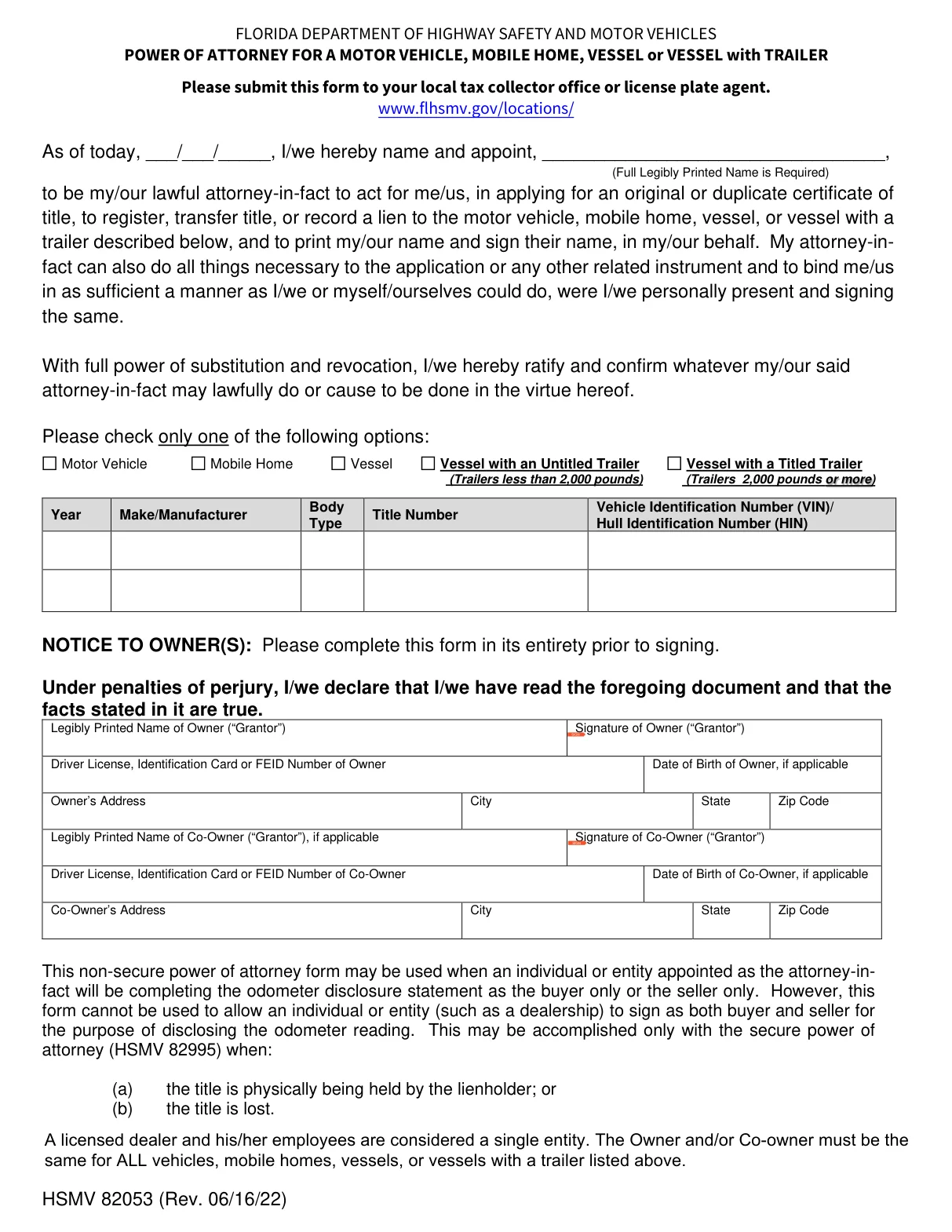
Florida motor vehicle power of attorney form preview

Create a free high quality Florida Motor Vehicle PoA online now!

Build Your Document

Answer a few simple questions to make your document in minutes

Save and Print

Save progress and finish on any device, download and print anytime

Sign and Use

Your valid, lawyer-approved document is ready

... or download your Florida Motor Vehicle Power of Attorney as a  PDF file

What Is a Florida Motor Vehicle Power of Attorney?

A motor vehicle power of attorney names a person you trust to take care of title paperwork for your car, mobile home or vessel. You are the owner who signs the form, and the person you name is called your attorney-in-fact.

The form this page hands out, HSMV 82053, asks for:[1]

  • The date and the full printed name of the person you appoint
  • The type of property, checked from five options, and the vehicle or vessel details
  • The owner and co-owner details, with signatures

Transfer and other reassignment forms compilation is regulated by the Florida Statutes (Title 23). One has to be very careful when choosing a trustee, as this person will be responsible for the principal’s financial and material assets. That is why people usually choose an old friend or a close relative for this role.

The legal rules and regulations for this procedure vary from state to state. The Department of Motor Vehicles (DMV) is responsible for issuing certificates of titles.

Federal odometer rules require any physical document used to reassign a title to include a space for the odometer disclosure.[4] The document must also carry a statement that refers to federal law and warns that failing to complete the disclosure or giving false information may result in fines or imprisonment.[4]

Tip: Keep a signed copy of the finished form for your records, and give the person you appoint a copy too.

Florida Motor Vehicle Power of Attorney Form Details

The table below lists the basics of HSMV 82053, the FLHSMV form this page hands out. It shows the document name, the state form name and the time it takes to fill out. It also gives the number of fillable fields, the file format and a link to the Florida Highway Safety and Motor Vehicles website.

Document Name Florida Motor Vehicle Power of Attorney Form
State Form Name Power of Attorney for a Motor Vehicle, Mobile Home, Vessel or Vessel with Trailer, HSMV 82053 (Rev. 06/16/22)
Relevant Link Florida Highway Safety and Motor Vehicles
Avg. Time to Fill Out 8 minutes
# of Fillable Fields 33
Available Formats Adobe PDF

How to Fill Out the Florida Motor Vehicle Power of Attorney Form

The steps below follow the Florida Department of Highway Safety and Motor Vehicles’ Power of Attorney for a Motor Vehicle, Mobile Home, Vessel or Vessel with Trailer, HSMV 82053 (Rev. 06/16/22), the official form this page hands out, in the same order as the parts on the form.[1] Keep the vehicle title and the driver license or ID of each owner next to you before you start. The form asks you to complete it in its entirety before signing, so fill in every line, then read the form once before anyone signs.

The screenshots under each step show the FLHSMV Power of Attorney (HSMV 82053), the official Florida form, filled with sample entries in blue, so you can see where each answer goes. The names, addresses, dates and vehicle details are examples only.


  1. As of today, and the person you appoint. On the first line, enter today’s date in the “As of today” blanks, then the full, legibly printed name of the person you appoint as your attorney-in-fact. The paragraphs below that line are printed on the form and need no entry. They give that person authority to apply for an original or duplicate title, register, transfer title or record a lien for the property you describe next.
    Florida FLHSMV Power of Attorney (HSMV 82053): As of today, the date and the attorney-in-fact, filled with sample entries
    Step 1: sample entries, not a real document.
  2. Please check only one of the following options. Check one box for the type of property: Motor Vehicle, Mobile Home, Vessel, Vessel with an Untitled Trailer (trailers less than 2,000 pounds) or Vessel with a Titled Trailer (trailers 2,000 pounds or more).
    Florida FLHSMV Power of Attorney (HSMV 82053): Please check only one of the following options, filled with sample entries
    Step 2: sample entries, not a real document.
  3. Year, Make/Manufacturer, Body Type, Title Number and VIN/HIN. In the table, enter the year, the make or manufacturer, the body type, the title number and the vehicle identification number (VIN), or the hull identification number (HIN) of a vessel. The table has two rows, so a second vehicle, mobile home or vessel of the same owner can go on the second row.
    Florida FLHSMV Power of Attorney (HSMV 82053): Year, Make/Manufacturer, Body Type, Title Number, VIN/HIN, filled with sample entries
    Step 3: sample entries, not a real document.
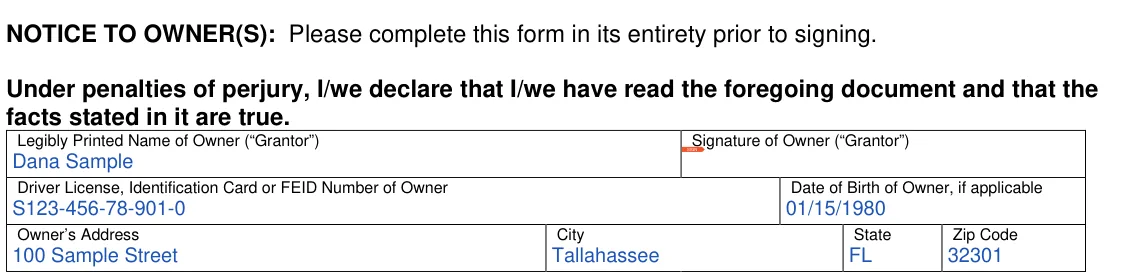
  4. Owner (“Grantor”). Under the declaration made under penalties of perjury, the owner legibly prints their name, signs on the Signature of Owner line, and fills in their driver license, identification card or FEID number, their date of birth if applicable, and their address, city, state and ZIP code.
    Florida FLHSMV Power of Attorney (HSMV 82053): Owner (Grantor): printed name, signature, ID number, date of birth and address, filled with sample entries
    Step 4: sample entries, not a real document.
  5. Co-Owner (“Grantor”), if applicable. If the title shows a co-owner, that person fills in the same lines in the co-owner block and signs on the Signature of Co-Owner line.
    Florida FLHSMV Power of Attorney (HSMV 82053): Co-Owner (Grantor), if applicable, filled with sample entries
    Step 5: sample entries, not a real document.

The paragraph at the bottom of the form explains its limits. This non-secure form cannot be used to let one person or entity, such as a dealership, sign as both buyer and seller for the odometer disclosure. That needs the secure power of attorney, HSMV 82995, when the title is held by the lienholder or the title is lost. The owner and co-owner must be the same for every vehicle, mobile home or vessel you list.[1]

How to Sign and Use the Florida Motor Vehicle Power of Attorney

Once you finish the paperwork, the form goes to your local tax collector office or license plate agent, as the form itself says.[1] What signing takes depends on the document you use: HSMV 82053, the FLHSMV form this page hands out, or the FormsPal template you get from Create My Document. Before the form leaves your hands, check that every name and number matches your IDs and the title.

  1. Check the details. Read each line once. Compare the names, the ID numbers and the vehicle identification number with your IDs and the title, then fix any typo.
  2. The FLHSMV form has no notary section. HSMV 82053 has no notary section and no witness lines. Each owner signs under the printed declaration: “Under penalties of perjury, I/we declare that I/we have read the foregoing document and that the facts stated in it are true.”[1] The Florida Power of Attorney Act, including its signing rule, does not apply to a power created on a form a government agency prescribes for a governmental purpose, such as this FLHSMV form.[2]
  3. The FormsPal template needs two witnesses and a notary. The FormsPal template from Create My Document is not a form a government agency prescribes, so the Florida Power of Attorney Act applies to it.[2] Under the act, a power of attorney must be signed by the principal and by two subscribing witnesses and be acknowledged by the principal before a notary public.[3]
  4. Sign and deliver the form. Once you have finished completing the document, sign it, and deliver it to your local tax collector office or license plate agent. Make a copy of the signed form first.
  5. Keep your copies. Store the copy with your other car papers and give another copy to the person you appoint.

Common Mistakes to Avoid

Most problems come from small slips, not from the form itself. A quick read-through before you sign catches the common ones, so go through this short list once every line is filled in.

  • Names that do not match your IDs. Spell each name exactly as it appears on the driver license or ID.
  • A mistyped identification number. Compare the number you entered with the title, character by character.
  • A missing co-owner. Check the title for a second owner, then fill in the co-owner lines for that person.
  • Skipped lines. Scan the page once for a line you meant to fill in.
  • No spare copy. Make a copy of the finished form before you hand over the original.
Template Preview
Create a free high quality Florida Motor Vehicle PoA online now!

Frequently Asked Questions

How long does it take to fill out the form?

The details table above lists an average of 8 minutes and 33 fillable fields. Having the vehicle title and the IDs next to you makes it faster, and the online tool lets you save your progress and come back to the form later.

Can I fill out this form online?

Yes. Select Create My Document at the top of this page and answer a few questions. The FormsPal tool builds the FormsPal template from your answers, so you can save your progress, print it or download it as a PDF. The download on this page is the FLHSMV’s own form, HSMV 82053, which has fillable fields, so you can also type into that PDF before you print it.

How do I edit the PDF after I download it?

Open the downloaded file in the FormsPal PDF editor to type in or change the fields. Print a clean copy when you are done.

What details should I have ready before I start?

Have these details ready before you start:

  • Your full name, address, date of birth, and driver license or ID number
  • The full printed name of the person you appoint
  • The year, make, body type, title number and identification number of the vehicle
  • The same owner details for a co-owner, if there is one

What does the “check only one” section ask for?

It asks you to check one box for the type of property: Motor Vehicle, Mobile Home, Vessel, Vessel with an Untitled Trailer, or Vessel with a Titled Trailer. The table below it asks for the year, make or manufacturer, body type, title number and the VIN or HIN.

What is the difference between the owner and the attorney-in-fact?

The owner, who is called the grantor on the form, is the person who signs. The attorney-in-fact is the person the owner picks to act for them.

Are there other types of power of attorney forms?

Yes. FormsPal has other Florida power of attorney forms for other situations. Use the Florida POA forms link near the top of this page to compare them.

Can I keep a digital copy?

Yes. Download the PDF and store it with your other car papers. You can print more copies whenever you need them.

General information, not legal or tax advice.

Sources

  1. Florida Department of Highway Safety and Motor Vehicles, Power of Attorney for a Motor Vehicle, Mobile Home, Vessel or Vessel with Trailer, HSMV 82053 (Rev. 06/16/22). Accessed October 15, 2026.
  2. Fla. Stat. § 709.2103. Accessed October 15, 2026.
  3. Fla. Stat. § 709.2105. Accessed October 15, 2026.
  4. 49 C.F.R. § 580.5. Accessed October 16, 2026.
Mara Erlach
Mara Erlach
Writer & Attorney
Mara has been practicing estate planning and trust law in California since 2003, taking pride in helping clients of all backgrounds and asset profiles form a complete and customized estate plan. Her specialties are: estate planning, wills and trusts, trust and probate administration.
Published: Apr 14, 2022