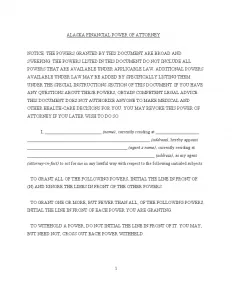
The Alaska general financial power of attorney allows an individual (the principal) to designate another person (the agent) to manage their financial affairs. This power of attorney form gives the agent broad authority to handle tasks such as banking, real estate transactions, personal property management, and even tax matters on behalf of the principal.
A general power of attorney grants an attorney-in-fact wide-ranging powers over the principal’s finances. Unlike a durable form, which stays valid if the principal becomes incapacitated, a general option may become void under the same circumstances.
This form’s effectiveness and the extent of its powers can be tailored to the principal’s needs by including limitations or specific instructions within the document. Consider other Alaska power of attorney forms if you need to grant your agent limited powers.
Build Your Document
Answer a few simple questions to make your document in minutes
Save and Print
Save progress and finish on any device, download and print anytime
Sign and Use
Your valid, lawyer-approved document is ready
In Alaska, General Powers of Attorney are regulated by Alaska Statutes, Sections 13.26.600 to 13.26.695. These laws stipulate specific guidelines to ensure the proper execution and revocation of powers of attorney within the state. A critical component for the legality of these documents is their notarization, as required under Section 13.26.600, which formally validates the principal’s consent to delegate financial responsibilities. Key points about the termination of a power of attorney in Alaska include:
Revocation also occurs if the agent cannot serve due to incapacity, resignation, or death unless a substitute agent is designated. Unless stated otherwise in the power of attorney, an agent can resign by notifying the principal. If the principal is incapacitated, the agent must also inform the principal’s conservator, guardian, a concerned party, or a relevant governmental agency.
| Document Name | Alaska General Power of Attorney Form |
| Other Name | Alaska Financial Power of Attorney |
| Relevant Laws | Alaska Statutes, Sections 13.26.600 to 13.26.695 |
| Avg. Time to Fill Out | 10 minutes |
| # of Fillable Fields | 41 |
| Available Formats | Adobe PDF |
Completing this form requires careful consideration to ensure your financial matters are handled according to your wishes. Below is a step-by-step guide on effectively filling out the Alaska general power of attorney.
1. Naming Your Agent
Select a trustworthy individual as your agent, the person authorized to handle your affairs. This agent will have significant control, so choose someone who understands your preferences and can act in your best interests without court oversight. Discuss your expectations and the extent of their powers in detail.
2. Granting Specific Powers
You will see a list of powers from A to O on the form, including real estate transactions, banking, and more. You don’t have to grant all these powers; you can specify which ones your agent should have. To withhold power, strike through it and initial next to the line. This customization ensures your agent only has the powers you are comfortable giving.
3. Setting Conditions for Multiple Agents
If you appoint more than one agent, you must decide if they can act independently or must make decisions jointly. This decision impacts how your affairs are managed and can provide an additional layer of security by requiring agents to agree on actions.
4. Defining the Effective Date and Duration
Decide when the power of attorney will become active. You can have it take effect immediately or only if you become incapacitated. Additionally, determine if the power should be durable, meaning it remains in effect even if you become disabled, or if it should be limited to a specific duration or until a particular task is completed.
5. Addressing Durability
In Alaska, a general power of attorney functions identically to a durable form, with the key difference being that the “This document shall be revoked by my subsequent disability” option is selected as “Yes.”
6. Specifying Termination Conditions
You may also set a specific date or condition under which the power of attorney ceases to be effective, such as completing a specified task. If no end date is provided, and the power is durable, it will remain in effect indefinitely unless you revoke it.
7. Revoking the Power of Attorney
Understand that you can revoke this document at any time while you are mentally competent. To revoke, you should destroy the original document and notify any relevant parties, potentially using a formal notice of revocation, which should be notarized and distributed similarly to how the original was handled.
8. Appointing Successor Agents
Understand that you can revoke this document at any time while you are mentally competent. To revoke, you should destroy the original document and notify any relevant parties, potentially using a formal notice of revocation, which should be notarized and distributed similarly to how the original was handled.
9. Notarization Requirements
Before the general power of attorney is considered legally valid, it must be notarized. It means signing the document in the presence of a notary public who will verify your identity and your understanding of the document’s significance. The notary will then seal the document, finalizing its authenticity.