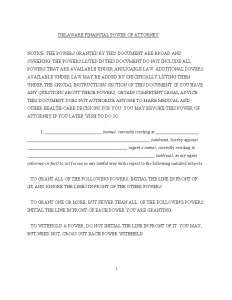
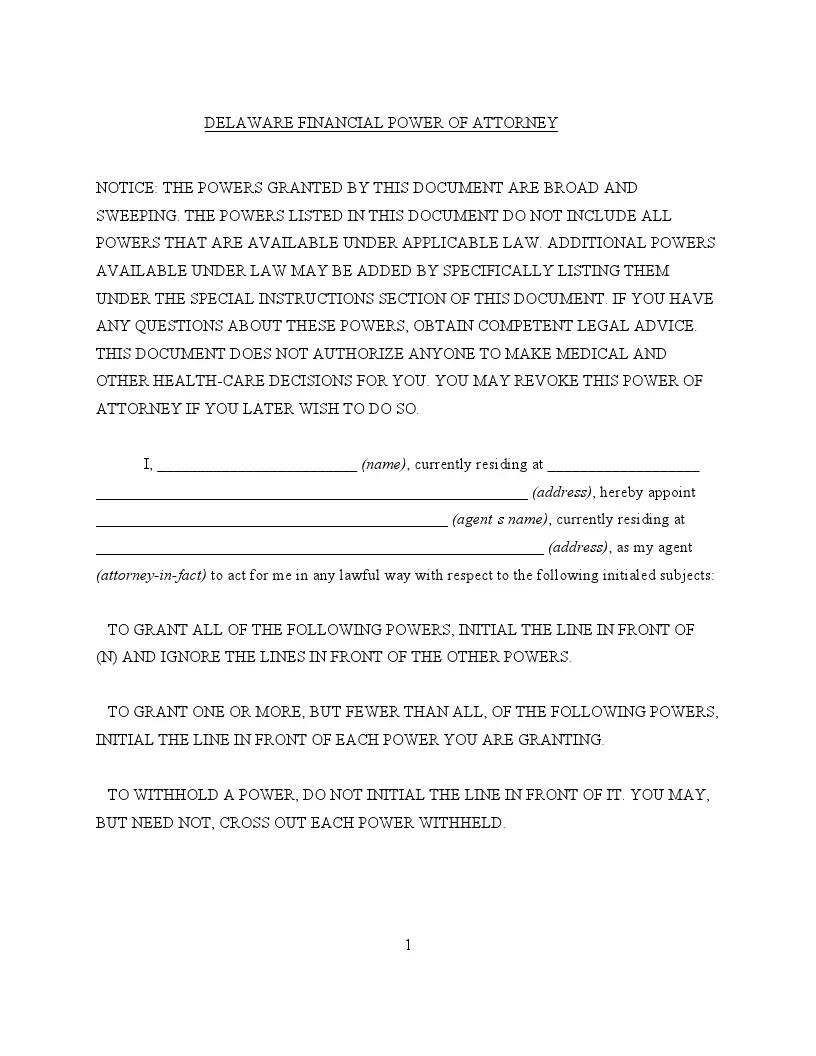
The Delaware general financial power of attorney is a legal document that grants one person (the agent or attorney-in-fact) the authority to act on behalf of another person (the principal) in various matters. This document typically grants broad powers to the agent to handle the principal’s financial and business matters, real estate transactions, and other personal affairs.
The powers granted can be extensive, including but not limited to managing financial accounts, signing legal documents, handling business operations, and making other legal decisions. Unlike a limited option, which restricts the agent’s authority to specific activities, a general power of attorney covers a wide range of actions without such limitations.
However, it is important to note that a general power of attorney usually becomes ineffective if the principal becomes incapacitated unless designated as “durable.” On FormsPal, you can get all Delaware power of attorney forms.
Build Your Document
Answer a few simple questions to make your document in minutes
Save and Print
Save progress and finish on any device, download and print anytime
Sign and Use
Your valid, lawyer-approved document is ready
The laws governing the creation and use of a general power of attorney are detailed in the Delaware Code — Title 12, Chapter 49A. This act outlines the conditions and legal stipulations for such powers to be valid and enforceable.
A “power of attorney,” defined under Section 49A-102 of the Delaware Code, is a written authorization allowing an agent to act on the principal’s behalf. This involves managing the principal’s property rights and conducting transactions that the principal could perform if personally present. The main aspects of the law include:
These provisions protect the principal’s interests while allowing the agent to act efficiently and responsibly.
| Document Name | Delaware General Power of Attorney Form |
| Other Name | Delaware Financial Power of Attorney |
| Relevant Laws | Delaware Code, Sections 49A-101 to 49A-301 |
| Avg. Time to Fill Out | 10 minutes |
| # of Fillable Fields | 41 |
| Available Formats | Adobe PDF |
Completing a Delaware general power of attorney is a significant step in managing your affairs through an agent of your choice.
1. Read the Notice and Instructions
Start by thoroughly reading the introductory notice and instructions provided at the beginning of the form. This section explains the extent of authority you’re granting, emphasizing that the POA does not cover health care decisions and is non-durable — meaning it does not extend beyond your capacity to make decisions.
2. Fill in Agent Details
Specify the person you choose as your primary agent by filling out their full name, address, and telephone number. This individual will act on your behalf according to the powers you grant in the document.
3. Specify Additional or Successor Agents
If desired, appoint one or more successor agents to take over should your primary agent be unable to perform their duties. Provide detailed information for each successor agent as you did for the primary agent.
4. Choose How Agents Will Operate
Decide and indicate whether the agents are to act successively, concurrently, or jointly. This choice determines how the agents will make decisions, either independently or collaboratively.
5. Set the Power of Attorney’s Validity
State clearly that a power of attorney is effective immediately unless otherwise specified, and note that it will terminate upon your death, incapacity, or revocation.
6. Initial Each Power You Grant
Review each category listed under the Grant of General Authority. These categories include real property, financial institutions, and taxes. Initial next to each power you wish to grant and cross out any you do not.
Carefully read and decide if you want to grant specific powers that could significantly impact your property or estate. These include making gifts, changing beneficiary designations, or amending trusts. Initial each power you agree to grant.
7. Sign and Witness
Complete the form by signing and dating it in the presence of a witness who meets the specified criteria (not related by blood, marriage, or entitled to any part of your estate). The witness must also sign and print their name.
8. Notarize the Document
Finally, the form must be notarized to affirm its authenticity. Ensure the notary public completes their section, including their signature and the date of notarization.