The Vermont general financial power of attorney form is a legal document that allows one person, known as the principal, to designate another person, referred to as the agent, to manage their financial affairs. This authority can include handling banking transactions, managing real estate, dealing with government benefits, entering into contracts, and handling other financial matters.
This POA form is generally broad, giving the agent extensive powers to act on the principal’s behalf. Importantly, a general power of attorney in Vermont terminates when the person granting the power becomes incapacitated. Check out all Vermont POA forms to get a durable power of attorney that will be effective in such cases.
Build Your Document
Answer a few simple questions to make your document in minutes
Save and Print
Save progress and finish on any device, download and print anytime
Sign and Use
Your valid, lawyer-approved document is ready
The laws governing a General Power of Attorney are detailed in the Vermont Statutes Annotated, Title 14, Chapter 127. It enables a principal to grant comprehensive powers to an agent, allowing the agent to perform nearly any act the principal could do themselves. These powers, as outlined in Sections 4034 to 4046, include managing:
To execute a general power of attorney, the document must be signed by the principal or another at the principal’s direction and in their presence. This signature must be acknowledged before a notary public or another authorized official to be considered valid (14 V.S.A. § 4005).
| Document Name | Vermont General Power of Attorney Form |
| Other Name | Vermont Financial Power of Attorney |
| Relevant Laws | Vermont Statutes Annotated, Title 14, Chapter 127 |
| Avg. Time to Fill Out | 10 minutes |
| # of Fillable Fields | 41 |
| Available Formats | Adobe PDF |
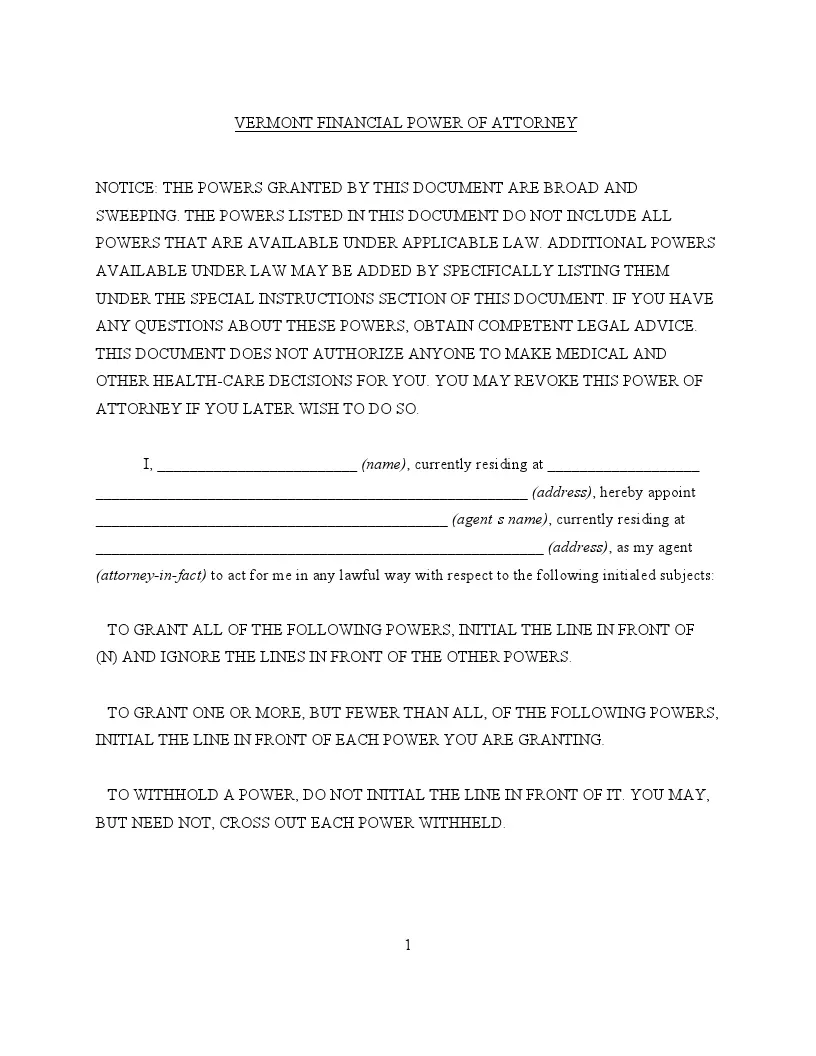
Completing the Vermont general financial power of attorney form involves a series of precise steps to ensure the document is legally valid and reflects your intentions.
1. Reading the Form and Gathering Information
Begin by thoroughly reading the form and understanding the different sections and what they entail. Gather all necessary information, including your full legal name, address, and the details of the agent you choose to appoint. Also, decide if you want to appoint a successor agent if the primary agent is unable or unwilling to act.
2. Designating Your Agent
Under the “Designation of Agent” section, clearly write your name and address, then provide your chosen agent’s name, address, and telephone number. If you decide to revoke all previous powers of attorney, initial the corresponding line to indicate this decision.
3. Granting General Authority
In the “Grant of General Authority” section, you will see a list of areas where you can grant authority to your agent. These areas cover everything from real estate to taxes. You must initial next to each specific authority you wish to grant. If you prefer to grant authority across all areas, you can initial “All Preceding Subjects” instead of initialing each line individually.
4. Granting Specific Authority (Optional)
If you wish to grant specific powers that involve significant actions like making gifts or changing beneficiary designations, go to the “Grant of Specific Authority” section. Here, you need to initial next to each power you are granting. Be cautious, as these powers can significantly impact your property and how it is distributed upon your death.
5. Special Instructions (Optional)
If you have any special instructions that modify or limit the powers granted, specify them in the “Special Instructions” section. It might include limitations on gifts or specifying conditions under which the power of attorney becomes effective.
6. Signing and Acknowledgment
The form must be signed in the presence of a notary or another individual authorized by law to take acknowledgments. Your signature must be acknowledged to ensure it is genuine, which is crucial for the form’s legality.
7. Effective Date and Nomination of Guardian (Optional)
Specify when the power of attorney will take effect — immediately, upon a specified date, or your incapacity. If desired, nominate a guardian for your person or estate in the corresponding section, providing their full details.
Once all sections are completed and the form is signed and notarized, make copies for your records and your agent.