An Idaho minor child power of attorney is a written document that lets a parent or guardian delegate powers over a child's care, custody, or property to another person. The Idaho power of attorney requirements for a minor child are in Idaho Code § 15-5-104. It limits a delegation to six months, or twelve months for military personnel serving beyond the territorial limits of the United States.[1]
Last Updated: October 2026. This guide is reviewed and updated regularly to reflect current Idaho law. If you notice an error or outdated information, please contact us.
Create a personalized Idaho Minor Child Power of Attorney Form online now!
Build Your Document
Answer a few simple questions to make your document in minutes
Save and Print
Save progress and finish on any device, download and print anytime
Sign and Use
Your valid, lawyer-approved document is ready
... or download your Idaho Minor Child Power of Attorney as a PDF file
What Is an Idaho Minor Child Power of Attorney?
In an Idaho minor child power of attorney, a parent or guardian names another person to act for the child for a limited time. That person is called the agent or the attorney-in-fact. The terms below appear on the FormsPal template and in the rest of this guide.
Parent, guardian or conservator: the person who signs the form and delegates powers over the child. The form asks you to mark which one you are.
Agent: the person you appoint to act for your child. The form calls the agent the attorney-in-fact.
Successor attorney-in-fact: the person named on page 2 who steps in if the agent cannot serve.
Acknowledgment: the notary's certificate on page 3 that you signed the form. It is optional in Idaho.[1]
Before you start the form, gather these details so you can fill it out in one sitting.
Your full name and address, and whether you sign as a parent, guardian, or conservator.
The child's full name, date of birth, and address.
The full name and address of the agent, and of a successor attorney-in-fact.
The powers you want to delegate, and the start and end dates for them.
Idaho Power of Attorney Requirements for a Minor Child
A parent or guardian can use a power of attorney template like this one to delegate powers over a minor child to another person. Idaho Code § 15-5-104 covers care, custody, and property, including medical care and education. The sections below walk through each rule.[1]
Duration: a delegation to another person can last no longer than six months, or twelve months for military personnel serving beyond the territorial limits of the United States.[1]
Grandparents and siblings: a delegation to a grandparent of the child, a sibling of the child, or a sibling of either parent continues until the time period, date, or condition stated in the document for automatic expiration. If the document states none, the power continues for three years.[1]
Powers that stay with the parent: a parent or guardian cannot delegate the power to consent to the child's marriage or adoption.[1]
Revocation: for a grandparent or sibling, the parent or guardian can revoke the power before it expires in a writing delivered to that person. If the power was recorded, any written revocation must also be recorded before it takes effect.[1]
On notarization, Idaho Code § 15-5-104 says:
The power of attorney does not need to be notarized or recorded to be valid.
So you do not need a notary for the power of attorney to be valid. Page 3 of the FormsPal template is a notary acknowledgment that you can leave blank.
You may also see this document called a temporary guardianship form or a parental power of attorney. In Idaho it is a power of attorney that delegates parental powers to another person. The form states that the parent does not intend to give up parental rights.
People often use this power of attorney when they expect to be away from their child for a while, for example during military deployment, medical treatment, or long travel. For a broader overview of healthcare, financial, and minor child authorizations, see all Idaho POA forms.
Up to six months, or up to twelve months for military personnel serving beyond the territorial limits of the United States. Grandparents and siblings: the period the document states.[1]
Avg. Time to Fill Out
10 minutes
# of Fillable Fields
44
Available Formats
Adobe PDF
What an Idaho Minor Child Power of Attorney Lets the Agent Do
You hand some of your powers over your child to the agent for a limited time. Under Idaho Code § 15-5-104, those powers cover the care, custody, or property of the child, including medical care and educational care.[1] The agent acts for you in those matters while the power of attorney is in effect.
With option 1 on the form, the agent receives all authority that Idaho law allows you to delegate.
With option 2, the agent receives only the limited powers you write on the form.
Consent to the child's marriage or adoption stays with you in either case.[1]
The form also states that you do not intend to give up your parental rights. Keep a copy of the signed power of attorney with you when you speak to the school or doctor, so you can show who may act for your child.
Filling Out the Idaho Minor Child Power of Attorney Form
The FormsPal template runs three pages. Work through the steps below in order. Each step names the part of the form it covers and the page it is on, so you can check your entries against the printed form as you go.
The screenshots under each step show the FormsPal Idaho minor child power of attorney template filled with sample entries in blue, so you can see where each answer goes. The names, addresses, dates and amounts are examples only.
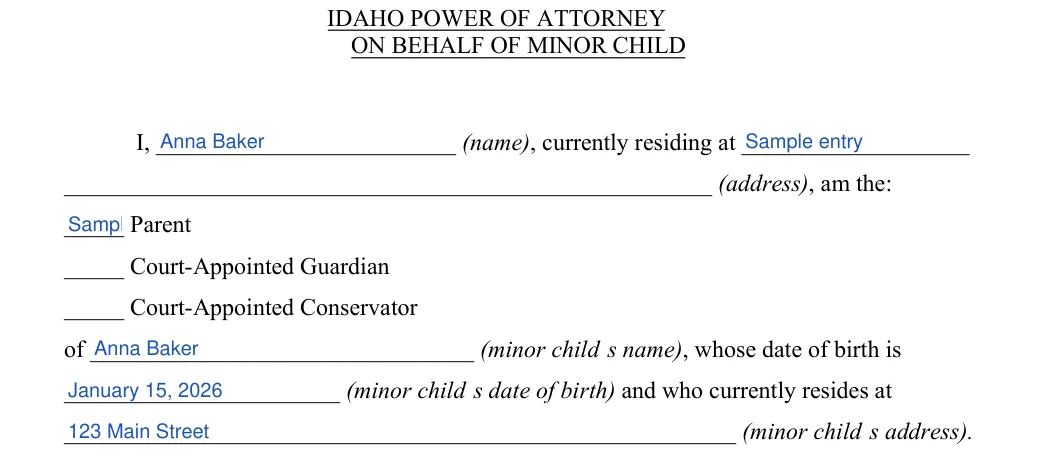
Parent, guardian or conservator and the minor child (page 1). Enter your name and address, then mark whether you are the parent, a court-appointed guardian, or a court-appointed conservator. Add the child's name, date of birth, and address.Step 1: sample entries, not a real document.
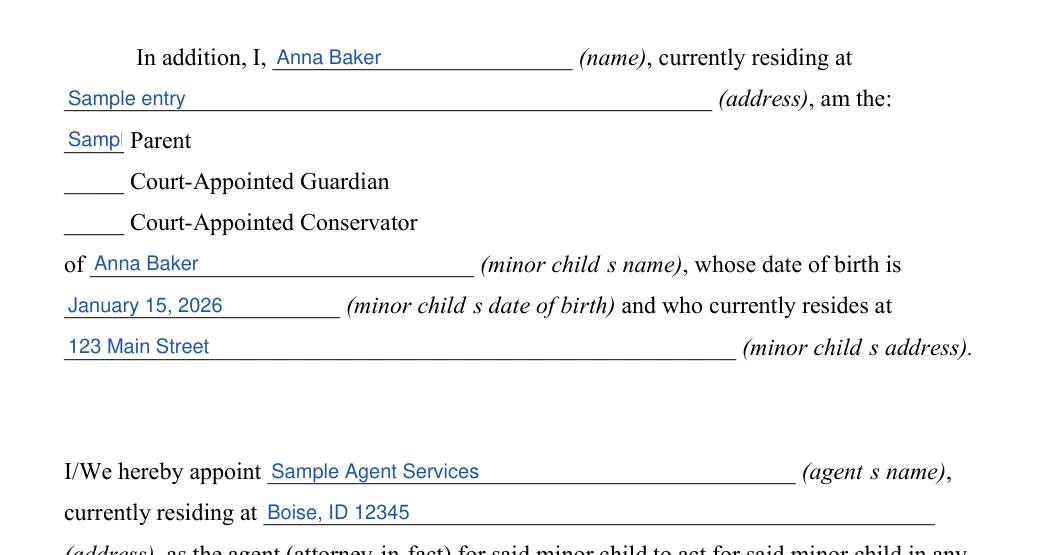
Second parent or guardian and the agent (page 1). Complete the additional statement only if a second parent, guardian, or conservator also signs. Then enter the full name and address of the agent. The agent is the person you appoint as attorney-in-fact.Step 2: sample entries, not a real document.
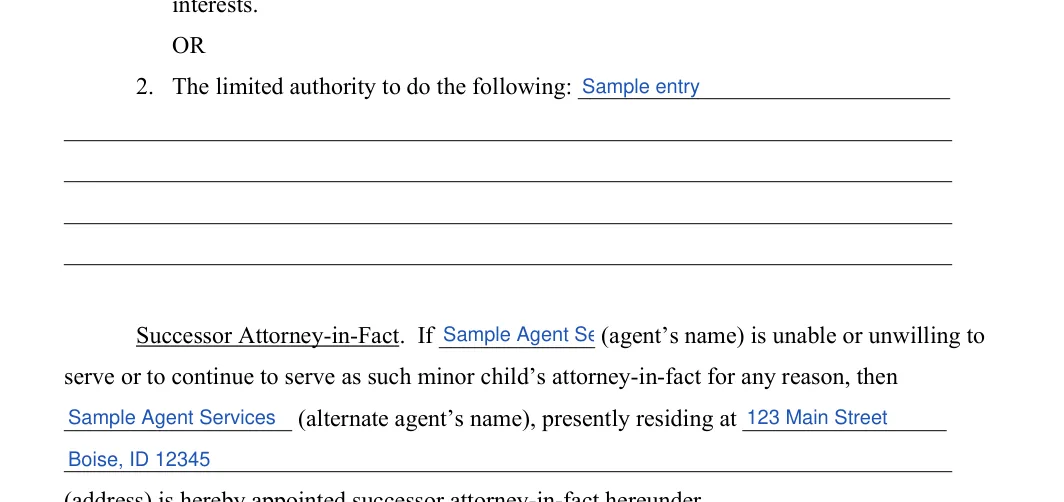
Powers and the successor agent (page 2). Use option 1 to give the agent all authority that Idaho law allows to be delegated, including consent to medical treatment and decisions about schooling. Use option 2 to write limited powers on the lines provided. Then name a successor attorney-in-fact who steps in if the agent cannot serve.Step 3: sample entries, not a real document.
Effective date (page 2). Enter the date the power of attorney takes effect and the date it continues until. Pick an end date that fits the limits in the requirements section above.Step 4: sample entries, not a real document.
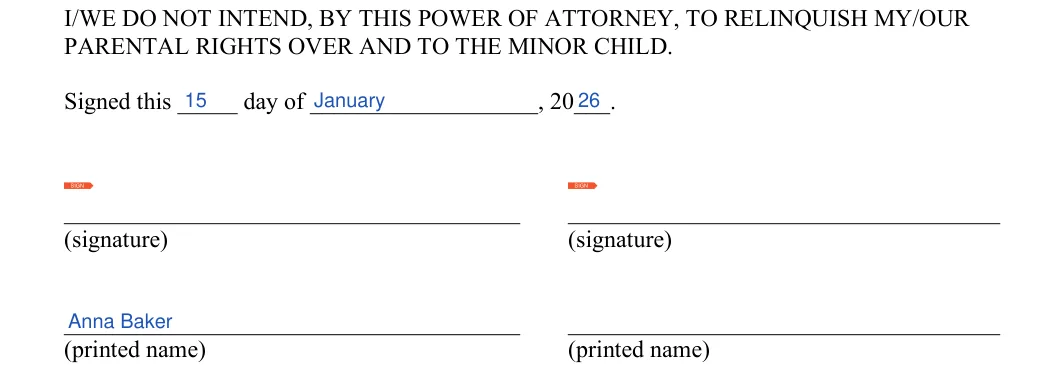
Parental rights statement, date and signatures (page 2). The form states that you do not intend to give up your parental rights. Enter the day, month, and year, then sign and print your name. A second parent or guardian uses the second signature line.Step 5: sample entries, not a real document.
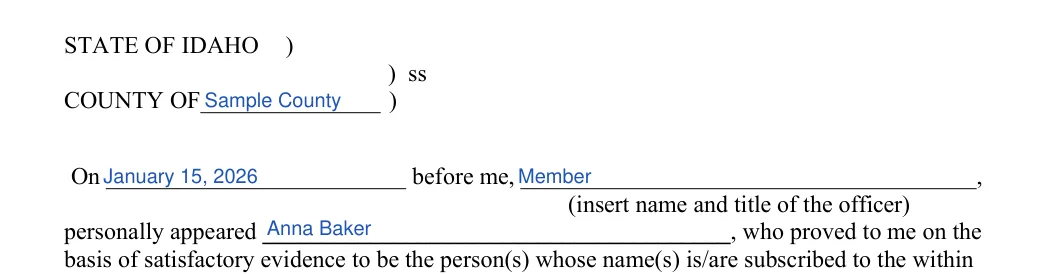
Acknowledgment: county, date and officer (page 3). Page 3 is for a notary. If you use one, the officer enters the county, the date, the officer's name and title, and the name of the person who signed. Sign in front of the officer in that case.Step 6: sample entries, not a real document.
Officer signature and seal (page 3). The notary or other officer signs the Signature line and adds the seal. Page 3 stays blank unless you use a notary, which Idaho does not require.[1]Step 7: sample entries, not a real document.
The table below uses made-up names and addresses to show how entries on pages 1 and 2 fit together. Replace every entry with your own details.
Part of the form
Sample entry
Parent
Anna Baker, 123 Main Street, Boise ID 83701
Child
Emma Baker, born 01/01/2015
Agent (attorney-in-fact)
Ben Carter, 456 Oak Avenue, Boise ID 83701
Powers
Option 2, limited: pick up the child from school and consent to routine medical care
Effective and end dates
06/01/2027 until 11/30/2027, which is under six months
Sign the form only after every entry is complete. A form signed with blank lines can be filled in later by someone else.
How to Sign and Use the Idaho Minor Child Power of Attorney
After you complete the form, decide whether to have it notarized, sign it, and get copies to the people who need them. Idaho does not require a notary or a recording for the power of attorney to be valid.[1] The steps below cover signing, sharing copies, and ending the power of attorney later.
Decide about a notary. Idaho does not require one, so ask the school, doctor, or other third party whether they want a notarized copy before you sign.[1]
Give the signed original to the agent and keep a copy for yourself.
Share copies with the child's school, doctor, or other healthcare provider so they know who may act for your child.
Note the end date you entered on the form. If you still need someone to act for your child after that date, plan ahead.
If plans change, revoke the power in writing. For a grandparent or sibling, the writing is delivered to that person, and a recorded power needs a recorded revocation before it takes effect.[1]
Create a personalized Idaho Minor Child Power of Attorney Form online now!
Frequently Asked Questions
The answers below cover notarization, how long the power lasts, which powers a parent keeps, and how to revoke it under Idaho law, with the source cited after each answer.
Does an Idaho minor child power of attorney need to be notarized?
No. Idaho Code § 15-5-104 says the power of attorney does not need to be notarized or recorded to be valid.[1]
How long does an Idaho minor child power of attorney last?
A delegation to another person can last no longer than six months. For military personnel serving beyond the territorial limits of the United States, the limit is twelve months.[1] Grandparents and siblings follow a different rule, covered in the next question.
How long does it last when the agent is a grandparent or sibling?
A delegation to a grandparent, a sibling of the child, or a sibling of either parent depends on what the document states.[1]
If it states a time period, date, or condition for automatic expiration, the power continues until then.
If it states none, the power continues for three years.
Which powers can a parent not delegate in Idaho?
A parent or guardian cannot delegate the power to consent to the marriage or adoption of the child. Other powers over the care, custody, and property of the child, including medical care and education, can be delegated.[1]
How do I revoke an Idaho minor child power of attorney?
For a grandparent or sibling, the parent or guardian can revoke the power before it expires in a writing delivered to that person. If the power of attorney was recorded, any written revocation must also be recorded before it takes effect.[1]
Mara has been practicing estate planning and trust law in California since 2003, taking pride in helping clients of all backgrounds and asset profiles form a complete and customized estate plan. Her specialties are: estate planning, wills and trusts, trust and probate administration.