
Updated:
A minor child power of attorney is a parent's written caregiver appointment. Mississippi repealed Code Sections 93-31-1, 93-31-5 and 93-31-7 in Miss. Laws 2026, 1st Ex. Sess., S.B. 2001, § 65. Parents use the form when another adult cares for their child during deployment, travel or illness.
This page explains what the Mississippi form contains, how to fill out each part, how signing and the notary acknowledgment work, and how long the authority lasts. It also covers the difference between a power of attorney and a guardianship.
Key facts

Build Your Document
Answer a few simple questions to make your document in minutes
Save and Print
Save progress and finish on any device, download and print anytime
Sign and Use
Your valid, lawyer-approved document is ready
A Mississippi minor child power of attorney is a written delegation of care for a child: the parent, guardian or conservator names another adult to act for the child while the parent is away or unable to act. The document is also called a parental power of attorney.
The form uses three roles. The principal is the parent, guardian or conservator who signs. The attorney-in-fact, also called the agent, is the adult who acts for the child. The successor attorney-in-fact is the backup agent who steps in if the first agent is unable or unwilling to serve.
The form covers temporary care. A court custody order is a separate document, and the power of attorney does not take its place.
The Mississippi form is signed by one of three people: a parent, a court-appointed guardian or a court-appointed conservator of the child. A second statement and signature line let another parent, guardian or conservator join the same document.
| Document Name | Mississippi Minor Child Power of Attorney Form |
| Other Names | Mississippi Parental Power of Attorney; power of attorney for a minor child |
| Parties | Parent, court-appointed guardian or court-appointed conservator; attorney-in-fact; successor attorney-in-fact |
| Statute status | Sections 93-31-1, 93-31-5 and 93-31-7 repealed, Miss. Laws 2026, 1st Ex. Sess., S.B. 2001, § 65 |
| Recording | Permitted once acknowledged like a land conveyance, Miss. Code Ann. § 87-3-1 |
| Available Formats | Adobe PDF |
Keep a signed copy of the finished form with your own records. A phone photo of the signed pages makes a handy backup.
The repeal of Sections 93-31-1, 93-31-5 and 93-31-7 of the Mississippi Code took effect through Miss. Laws 2026, 1st Ex. Sess., S.B. 2001, § 65. The bill calls those sections the remaining provisions of the Supporting and Strengthening Families Act.
That Act was the part of the Code earlier editions of this page relied on for parental delegation. This edition no longer lists a duration limit, a service member extension, an agency check or a youth court filing step from that Act, because the sections behind them are gone.
The sections on recording, revocation, durability and the death of the principal below come from Title 87, Chapter 3 of the Code, the general rules on letters of attorney.
The Mississippi minor child POA form holds seven parts across three pages: the parents and child, the agent, the powers, the successor, the dates, the signatures and the notary acknowledgment. Each part is listed here so you can gather the details first.
The powers section offers two choices: item 1 grants the broad authority printed on the form, and item 2 grants only the limited authority you write on the lines provided. A limited grant suits a short stay or a single purpose, such as school matters.
The successor paragraph names a backup agent who acts if the first attorney-in-fact is unable or unwilling to serve. The paragraph needs the successor's full name and address.
The dates section sets when the authority begins and ends. A written end date makes the term clear to schools, doctors and anyone else who reads the form.
The form is filled out in seven parts, in order, from the principal's details on page one to the notary's seal on page three. Have the full names and addresses of everyone named on it ready before you start.
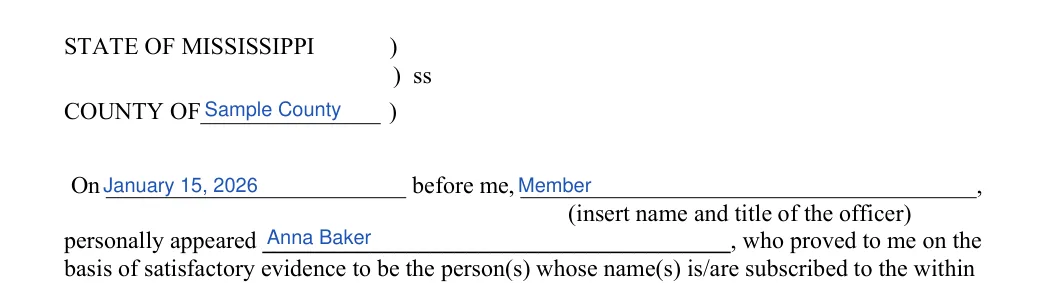
The screenshots under each step show the FormsPal Mississippi Mississippi Minor Child Power of Attorney template filled with sample entries in blue, so you can see where each answer goes. The names, addresses, dates and amounts are examples only.
Your details and the minor child
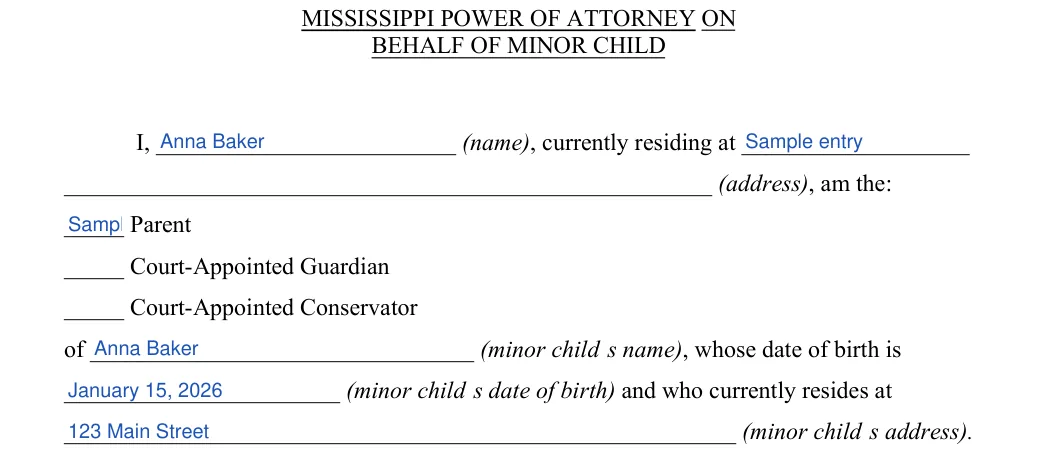
Start with the first statement on page 1. Enter your name and address, then mark whether you are the Parent, Court-Appointed Guardian or Court-Appointed Conservator. Enter the child's name, date of birth and address.
Second parent and the agent
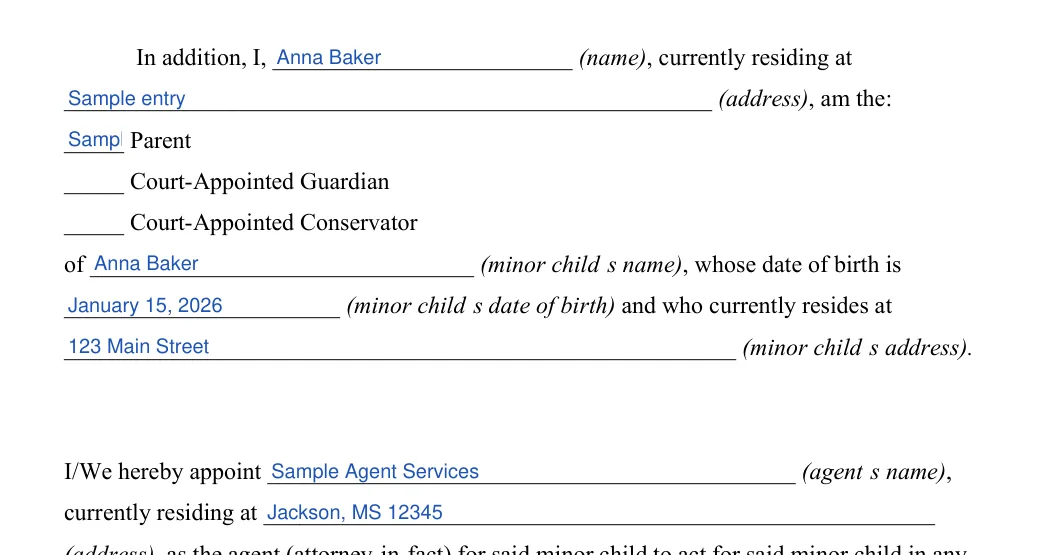
Complete the additional statement only if a second parent, guardian or conservator is named on the form. Then enter the name and address of the agent, also called the attorney-in-fact, who will act for your child.
Powers and successor attorney-in-fact
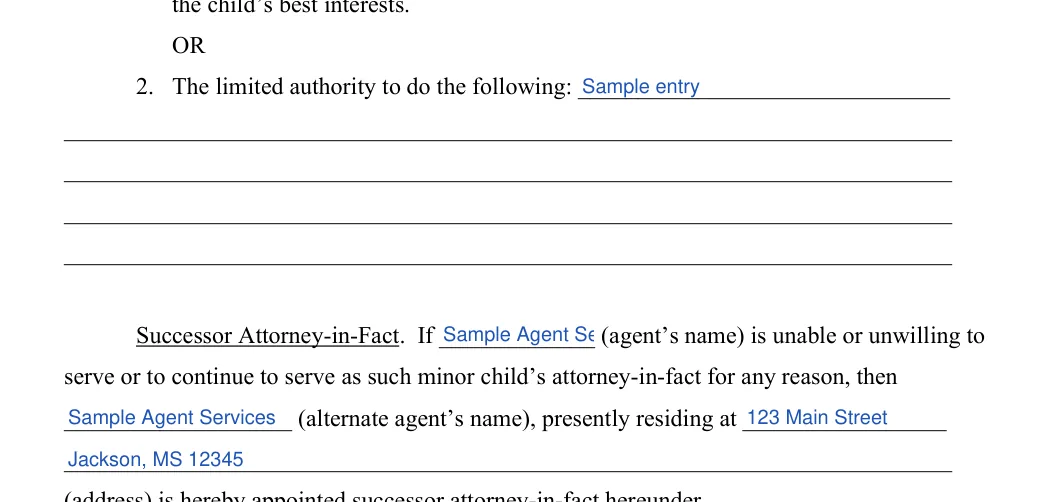
On page 2, pick item 1 for the broad authority printed on the form, or item 2 and write the limited authority on the lines provided. Then enter the agent's name, and the name and address of the alternate agent in the Successor Attorney-in-Fact paragraph.
Effective date
Enter the date the power of attorney starts and the date it continues until.

Date, sign and print names
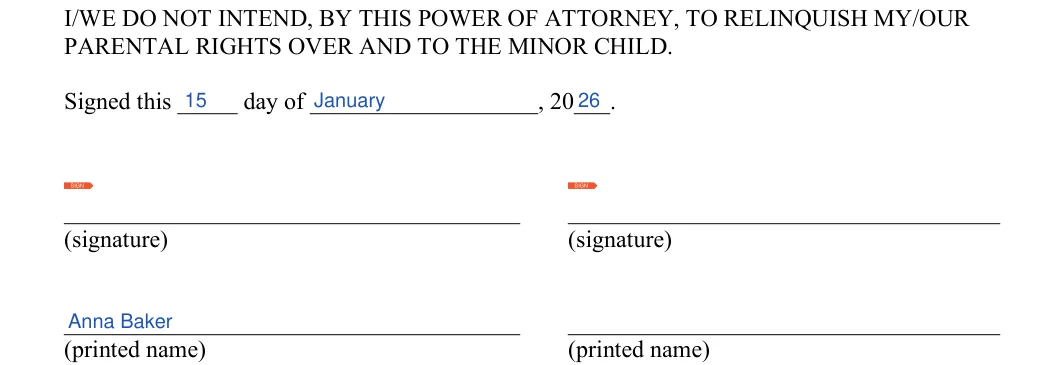
Enter the day, month and year of signing. Then sign on the signature line and print your name below it. A second signature line is there for another parent or guardian.
Acknowledgment details
Page 3 is the notary acknowledgment. Enter the county, the date, the name and title of the officer, and the name of the person who appeared at the signing.
Notary signature and seal
The last line on page 3 is for the notary or other officer. Leave it empty so the officer can complete it.

The finished form is signed in front of a notary public, who completes the acknowledgment on its last page. Work through these steps in order and keep a copy of everything.
Before you finish, check that every name and date on the form matches the IDs of the people involved.
A letter of attorney intended for use in Mississippi may be acknowledged or proved as conveyances of land are required to be, and, when so acknowledged or proved, it may be recorded in like manner, Miss. Code Ann. § 87-3-1. Duly certified copies of it are admitted in evidence without accounting for the original, under the same Miss. Code Ann. § 87-3-1.
The Mississippi form lasts from the start date to the end date written on it, because the form asks for both. The rules below cover durability, the parent's death or incapacity and revocation.
A durable power of attorney is one whose writing shows the authority survives incapacity, with words such as "This power of attorney shall not be affected by subsequent disability or incapacity of the principal, or lapse of time," or similar words, Miss. Code Ann. § 87-3-105. For a durable power of attorney, the power stays exercisable despite lapse of time unless the instrument states a time of termination, Miss. Code Ann. § 87-3-107. The end date on this form is such a time of termination.
The death of a principal who signed a written power of attorney does not revoke it as to an agent who acts in good faith under it when the agent has no actual knowledge of the death, Miss. Code Ann. § 87-3-111. If the power is not durable, the principal's later disability or incapacity likewise does not revoke it as to an agent who acts in good faith without actual knowledge of it, Miss. Code Ann. § 87-3-111.
A written revocation of letters of attorney, when acknowledged or proved like a land conveyance, may be recorded in the office where the revoked letters were recorded, with effect from the time it is filed for record, Miss. Code Ann. § 87-3-17. Give the agent, the school and the doctor a copy of any revocation as well.
A power of attorney for a child is a document the parent signs, while a guardianship is an appointment by a court. The form itself lists a court-appointed guardian as one of the people who can sign it.
The power of attorney keeps the parent as the principal and ends on the date written in it. A guardianship comes from a court case, so its terms come from the court's order rather than from a form.
A power of attorney for health care covers the signer's own medical decisions, not a child's care. For a power of attorney for health care, Mississippi requires a writing that is dated and signed by the principal, and either signed by at least two witnesses or acknowledged before a notary public, Miss. Code Ann. § 41-41-205(2). Other kinds of power of attorney are listed on the Mississippi power of attorney forms page.
The minor child form is signed by the parent, court-appointed guardian or court-appointed conservator, not by the child. The form names an attorney-in-fact and the dates it covers. Sections 93-31-1, 93-31-5 and 93-31-7 were repealed by Miss. Laws 2026, 1st Ex. Sess., S.B. 2001, § 65. A school or doctor may ask for more than this form before acting on it.
The parent fills out the form, names an agent and a successor, and signs it before a notary public, who completes the acknowledgment. The steps above walk through each part.
No. The power of attorney is a document the parent signs for temporary care, while custody set by a court comes from a court order.
A letter of attorney to transact any business need only express plainly the authority conferred, Miss. Code Ann. § 87-3-7. Write any limited powers in plain words so the agent's authority is clear.
Have the full names and addresses of the parent or guardian, the child and the agent ready. Add the child's date of birth and the name of a successor agent.
The attorney-in-fact, also called the agent, is the adult named on the form to act for your child. The form has a separate line for a successor, who is the backup agent.
General information, not legal or tax advice.
