
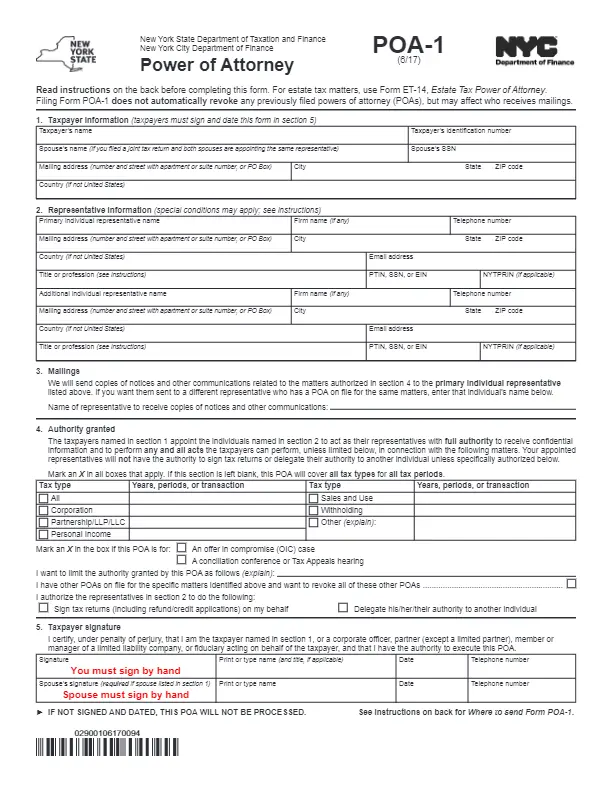
The New York Tax Power of Attorney form (also called POA-1) is a document normally created when the taxpayer needs to delegate certain tax-related powers (except estate tax) to another person. Such a document is mostly used by individuals who manage their entities’ tax matters, but it may also be necessary for out-of-business individuals.
Last Updated: October 2026. This guide is reviewed and updated regularly to reflect current law. If you notice an error or outdated information, please contact us.
Form POA-1 is the New York State power of attorney form for naming a tax representative. The POA PDF has 57 fillable fields, so you can type your answers instead of writing them by hand. Keep the POA-1 name in mind when you look for related guidance on the state website.
| Document Name | New York Tax Power of Attorney Form |
| State Form Name | New York Form POA-1 |
| Relevant Link | New York Department of Taxation and Finance |
| Where to File? | Per fax or mail to: NYS Tax Department POA Central Unit W A HARRIMAN CAMPUS ALBANY NY 12227-0864 |
| Avg. Time to Fill Out | 10 minutes |
| # of Fillable Fields | 57 |
| Available Formats | Adobe PDF |
Tax tasks come in many kinds, from filing returns to collecting refunds. Before you fill in the power of attorney, think about which tasks you want to hand over and which ones you would rather keep for yourself. Having that list in mind makes the later steps quicker to finish.
Execution of this paper is regulated by NY Gen Oblig L § 5-1502M (2019). An agent is granted various powers:
Picking the attorney-in-fact for your POA is one of the biggest choices on this form. Think about who knows your situation well and who will be easy to reach when a question comes up. Before you begin, gather these details for each person you plan to name:
All representatives are authorized to act on their own unless you indicate your wish for them to act jointly in this document.
If the form is being completed by an individual and their spouse and designates the same attorney-in-fact, the spouse’s personal data should be indicated in the paper. If the spouses have chosen to designate different agents, each of them needs to complete an individual form.
Only individuals (not firms) can be selected to represent the taxpayer. You can choose more than one agent if you wish.
If you are not designating a tax professional, indicate your relationship in the New York Tax Power of Attorney.
Remember that section 73(8) of the New York State Public Officer’s Law restrains a former government worker from appearing or practicing before a former company for two years after leaving public service.
New York power of attorney – click to see all the POA documents you can draft for this state.
We recommend using our form-building software to generate a personalized form for submission. The form has five short steps, and you can work through them in order, from the taxpayer's details to the signature. It is worth mentioning that creating a new Tax POA does not revoke the previous forms you have executed in the state of New York.
If the taxpayer decides to revoke one attorney-in-fact and has appointed more than one in the POA form, they are all withdrawn automatically. You will need to create a new POA indicating those persons you wish to act on your behalf in such a case.
Enter the Taxpayer's Personal Data
Enter the taxpayer's full name, ID number, and mailing address. Add the spouse's details if they apply.
Provide the Representative's Information
You may choose to designate one or more representatives. Enter the primary representative's full name, firm name (if any), telephone number, and mailing address, including city, state, and ZIP. Then add the country (if not US), email address, title or profession, relevant ID number, and NYTPRIN (if applicable). If you are appointing an alternative representative, provide the same information about them.
Name the Agent to Receive Mailings
All notices and written communications will be sent to the primary attorney-in-fact indicated in this form. If you wish another individual to receive these documents, write down their name in this section. Keep in mind that this person should be either an additional agent you are appointing above or a valid agent indicated in another effective POA form.
Choose the Authorities You Are Granting
The representative you are designating is about to be conveyed the right to possess full powers to act on your behalf unless you limit those powers in this section of the document. This section also asks for the years, periods, or transactions the tasks apply to. If you leave the section blank, your attorney-in-fact will perform any acts you can perform as the taxpayer.
Sign the Paper
The taxpayer declares to have provided true and correct information by affixing their signature, dating the form, providing the name or title in print (or titling it), and writing down the telephone number. If the taxpayer’s spouse is designating the same agents to represent them in tax matters, the spouse must sign the form and provide all other data.
Tip: Write names exactly as they appear on your records. Double-check each ID number before you move on to the next step.
A quick review of your power of attorney saves time later. Read each part once more and compare it with your records. If you notice a blank box or a missing date, fix it before you send the form, and make sure the names and ID numbers match across every part.
Small slips are easy to make when you fill in a POA for the first time. A few minutes of care with the power of attorney can save you from filling in the form again. These are the slips worth watching for:
After you sign the POA, think about how you want to send it. Pick the option that fits how quickly you want it delivered and how much paper you want to handle. Keep a copy of the signed form for your own records.
The taxpayer may choose to submit their POA-1 application online, through US mail, or by fax. Once the form has been processed, there is no need to send any extra documentation.
Once your power of attorney is in place, a little communication goes a long way. Share a signed copy with your attorney-in-fact and talk through which tasks they will handle for you. Agree on how you will exchange documents, and keep notes of anything you hand over.
Form POA-1, also called the New York Tax POA, is the form for naming a tax representative. Most people fill it in when they want another person to handle their taxes for them.
Use our form-building software to type your answers on screen. Work through the five steps above in order, and check each entry as you go. When every box is filled in, review the POA once more, then sign and date it.
Make a copy for your records and check that every name and ID number matches your records. Then send the POA in one of the ways listed under Submitting the Form.
A tax professional, an attorney, or a legal advisor can talk through your situation and explain what each task means for you. Bring your list of tasks and the names of the people you are considering.
General information, not legal or tax advice.
