
An Ohio minor child power of attorney is a document that lets a parent, guardian, or custodian give a grandparent their rights and responsibilities for the child's care, physical custody, and control.[1] The child must be residing with that grandparent, so people also call it an Ohio grandparent power of attorney. Download the free Ohio minor child power of attorney form PDF below or fill it out online.
Last Updated: October 2026. This guide is reviewed and updated regularly to reflect current Ohio law. If you notice an error or outdated information, please contact us.
Build Your Document
Answer a few simple questions to make your document in minutes
Save and Print
Save progress and finish on any device, download and print anytime
Sign and Use
Your valid, lawyer-approved document is ready
Ohio lets a parent, guardian, or custodian give a grandparent, with whom the child is residing, a power of attorney over the child's care. The rules on who signs, which form to use, and notarization are in Sections 3109.53 and 3109.54 of the Ohio Revised Code.[1]
| Document Name | Ohio Minor Child Power of Attorney Form |
| Other Name | Ohio Grandparent Power of Attorney Form |
| Relevant Laws | Ohio Revised Code, Sections 3109.52 to 3109.61 |
| Duration | Ends on the first of five events listed in the statute[2] |
| Avg. Time to Fill Out | 8 minutes |
| # of Fillable Fields | 44 |
| Available Formats | Adobe PDF |
The person you appoint is the agent, which the statute calls the attorney in fact. Ohio sets these terms for the agent and the document:
The power of attorney must be signed by the parent, guardian, or custodian granting it and by the grandparent designated as the attorney in fact.[3] Ohio also makes notarization a condition of the document taking effect:
For the power of attorney to be effective, the signatures must be notarized.
To create this power of attorney, a parent, guardian, or custodian must use a form that is identical in form and content to the form printed in Section 3109.53.[2] Read the statute's own form next to any template you use before you sign.
This power of attorney ends on the first of five events listed in the statute. The events include a written revocation, the child no longer living with the grandparent, and a court order. The list below gives all five.
Whichever of these happens first ends the document.[2] If you revoke it, keep a dated copy of each notice you send.
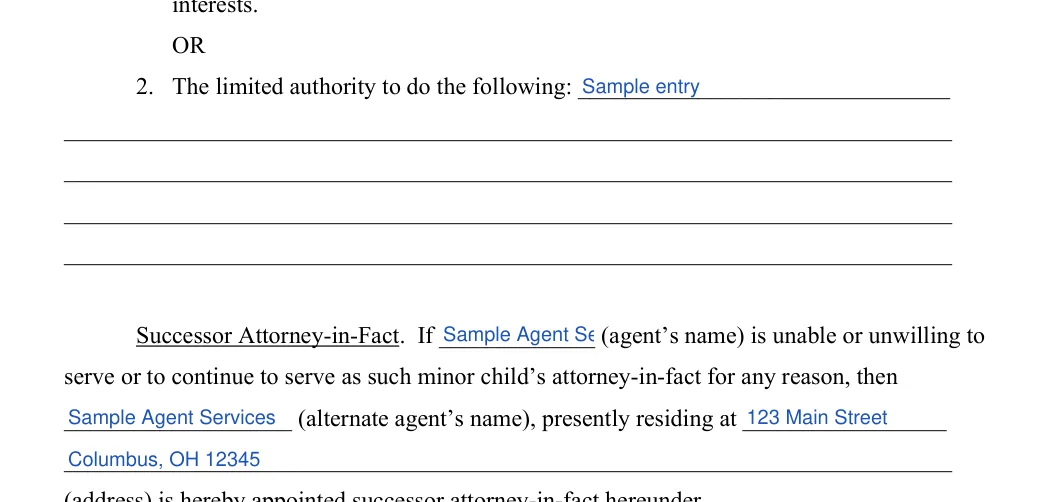
The FormsPal template lets the person signing choose between two kinds of authority over the child. Page 2 offers either all authority that Ohio law allows to be delegated, or limited authority that you write out on the lines provided. The template also has room for a successor agent and for start and end dates.
If you choose all authority, the form names these powers, and its wording is not limited to them:
| Principal | The parent, court-appointed guardian, or court-appointed conservator who signs on behalf of the minor child. |
| Agent (attorney-in-fact) | The person the form appoints to act for the minor child. |
| Successor attorney-in-fact | The person who takes over if the first agent is unable or unwilling to serve. |
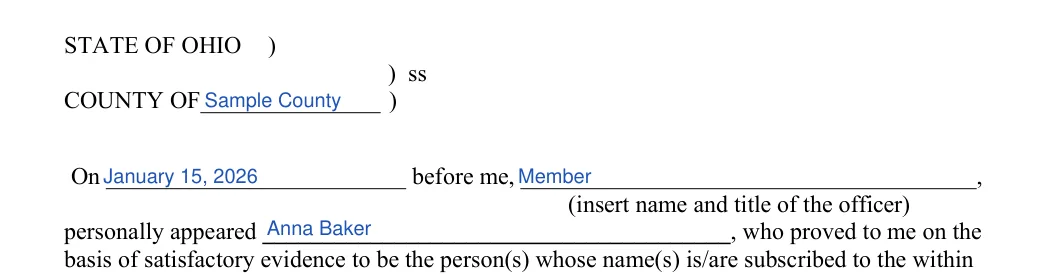
| Acknowledgment | The notary block on page 3. It verifies only the identity of the person who signed, not whether the document is truthful, accurate, or valid. |
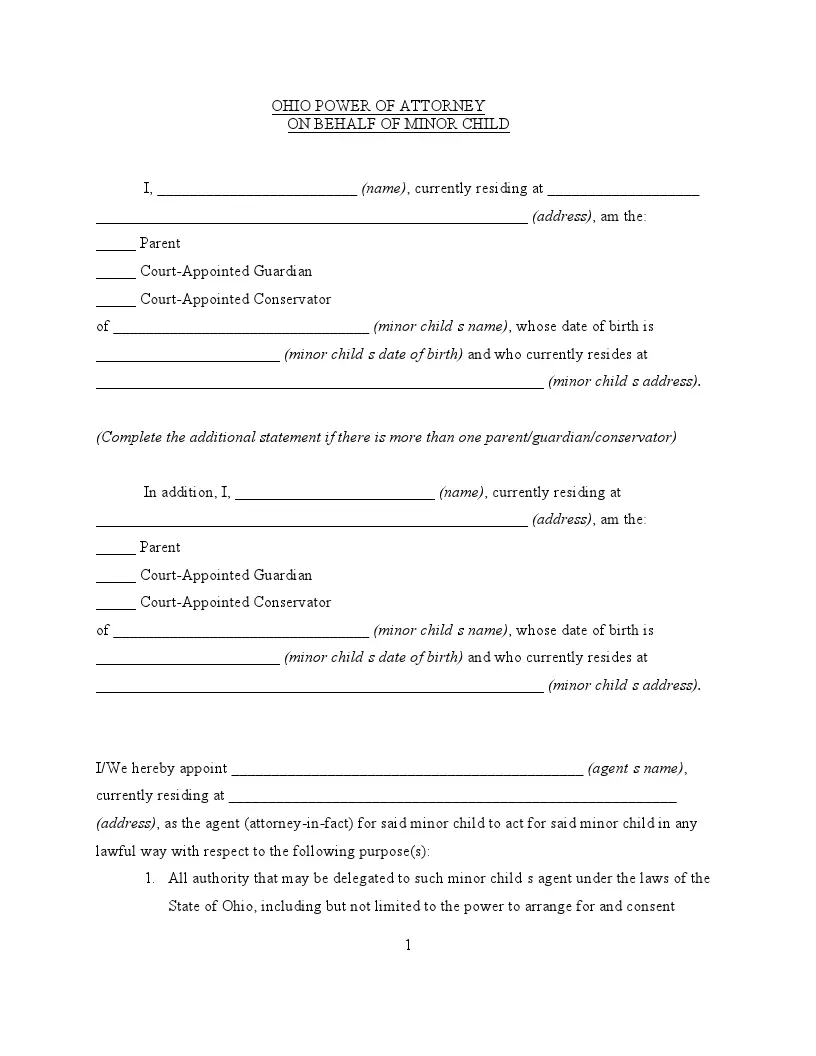
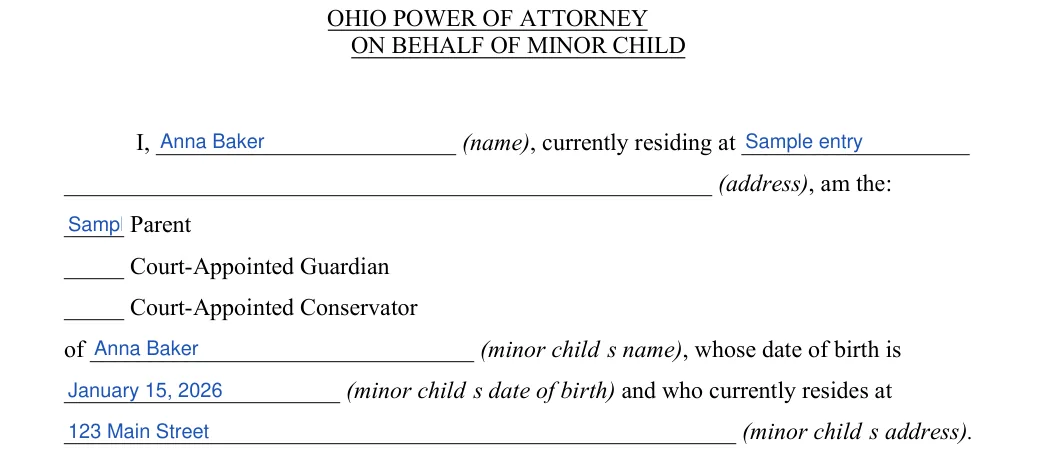
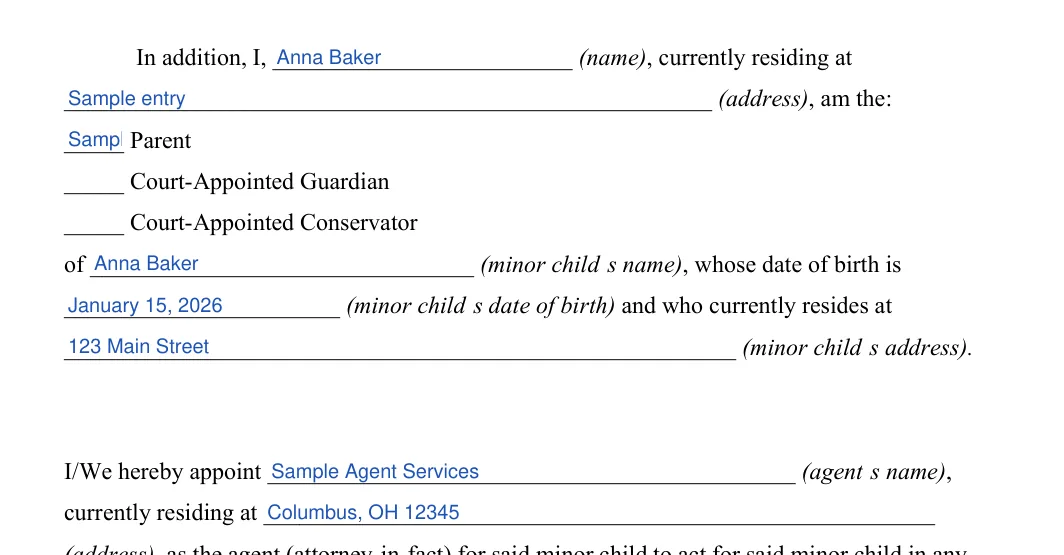
The FormsPal Ohio minor child power of attorney form PDF is a three-page template with 44 fillable fields. Pages 1 and 2 hold the details and signatures, and page 3 is an acknowledgment for the notary. Work through the seven parts below in the order the form gives them.
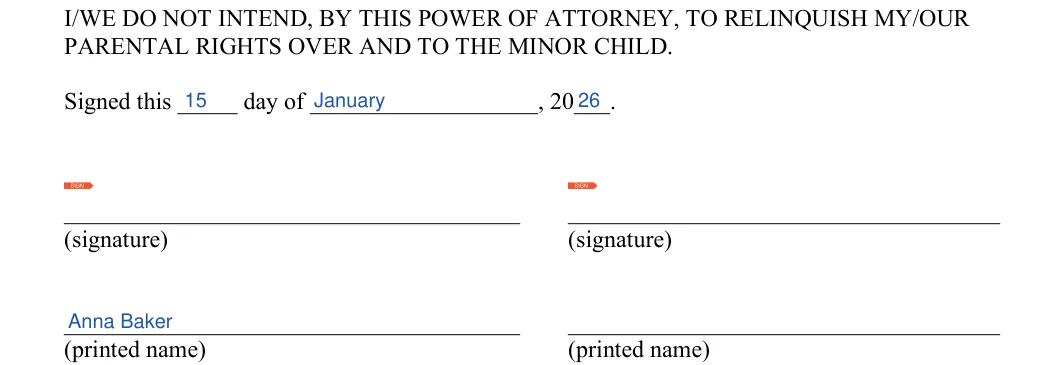
The screenshots under each step show the FormsPal Ohio minor child power of attorney template filled with sample entries in blue, so you can see where each answer goes. The names, addresses, dates and amounts are examples only.


Filling out the form is only the first part. After that, the parent, guardian, or custodian and the grandparent sign it, a notary notarizes the signatures, and the document is filed with a court. Follow these steps in order.[3][2]
Use this checklist before you sign. It follows the steps above and the Ohio rules summarized on this page, so you can check each item off in order. Keep it next to the filled-out form while you work.
A minor child power of attorney covers one situation. If you need a different document, FormsPal has other Ohio power of attorney templates and a page for the Ohio notary acknowledgment. Browse the list below or return to the main Ohio power of attorney page.
These answers cover the questions people ask most about the Ohio minor child power of attorney. Each one comes from the Ohio Revised Code sections listed at the end of this page. Ohio's rules apply to a power of attorney that a parent, guardian, or custodian gives to a grandparent with whom the child is residing.
It lets a parent, guardian, or custodian give a grandparent with whom the child is residing any of their rights and responsibilities for the child's:[1]
For the power of attorney described on this page, yes. The statute says the signatures must be notarized for the power of attorney to be effective.[3]
It lasts until the first of five events in the statute happens. Examples are a written revocation, the child ceasing to live with the attorney in fact, and a court order.[2]
No. The power of attorney may not grant authority to consent to the marriage or adoption of the child.[1]
The parent, guardian, or custodian granting it and the grandparent designated as the attorney in fact must sign it.[3]
Use a form identical in form and content to the one printed in Section 3109.53. The signatures must be notarized. The signed document must then be filed with the juvenile court of the county in which the attorney in fact resides, not later than five days after it is created.[2][3]
The grandparent receives the rights and responsibilities for the child's care, physical custody, and control that the document passes on. Authority to consent to the child's marriage or adoption cannot be passed on.[1] The FormsPal template also states that the signer does not intend to relinquish parental rights over and to the minor child.
General information, not legal or tax advice.
The sources below are the sections of the Ohio Revised Code that this page relies on. Each bracketed number in the text above links to its entry in this list, so you can read the statute for yourself.
