
Updated:
A Pennsylvania minor child power of attorney is a parent's caregiver appointment. Parents use it when a trusted adult cares for their child for a set time.
Key facts

Build Your Document
Answer a few simple questions to make your document in minutes
Save and Print
Save progress and finish on any device, download and print anytime
Sign and Use
Your valid, lawyer-approved document is ready
A Pennsylvania minor child power of attorney is a short signed form that names an adult to care for a child between the start and end dates written on it. The adult is the agent or attorney-in-fact; the parent or guardian who signs is the principal. The form covers these details:
This page does not address any limit Pennsylvania sets on how long a parent may hand over a child's care, or on decisions a parent cannot hand over.
The form is also called a Pennsylvania parental power of attorney. Families use it for temporary custody arrangements: a long trip by both parents, a work posting, a hospital stay or a school year spent with a relative.
The form keeps decisions close to the family. A close family friend or a relative the child trusts is the usual choice of agent, and a talk with that person before the signing avoids surprises later.
| Document Name | Pennsylvania Minor Child Power of Attorney Form |
| Other Name | Pennsylvania Parental Power of Attorney |
| Signing Rules | The form prints signature lines and a notary acknowledgment, with no witness lines. Pennsylvania's general power of attorney rules call for a notary and two witnesses aged 18 or older, even when the principal signs by hand | 20 Pa.C.S. § 5601(b)(3)(ii) |
| Duration | The start and end dates written on the form |
| Available Formats | Adobe PDF |
Keep the phone number and address of the agent with your copy of the form. Add the school and doctor contact details for your child too, so they are easy to find.
A minor child power of attorney is a delegation the parent signs, not a guardianship granted by a judge. The parent picks the agent, writes the dates and sets the scope, and no hearing is part of the document itself.
The form fits a planned, temporary arrangement while the parent stays involved. The principals have the legal right to revoke a power of attorney at any time.
The form also works for an adult who already holds authority over the child. Its first line lets a court-appointed guardian or a court-appointed conservator sign in place of a parent, so that person can name an agent for the same child.
This page does not cover the court forms for appointing a guardian of a minor. A family that needs a permanent caregiver, or a caregiver for a child whose parents cannot sign, is looking for a different process than this document.
The Pennsylvania child power of attorney collects the parties, the authority and the dates on two pages, with a third page for the officer's acknowledgment. Each part below has its own place on the form.
The form has no notice page, no witness lines and no agent acknowledgment page. The next sections show where those parts come from in Pennsylvania's general power of attorney rules.
The first statement names the person who grants the power: a parent, a court-appointed guardian or a court-appointed conservator. A second statement, with its own signature line, is there for a second parent or co-guardian.
The agent section holds the name and address of the adult who will care for the child. The agent acts for the child only within the authority the form grants.
The authority section offers two options: option 1 grants all of the authority the form describes, and option 2 limits the agent to the tasks written on its line. Option 2 suits a parent who wants the agent to handle school matters or medical visits only.
The successor section names a backup agent who steps in if the first agent cannot act. The successor's name and address go on page 2.
The effective date section sets the day the power starts and the day it continues until. A clear end date tells schools and doctors how long the agent's authority lasts.
The Pennsylvania minor child power of attorney form is filled in seven parts, in order from the parent and the child to the officer's seal. Work through each part before anyone signs.
The screenshots under each step show the FormsPal Pennsylvania Minor Child Power of Attorney template filled with sample entries in blue, so you can see where each answer goes. The names, addresses, dates and amounts are examples only.
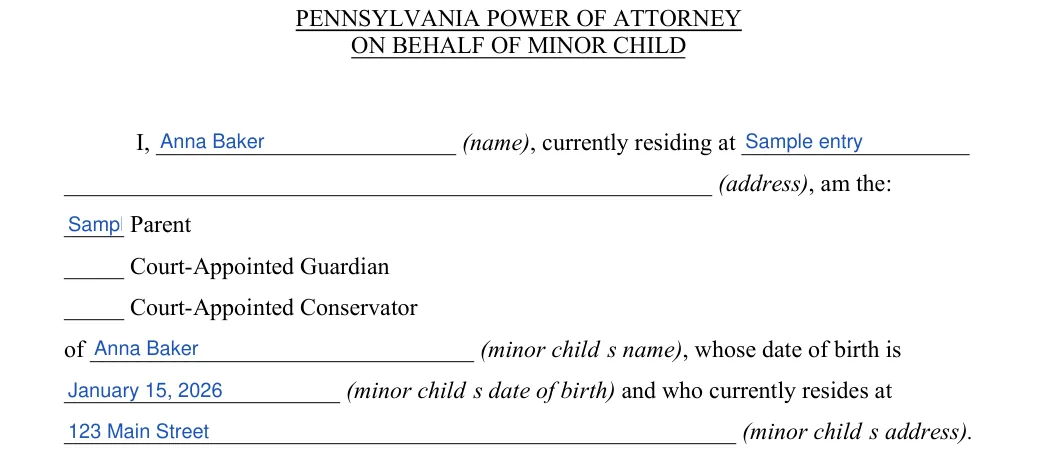
On behalf of minor child: first parent, guardian or conservator
Enter your name and address, then put your initials on the line beside Parent, Court-Appointed Guardian or Court-Appointed Conservator. Next, enter the child's name, date of birth and address. Check that the name and date of birth match the child's birth certificate.


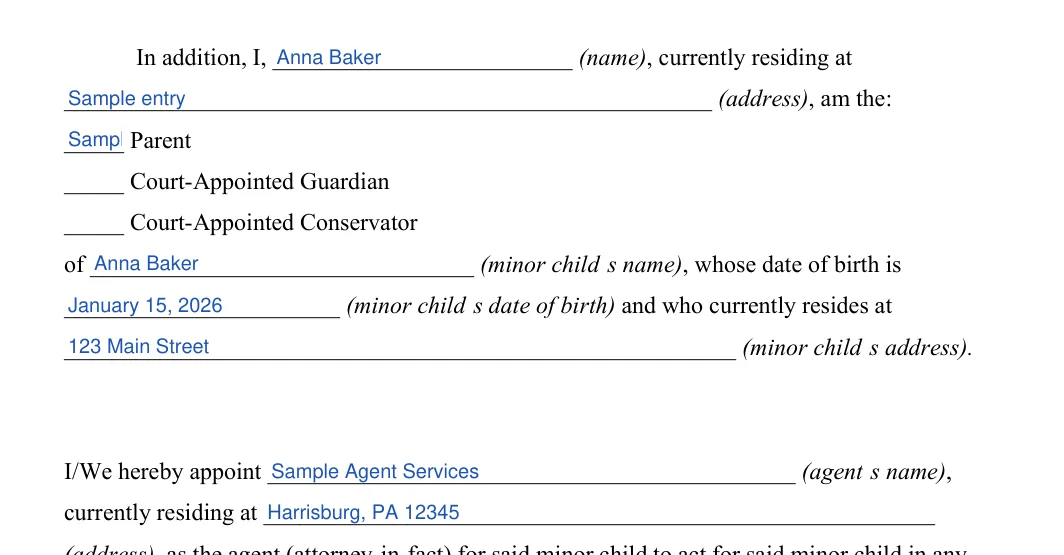
Second parent and the agent
Fill in the second statement for a second parent or co-guardian, if there is one. Then enter the name and address of the agent (attorney-in-fact) you appoint for the child.

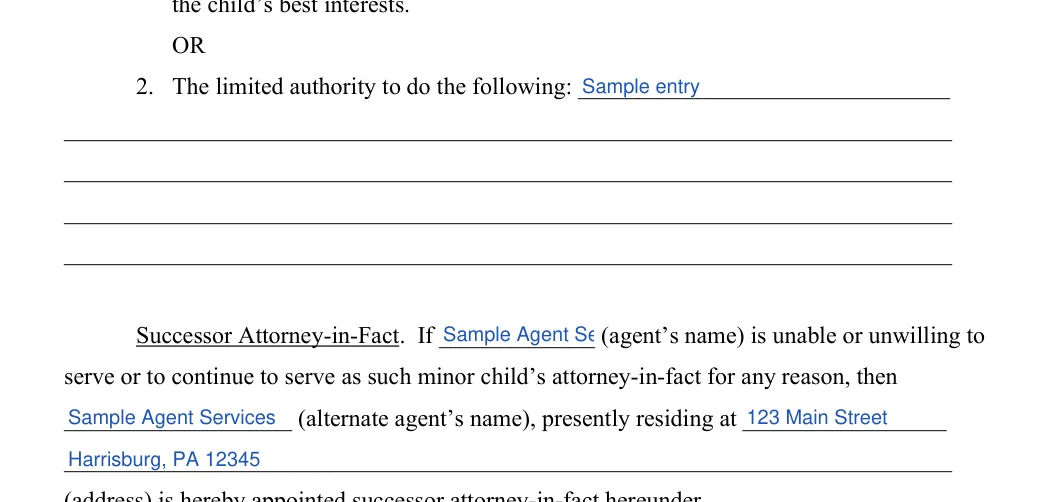
Purposes and successor attorney-in-fact
Choose option 1 for all authority, or option 2 for limited authority and write what the agent may do on the line. Describe the limits in plain words, such as "school enrollment and routine medical care". Then enter the name and address of the alternate agent, the successor attorney-in-fact.

Effective date
Enter the date the power of attorney starts and the date it continues until. The principals have the legal right to revoke a power of attorney at any time.

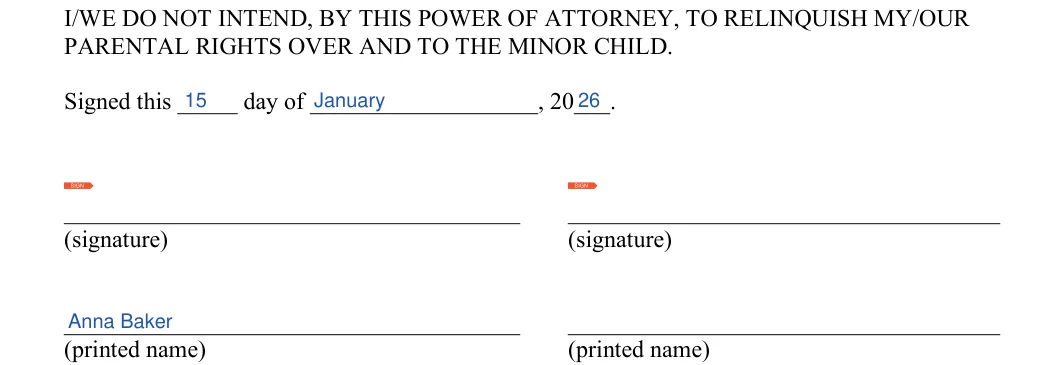
Sign and date the document
Read the statement about parental rights, fill in the day, month and year, then sign and print your name on the lines. A second parent or guardian uses the second signature line.
Acknowledgment: state, county and officer
Leave page 3 for the notary or officer. The county, the date, the officer's name and title and the name of the person appearing are filled in at the signing.
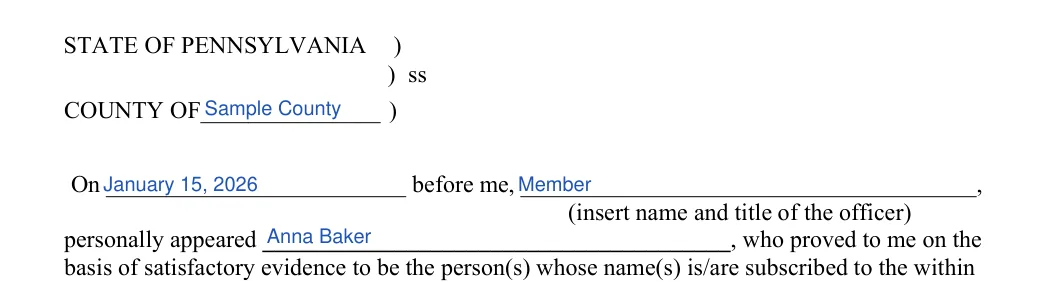
Officer signature and seal
The officer who completes the acknowledgment signs the Signature line and adds a seal.

Pennsylvania's general rules for a power of attorney call for one that is dated, signed, notarized and witnessed, under 20 Pa.C.S. § 5601, even when the principal signs by hand and not by mark. Each rule below names its subsection.
The exemptions in 20 Pa.C.S. § 5601(e.1) cover commercial, credit, stock transfer, business entity, confession of judgment, vehicle dealer and government form powers; a parent's delegation of a child's care is not among them. The form as printed carries none of the notice, the witness lines or the agent's acknowledgment, so a family that follows these general rules adds those pages at the signing.
The power of attorney is dated and signed by the principal by signature or mark, or by another individual at the principal's direction only if the principal is unable to sign, under 20 Pa.C.S. § 5601.
The principal's signature is acknowledged before a notary public or another individual authorized by law to take acknowledgments, under 20 Pa.C.S. § 5601(b)(3)(i), for a power of attorney signed after that rule took effect; the rule applies even when the principal signs by hand. The notary cannot be the agent named in the document, under 20 Pa.C.S. § 5601, which applies whenever an agent is named.
The signing is witnessed by two individuals, each 18 years of age or older, under 20 Pa.C.S. § 5601(b)(3)(ii), even when the principal signs by hand and not by mark.
The witness rule excludes three people under 20 Pa.C.S. § 5601, which applies whenever the document names them: the person who signed for the principal, the agent named in the document, and the notary before whom it is acknowledged.
Pennsylvania's general rules call for a power of attorney that opens with a notice in capital letters signed by the principal, under 20 Pa.C.S. § 5601(c), except for the classes the statute exempts, such as commercial transaction powers and powers coupled with an interest. When the notice is not signed and someone challenges the agent's authority, the agent carries the burden of showing the act was proper, under 20 Pa.C.S. § 5601(c).
Under the same general rules, the agent has no authority to act until the agent signs an acknowledgment and attaches it to the power of attorney, under 20 Pa.C.S. § 5601(d), when that person is to act as agent. In it the agent agrees to act in good faith, in the principal's reasonable expectations or best interest, and only within the authority granted.
The steps below follow the general rules of 20 Pa.C.S. § 5601, adding the pages the form does not print.
Sign the notice and the form
Add a page with the 20 Pa.C.S. § 5601(c) notice at the front and sign it; that statute prints the notice's wording for all powers of attorney outside its exemptions, and the wording speaks of broad powers over the principal's property, not of a child's care. Then sign the form in front of the notary and both witnesses under 20 Pa.C.S. § 5601(b)(3)(ii); each parent or guardian named on the form signs on a separate line.

Have the witnesses sign
Ask two adults who are not the agent and not the notary to sign as witnesses and print their names on an added page, since the form has no witness lines, under 20 Pa.C.S. § 5601.

Complete the acknowledgment
Let the notary or officer fill in page 3, sign it and add the seal.
Collect the agent's acknowledgment
Give the agent an acknowledgment in the 20 Pa.C.S. § 5601(d) wording to sign, since the form has none, and attach it to the document before the agent acts.
Keep copies
Make a copy of the signed document for each person named in it, and store the original where you can find it.
A minor child power of attorney lasts from its start date until its end date, as written in the effective date section. The principals have the legal right to revoke a power of attorney at any time.
The document ends sooner when a parent revokes it. A written revocation, given to the agent and to the school or doctor holding a copy, leaves no doubt about the date.
A designation of a spouse as agent is revoked when either spouse files for divorce, as of the filing, unless the power of attorney shows it was meant to survive that event, under 20 Pa.C.S. § 5605. A parent who names a stepparent as agent can say in the form whether that choice survives a divorce filing.
The Pennsylvania power of attorney forms below cover other needs: an adult's own finances, health care decisions or a single task. Each link opens a page with its own guide, so the documents can be compared side by side. All of them are listed on the Pennsylvania power of attorney page.
The questions below cover what parents ask most about a Pennsylvania power of attorney for a child.
A minor child power of attorney gives a chosen adult care authority through the parent's own signature, with no hearing in the document itself. It does not make that adult a court-appointed guardian; it lets the agent act within the authority and dates the parent sets.
Many parents choose a close family friend or a relative they trust. Pick someone your child feels comfortable with, and talk to that person before you fill in the form.
Have these details ready:
Yes. The form has a second statement for an additional parent, guardian or conservator, and two signature lines. Fill in both parts when two people sign.
An agent who acts in good faith without actual knowledge of the principal's death keeps the agency for those acts, under 20 Pa.C.S. § 5605, only until the agent learns of the death. A family in that situation needs advice on the child's care going forward.
No. A child power of attorney names an agent for a minor child, while a medical power of attorney names an agent for an adult's own health care decisions. Option 1 or the limited authority line of the child form is where a parent covers the child's medical visits.
General information, not legal or tax advice.
