
Updated:
A Rhode Island minor child POA is a parent's form naming a caregiver. The form names another adult to handle a child's school, medical care, travel and daily welfare. The form is needed by parents and guardians, especially during travel, illness or military deployment.
This page explains what the form covers, how to choose the agent and the powers, how to fill out each section of the power of attorney and how to sign and share it.
Key facts

Build Your Document
Answer a few simple questions to make your document in minutes
Save and Print
Save progress and finish on any device, download and print anytime
Sign and Use
Your valid, lawyer-approved document is ready
The form includes a parental rights statement above the signature lines.
The form can give the agent authority over these areas:
The form also names the child, the parent or guardian granting the powers, the agent and a successor agent. A conservator of the child can sign it in place of a parent, since the first section lets the signer mark that role.
A power of attorney for a child fits any stretch when another adult handles the child's daily needs. The written form shows a school, a doctor or a coach who is caring for the child and what that adult may decide.
The length of the absence and the tasks the agent will handle decide how the form is filled in. A weekend trip and a school year with a grandparent call for different dates and often different powers.
The child POA form offers a choice between all authority and limited authority, marked as option 1 or option 2 on the form. All authority lets the agent act on every area the form covers. Limited authority restricts the agent to the powers the parent writes on the lines below option 2.
Limited authority suits a short or narrow arrangement. Typical entries are school pickups, consent to routine doctor and dentist visits, or permission for a single trip. Each listed power should be specific enough that a school or a clinic can see whether a request falls inside it.
The agent, also called the attorney-in-fact, is the adult the form puts in charge of the child's care. A close relative, a longtime family friend or a trusted neighbor are common picks. The best choice is someone the child already knows and who is easy to reach.
The successor attorney-in-fact is the backup. The successor steps in when the first agent cannot act, so the form keeps working if plans change. The successor should be a different person from the agent.
A short talk with the agent settles the details the form and the agent will need:
Giving the child the agent's phone number also helps, so the child knows who to call.
The form lasts from the start date to the end date the parent writes in the effective date section. The agent has no authority before the start date or after the end date. Dates that cover the whole absence, plus travel days, avoid a gap.
For a long-term or permanent change in who raises the child, families usually look at guardianship instead, which is a separate process.
The template is a three-page PDF with fillable fields for names, addresses, dates and signatures. It can be completed on a computer or printed and filled in by hand.
| Document Name | Rhode Island Minor Child Power of Attorney Form |
| Other Name | Rhode Island Parental Power of Attorney |
| Duration | Set by the start and end dates written on the form |
| # of Fillable Fields | 44 |
| Available Formats | Adobe PDF |
The Rhode Island minor child POA form runs in seven sections from the parent's details to the officer's seal. The steps below follow it from top to bottom. Have every name, address and date ready before starting.
The screenshots under each step show the FormsPal Rhode Island Minor Child Power of Attorney template filled with sample entries in blue, so you can see where each answer goes. The names, addresses, dates and amounts are examples only.
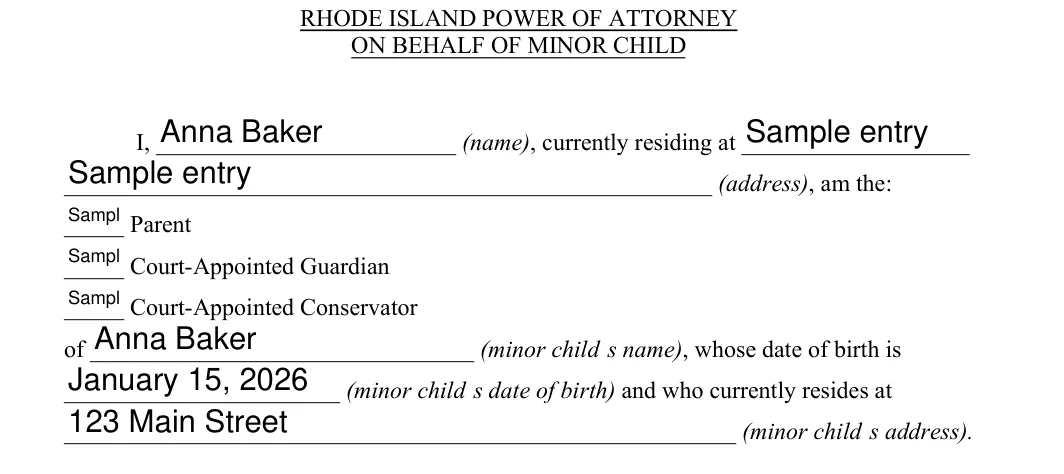
On Behalf of Minor Child: Your Details and the Child's
Enter your name, address and phone number, then initial the line that shows whether you are the parent, guardian or conservator. Write the child's full name, street address, city or town, zip code and phone number. Add the child's date of birth.
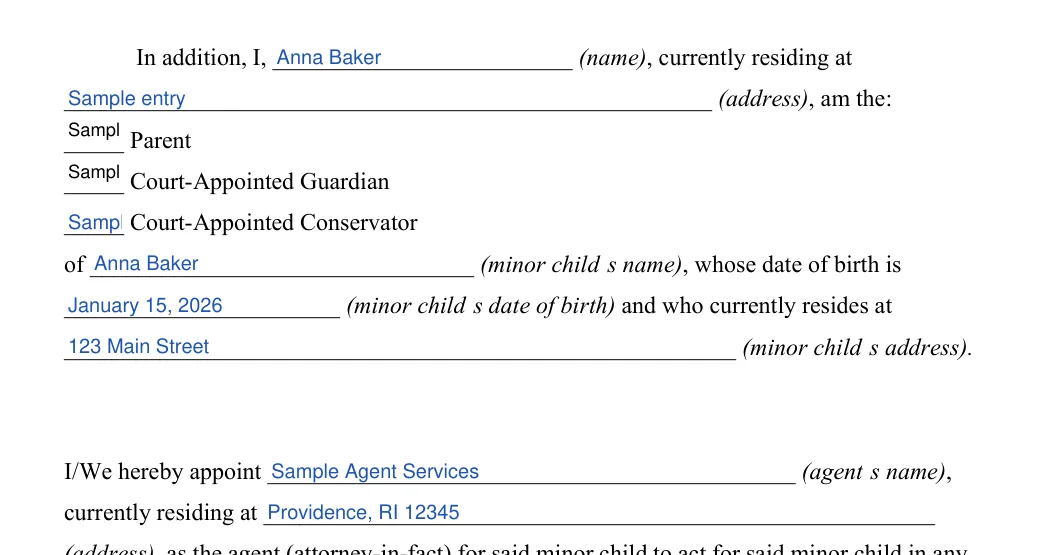
Second Parent or Guardian, and the Agent
Complete the additional statement the same way if a second parent, guardian or conservator joins. Then enter the name, relationship to the child and full address of the adult you appoint as agent.
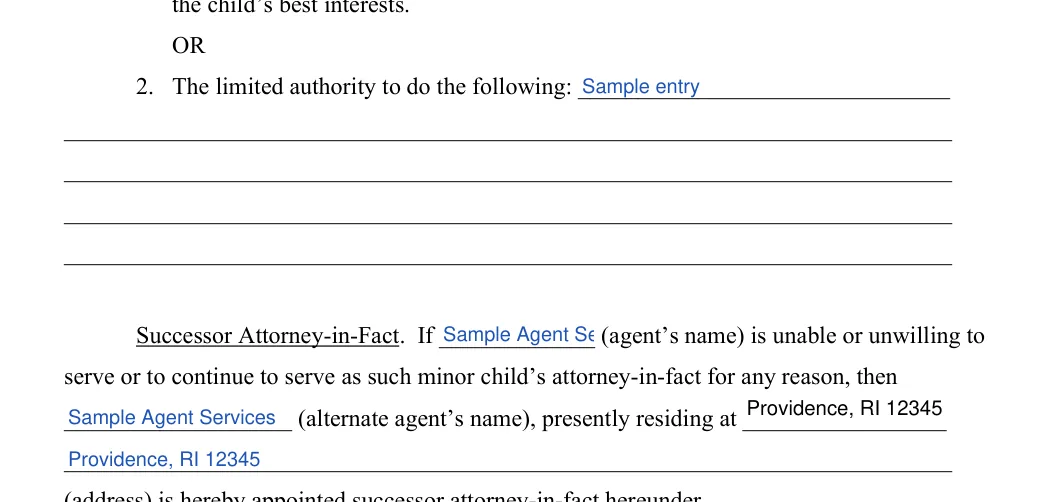
Powers and Successor Attorney-in-Fact
Choose 1 for all authority or 2 for limited authority. Write the specific powers on the lines provided if you choose 2. Then name a backup agent and enter that person's address.
Effective Date
Enter the date the power of attorney starts and the date it continues until. Pick dates that cover the whole time you plan to be away.

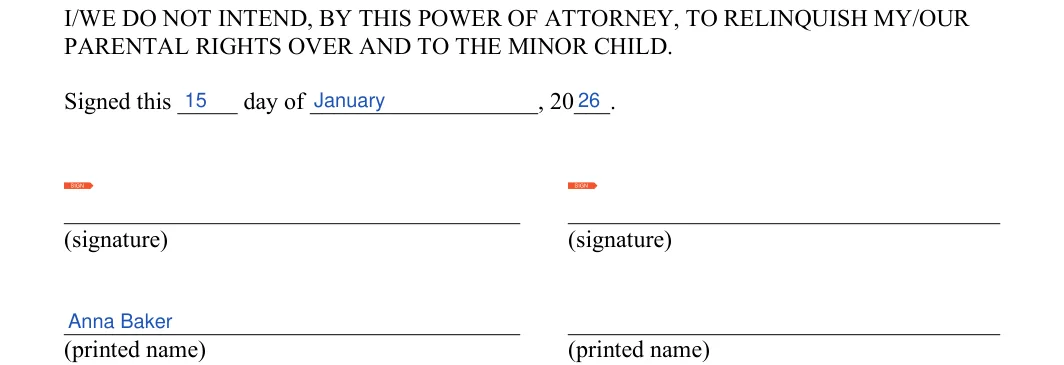
Parental Rights Statement and Signatures
Read the parental rights statement above the signature lines. Then enter the day, month and year, sign on the first signature line and print your name below it. A second parent or guardian who joins uses the second line.
Acknowledgment: State and County
Leave page 3 for the officer, who fills in the county, the date, the officer's name and title, and the name of the person who signed.
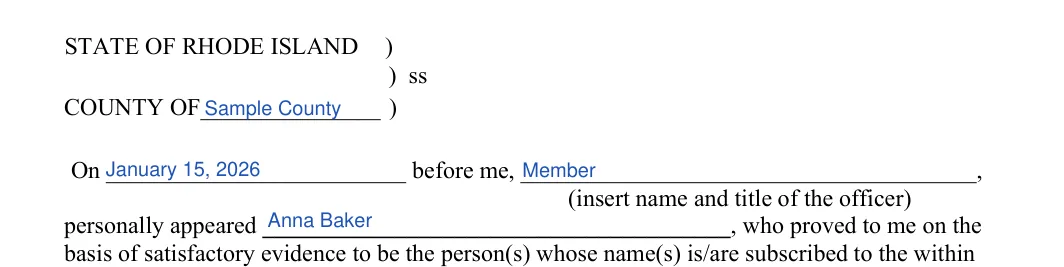
Officer's Signature and Seal
Leave the Signature line and the space marked (seal) empty. The officer signs and seals there.

The child POA form is signed by the parent or guardian granting the powers, and an officer such as a notary public completes the acknowledgment on its page 3. The steps below turn the filled-in form into a document the agent can show.
The witness and notary rules cited below belong to other Rhode Island power of attorney types, not to the minor child form.
The minor child POA covers a child's care, not the parent's own money or health. Rhode Island statutes set out two other power of attorney types that searches for "power of attorney Rhode Island" also cover.
The statutory short form power of attorney of Chapter 18-16 is a document for financial matters. A power of attorney counts as a statutory short form only when it is in writing, duly acknowledged by the principal and contains the exact wording of clause First of the statute (R.I. Gen. Laws 18-16-2(e)).
When a principal uses the statutory short form, its execution is acknowledged in the manner prescribed for the acknowledgment of a conveyance of real property (R.I. Gen. Laws 18-16-2(b)). If a statutory short form names more than one agent, the agents act jointly unless the principal specifically provides that they act severally (R.I. Gen. Laws 18-16-2(f)). Chapter 18-16 does not bar any other or different form of power of attorney the parties want (R.I. Gen. Laws 18-16-2(c)).
A Rhode Island durable power of attorney for health care is a witnessed document executed under § 23-4.10-2 (R.I. Gen. Laws § 23-4.10-1.1(5)). The health care power of attorney is not valid unless one notary public or two qualified witnesses, present when the principal signs or acknowledges the signature, sign it (R.I. Gen. Laws § 23-4.10-2).
Only qualified witnesses count for a health care power of attorney: the agent or alternate agent, a health care provider, a provider's employee, the operator of a community care facility and that operator's employee cannot witness it (R.I. Gen. Laws § 23-4.10-2). A parent who wants an agent to consent to a child's routine medical and dental care uses the minor child form instead, with medical care among the granted powers.
Our Rhode Island durable power of attorney page covers the financial form, and the Rhode Island POA forms page lists every type.
This document is a form in which a parent or guardian names another adult to care for a child for a set time. Parents use one during an illness, a trip or a deployment.
A parent gets one by filling out the form, signing it before a notary public or other officer, and giving copies to the agent. The steps above walk through each section and the signing.
Yes, the form lists medical and dental care among the powers a parent can give the agent. Under limited authority, the parent writes medical consent on the lines for specific powers.
Yes, the form has an additional statement and a second signature line for a second parent, guardian or conservator.
Have the full names and addresses of everyone named on the form, the child's date of birth, and the dates you want the document to start and end.
Keep the signed original safe and make copies. Give one to the adult you named and keep another with your child's papers.
General information, not legal or tax advice.
