
Updated:
A South Dakota minor child power of attorney is a parental delegation form. The parent names an agent to look after the child while the parent is away. Parents use one when travel, illness or military deployment keeps them away. This page explains the form's parts, how to fill it out, how it is signed and how it ends.
Key facts

Build Your Document
Answer a few simple questions to make your document in minutes
Save and Print
Save progress and finish on any device, download and print anytime
Sign and Use
Your valid, lawyer-approved document is ready
The South Dakota minor child power of attorney is a three-page form that records the parent or guardian, the child, the agent, a successor agent, the powers given, the start and end dates and the notary acknowledgment. The form is also called a parental power of attorney.
| Document Name | South Dakota Minor Child Power of Attorney Form |
| Other Name | South Dakota Parental Power of Attorney |
| General Power of Attorney Rules | S.D. Codified Laws § 59-12-4 (signing and acknowledgment), § 59-12-8 (when it takes effect) and SDCL 59-12-9 (when it ends) apply to powers of attorney in general |
| Duration | Set by the start and end dates written on the form; under SDCL 59-12-9, unless the power of attorney otherwise provides, an agent's authority is exercisable notwithstanding a lapse of time |
| Avg. Time to Fill Out | 10 minutes |
| # of Fillable Fields | 44 |
| Available Formats | Adobe PDF |
The South Dakota sections in the table are general power of attorney rules; they do not settle how far they reach a parent's delegation of a child's care.
A minor child power of attorney is a private delegation, not a guardianship appointment: the parent signs it, picks the agent and sets the dates without opening a guardianship case. Many people who search for South Dakota guardianship forms want exactly this: a way to let a relative care for a child for a set period.
Guardianship forms are the papers used to ask for the appointment of a guardian. The power of attorney asks no one for an appointment. The form has a line for a Court-Appointed Guardian or Court-Appointed Conservator, but a court appointee should confirm with the appointing court that the order lets them hand the child's care to an agent; a conservator manages a child's property, not the child's care.
| Document | What it does | Who it is for |
|---|---|---|
| Minor child power of attorney | Hands a child's day-to-day care to an agent for a set period | A parent or guardian who will be away |
| South Dakota limited power of attorney | Gives an agent one task or a short list of tasks | An adult who needs help with a single matter |
| South Dakota durable power of attorney | Contains words such as "This power of attorney shall not be affected by disability of the principal," so the agent's authority continues despite the principal's disability (S.D. Codified Laws § 59-12-3) | An adult planning for their own care |
The agent named in the form, also called the attorney-in-fact, is the adult who looks after the child's care while the parent is away. The best choice is someone the child already knows and trusts, who lives near the child's school and doctor and who answers the phone.
The Successor Attorney-in-Fact paragraph names the backup who acts if the first agent cannot. Under SDCL 59-12-9, a power of attorney terminates when the agent dies, becomes incapacitated or resigns and the power of attorney does not provide for another agent to act. A named successor keeps the child's care covered in that case.
Talk to both people before writing their names on the form.
The form offers two powers options: option 1 keeps the list of powers already printed on the form, and option 2 gives only the limited powers the parent writes in. The printed option 1 list reads best checked line by line before signing, so the parent knows each power the agent receives.
Option 2 suits a parent who wants the agent to handle only certain matters, such as school pickups or one medical appointment. Each power written on the option 2 lines reads best as one short, plain task.
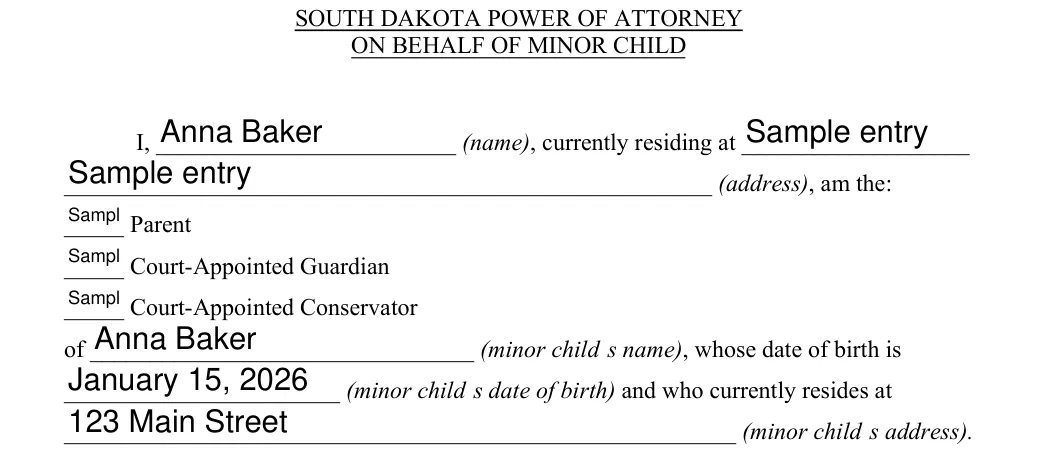
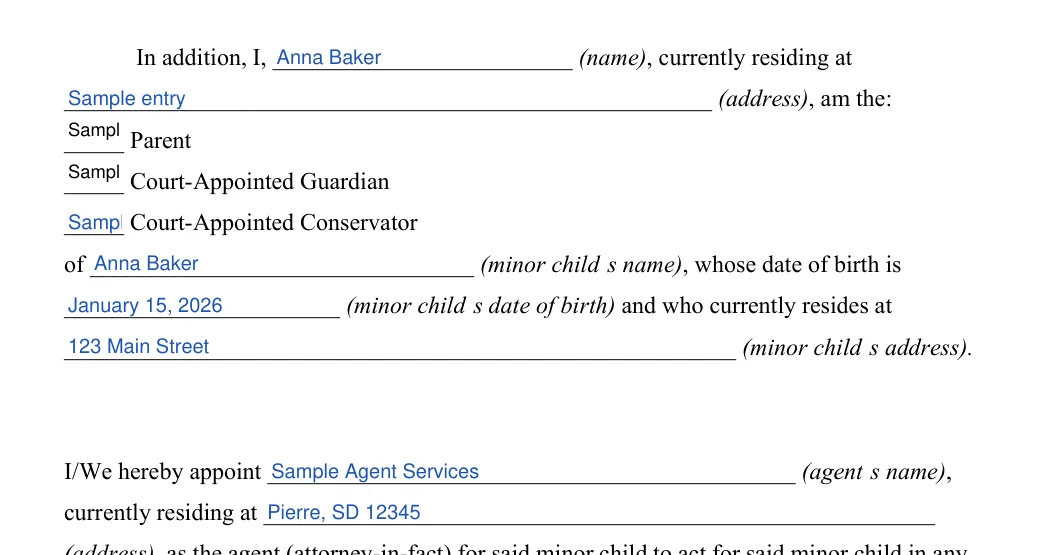
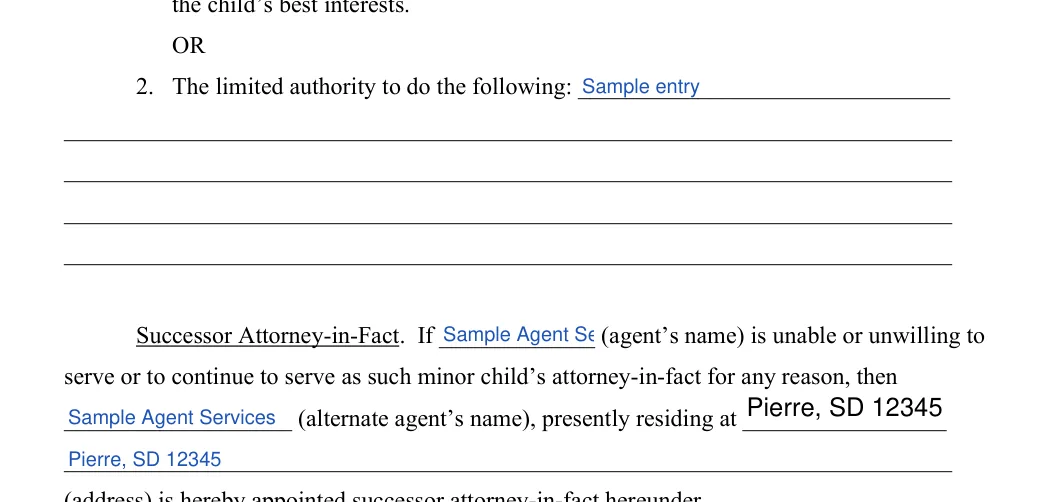
The South Dakota minor child POA form is filled in from the top of page 1 down to the notary acknowledgment on page 3, in seven steps.
The screenshots under each step show the FormsPal South Dakota Minor Child Power of Attorney template filled with sample entries in blue, so you can see where each answer goes. The names, addresses, dates and amounts are examples only.

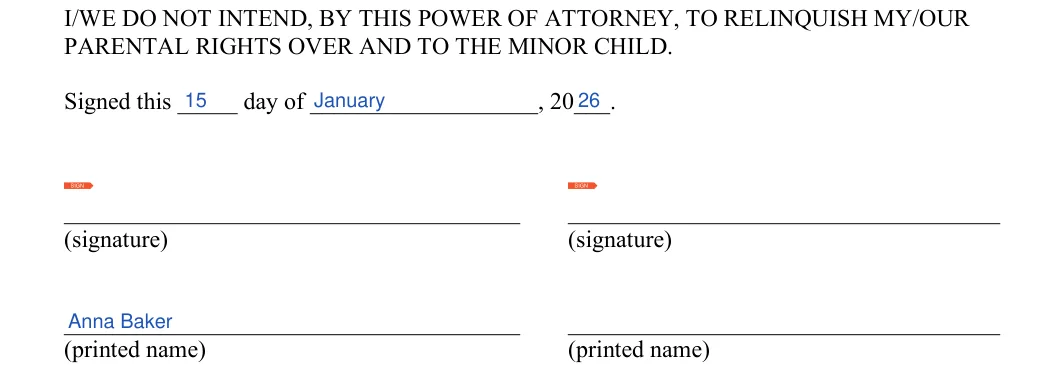
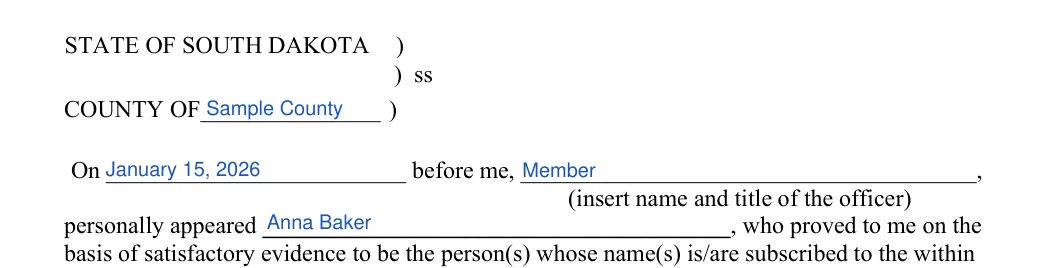

A South Dakota power of attorney is signed by the principal and acknowledged before a notary public or other individual authorized by law to take acknowledgments, under S.D. Codified Laws § 59-12-4. On this form the principal is the parent or guardian who gives the authority.
S.D. Codified Laws § 59-12-4 also lets another individual sign the principal's name, in the principal's conscious presence and at the principal's direction. When two parents sign, each signature goes before the notary, as the acknowledgment rule of S.D. Codified Laws § 59-12-4 covers any signature under that section.
See our notary acknowledgment page for how an acknowledgment block reads.
A South Dakota power of attorney takes effect when executed unless the principal provides that it becomes effective at a future date or upon a future event, under S.D. Codified Laws § 59-12-8. The start date on the form is that future date when it falls after the signing.
The end date matters as much. Unless the power of attorney otherwise provides, an agent's authority is exercisable until it terminates, notwithstanding a lapse of time since the signing (SDCL 59-12-9). A written end date gives the power a clear finish.
Under SDCL 59-12-9, a power of attorney terminates when any of these happens:
Under SDCL 59-12-9, the agent's own authority also ends, unless the power of attorney otherwise provides, when an action is filed for divorce, annulment or legal separation of the agent's marriage to the principal, or for a protection order.
A minor child power of attorney ends when the parent revokes it, one of the endings SDCL 59-12-9 lists, and the agent's authority ends when the parent revokes that authority. Telling everyone who holds a copy matters: under SDCL 59-12-9, a termination is not effective as to a person who acts in good faith when that person has no actual knowledge of it.
These answers cover getting the power of attorney, what to gather, signing for someone else and what happens when a parent falls ill.
A parent or guardian grants it by signing a minor child power of attorney that names you as agent, acknowledged before a notary public under S.D. Codified Laws § 59-12-4. Except as otherwise provided in the power of attorney, you accept the appointment by acting as agent or by other conduct showing acceptance (S.D. Codified Laws § 59-12-12).
The minor child power of attorney is the form a parent signs and has acknowledged for this delegation. The South Dakota sections this page cites (S.D. Codified Laws § 59-12-4, § 59-12-8 and SDCL 59-12-9) are general power of attorney rules, and they do not settle how far they reach a delegation of a child's care. A guardianship is a separate matter with its own papers, and the South Dakota POA forms page lists the other power of attorney types.
Gather these details first:
With everything in one place, you can fill in the form in a single sitting.
Yes, another individual may sign the parent's name if the parent directs it and it happens in the parent's conscious presence, under S.D. Codified Laws § 59-12-4. That signature is acknowledged before a notary like any other.
It ends on the parent's incapacity only if it is not durable (SDCL 59-12-9). Under S.D. Codified Laws § 59-12-3, a power of attorney stays exercisable despite the principal's disability if it contains words such as "This power of attorney shall not be affected by disability of the principal," or similar words showing that intent.
General information, not legal or tax advice.
