
Updated:
The Wyoming minor child power of attorney is a temporary caregiver authorization. The form names an agent to make school, medical and welfare decisions for your child. Parents and court-appointed guardians need it, especially before travel, illness or military service.

Build Your Document
Answer a few simple questions to make your document in minutes
Save and Print
Save progress and finish on any device, download and print anytime
Sign and Use
Your valid, lawyer-approved document is ready
Key facts
A Wyoming minor child power of attorney is effective when it is signed, unless the form sets a later start date or a future event (Wyo. Stat. Ann. § 3-9-109). The parent fills out the form, signs it and hands a copy to the agent.
The sections below explain each step. For money matters rather than child care, the Wyoming general financial power of attorney form is the document to use. Other documents are on the Wyoming power of attorney forms page.
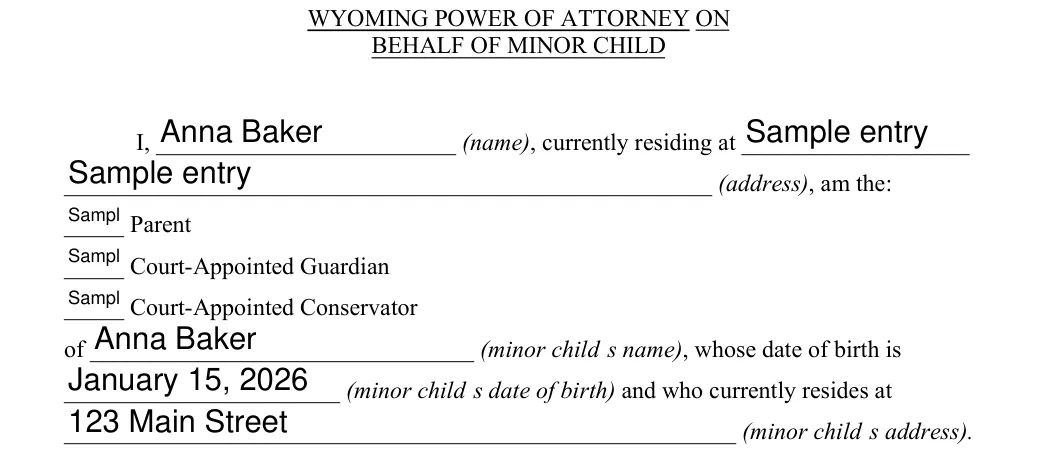
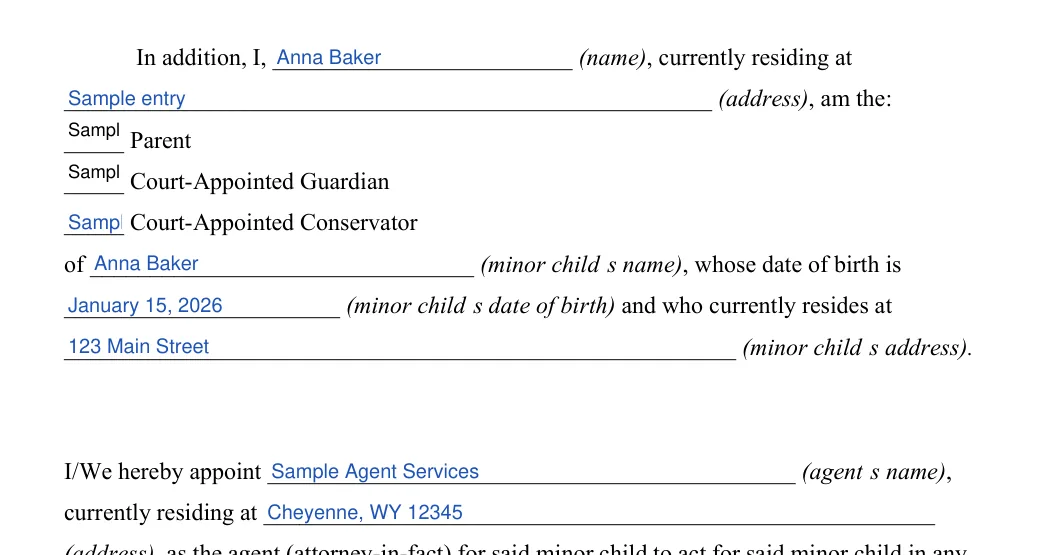
The Wyoming minor child power of attorney hands day-to-day authority over a child to a trusted adult while the parent cannot act, without ending the parent's own rights. The form names three people: the parent or guardian who grants the power, the minor child, and the agent who receives it.
The form calls the agent the attorney-in-fact. In law the person who grants the power is the principal; on this form, that is the parent, court-appointed guardian or court-appointed conservator. The signature page states that the parent does not intend to give up parental rights.
The agent is the adult who will look after the child, often a grandparent, an aunt or uncle, or a close friend. The best choice already knows the school, the doctors and the daily routine. Talk the plan through with that person before anyone fills in a blank.
The agent does not sign the form. A person accepts the role by acting as agent or by other conduct that shows acceptance, except where the power of attorney sets another way (Wyo. Stat. Ann. § 3-9-113).
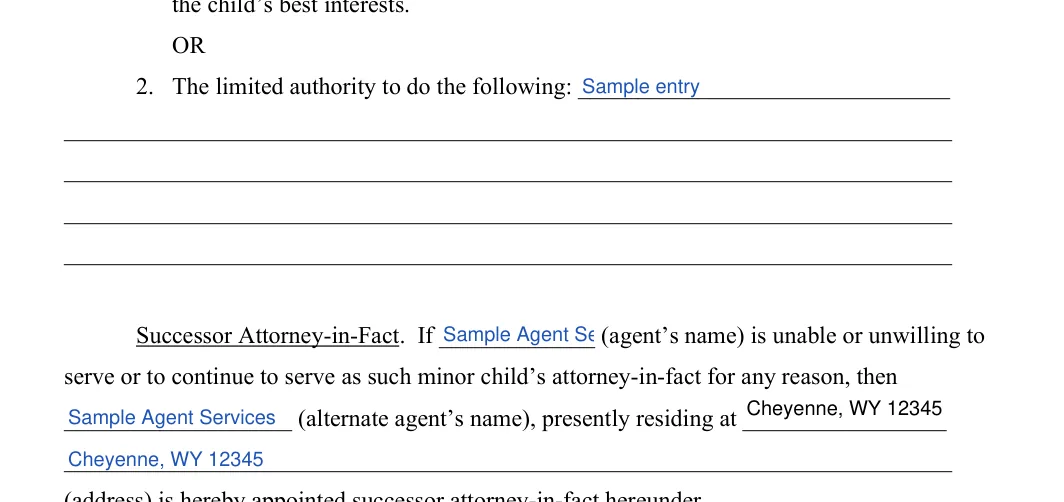
The successor agent line names a backup who steps in if the first agent cannot. A power of attorney terminates when the agent dies, becomes incapacitated or resigns and the document names no other agent to act (Wyo. Stat. Ann. § 3-9-110). A successor agent keeps the arrangement in place if that happens.
The form offers two choices of authority: the first item grants every power the parent can delegate, and the second limits the agent to the powers the parent writes on the lines.
The first item covers decisions about medical treatment, education, care, housing and the child's general welfare. It suits a long absence, when the agent will handle everything the parent normally would.
The second item is a limited power of attorney. It suits a narrow need, such as signing school permission slips during a short trip. Each power on the lines should be written in plain words so a school or doctor can read exactly what the agent may decide.
The form has a start date and an end date, and the power of attorney runs between them unless something ends it sooner. Leaving the start date blank means the power is effective when signed, unless the form names a later date or event (Wyo. Stat. Ann. § 3-9-109).
A power of attorney terminates when any of these happens, as Wyo. Stat. Ann. § 3-9-110 lists:
A power of attorney is durable unless it expressly provides that the principal's incapacity terminates it (Wyo. Stat. Ann. § 3-9-104). A parent who wants the power to stop on their own incapacity has to say so in the document. This rule comes from Wyoming's general power of attorney act, which applies to all powers of attorney except four kinds, one of them a power to make health care decisions (Wyo. Stat. Ann. § 3-9-103), so it does not reach the form's medical treatment power.
The parent can end the arrangement by revoking the power of attorney, one of the termination events in Wyo. Stat. Ann. § 3-9-110. A new power of attorney does not revoke an earlier one unless the new document says that the earlier one, or all others, are revoked (Wyo. Stat. Ann. § 3-9-110).
Termination does not bind an agent or another person who acts in good faith without actual knowledge of it (Wyo. Stat. Ann. § 3-9-110). Tell the agent, the school and the doctor in writing when you revoke the form, and ask for the copies back.
Title 3 of the Wyoming Statutes has no separate article on a parent's power of attorney for a child. Its article on temporary guardianship for educational, medical care and dental care purposes is a court appointment: a caregiver of a child may petition for it (Wyo. Stat. Ann. § 3-2-302). A caregiver there is a person, other than a natural parent or legal guardian, who is at least eighteen (18) years of age and is the primary physical custodian and a relative of a minor child (Wyo. Stat. Ann. § 3-2-301). These are the general power of attorney act's rules for the form's school, care and housing powers. The act applies to all powers of attorney except four kinds, and a power to make health care decisions is one of them (Wyo. Stat. Ann. § 3-9-103), so these rules do not cover the form's medical treatment power:
The medical treatment power has no rule on this page: its sources do not settle which Wyoming section governs a parent's delegation of a child's medical care. Ask the child's doctor or clinic what they accept before the agent relies on that power.
| Item | Detail |
|---|---|
| Document Name | Wyoming Minor Child Power of Attorney Form |
| Other Name | Wyoming Parental Power of Attorney |
| Who Grants the Power | Parent, court-appointed guardian or court-appointed conservator |
| Duration | Until the end date on the form, or earlier when the parent revokes it (Wyo. Stat. Ann. § 3-9-110) |
| Acknowledgment | A signature is presumed genuine if acknowledged before a notary public (Wyo. Stat. Ann. § 3-9-105) |
| Available Formats | Adobe PDF |
The Wyoming minor child power of attorney form runs over three pages, in the order of the steps below: the parties, the powers, the dates, the signatures and the acknowledgment. Gather every name, address and date of birth before you start.
The screenshots under each step show the FormsPal Wyoming Minor Child Power of Attorney template filled with sample entries in blue, so you can see where each answer goes. The names, addresses, dates and amounts are examples only.

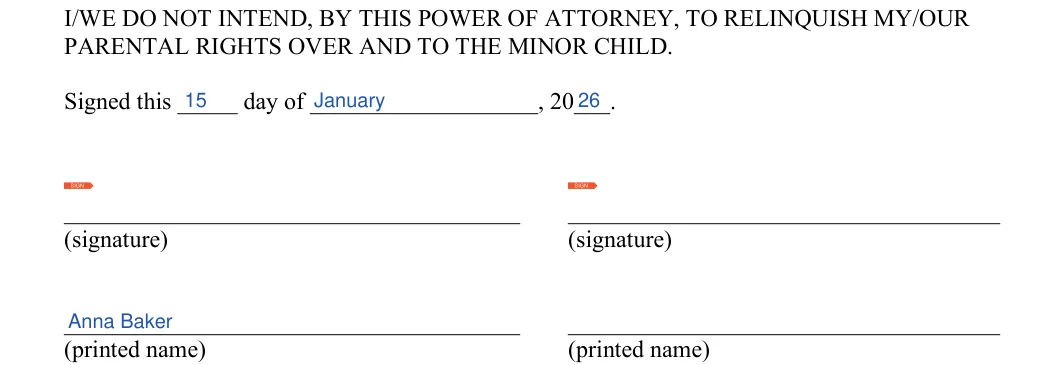
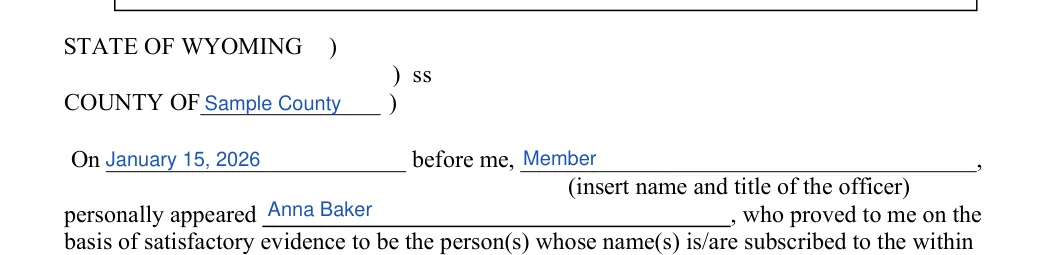

The Wyoming minor child power of attorney is signed by the parent and acknowledged before an officer, and a signature acknowledged before a notary public is presumed genuine if the parent makes that acknowledgment (Wyo. Stat. Ann. § 3-9-105). Print the pages and keep them together before the signing.
A photocopy or an electronically sent copy has the same effect as the original, except where other law provides otherwise (Wyo. Stat. Ann. § 3-9-106). Keep the signed original somewhere safe.
The most common slips on the Wyoming minor child power of attorney are a blank end date, a nickname in place of a full name, and an empty successor agent line. Read the form once more before anyone signs, and ask the agent and the other parent to check their own details too.
A Wyoming power of attorney is signed by the principal, or by another person only if the principal directs it and is consciously present (Wyo. Stat. Ann. § 3-9-105). A signature acknowledged before a notary public is presumed genuine if the principal makes that acknowledgment, under the same section.
The form includes a notary acknowledgment block on page 3, and Wyoming presumes a signature genuine if the parent acknowledges it before a notary public (Wyo. Stat. Ann. § 3-9-105). Completing that block before a notary gives the signature that presumption.
No. The statement above the signatures says the parent does not intend to give up parental rights; the form only lends authority to the agent for a period.
The agent does not sign this form. A person accepts appointment by acting as agent or by other conduct showing acceptance, except where the power of attorney provides another way (Wyo. Stat. Ann. § 3-9-113).
A power of attorney terminates when the principal dies (Wyo. Stat. Ann. § 3-9-110). The agent's authority ends with it, and the child's care then follows other arrangements.
Yes. Type your answers in Adobe Acrobat or the PDF editor, or print the form and write the answers by hand. Sign it on paper in front of the notary.
General information, not legal or tax advice.
