
Updated:
An unsecured promissory note is a written repayment promise without collateral. The note records the loan amount, the interest rate, the payment plan and the maturity date. The note suits a personal or family loan, especially one with a short term.
Key facts
Build Your Document
Answer a few simple questions to make your document in minutes
Save and Print
Save progress and finish on any device, download and print anytime
Sign and Use
Your valid, lawyer-approved document is ready
An unsecured promissory note is a signed promise to repay a loan that no asset backs: the borrower pledges no car, house or account, so the note rests on the borrower's word and credit record.
The note names two parties. The borrower, also called the maker, promises to pay. The lender, also called the holder or payee, receives the payments. The note puts the principal, the interest rate, the schedule and the payoff date on one signed page.
A promissory note can also be a negotiable instrument, a paper the lender can transfer to a buyer. W. Va. Code § 46-3-104(a), for example, defines a negotiable instrument as an unconditional promise or order to pay a fixed amount of money, with or without interest, if it meets the conditions the section lists, such as being payable to bearer or to order.
An unsecured note can follow one of five payment structures: fixed installments, installments with a balloon final payment, fully amortized payments, a single lump sum, or payment on the lender's demand.
An installment note splits the debt into equal payments due each month or each quarter. Every installment carries part of the principal and part of the interest, and each one falls due on a date the note names.
A balloon note sets regular installments that do not pay off the whole balance, then one larger final payment on the maturity date. The borrower pays less each month and owes the remaining balance at the end. On the form on this page, the fixed installment box holds the agreed installment, and the Maturity Date line holds the day the balloon falls due.
An amortized note spreads the principal and interest over a set number of years, so the last scheduled payment clears the debt. An amortization schedule lists each payment and how much of it goes to interest and to principal. The schedule is attached to the signed note.
A lump-sum note has the borrower repay the principal and the interest in one payment on the due date. Short loans often use it.
A demand note names no fixed due date: the borrower repays when the lender asks. The note can still set a lock-in period at the start, during which the lender agrees not to demand payment.
A promissory note's interest rate is the term state usury rules limit most often: a rate above a state's cap can cost the lender more than the excess interest: under Va. Code Ann. § 6.2-303, a contract made in violation of that section is void and no person has the right to collect its principal or interest.
The table lists the caps quoted from each state's own code, with the condition each cap carries. A state missing from the table can still cap rates; read its code before writing a rate on the note.
| State | Highest rate a written note can set | Condition | Section |
|---|---|---|---|
| Arizona | Any rate the parties agree to | Only when the rate is contracted for in writing, for a loan other than medical debt | Ariz. Rev. Stat. 44-1201(A)(2) |
| California | 10 percent per annum | Only when the loan is for use primarily for personal, family or household purposes | Cal. Const. art. XV, § 1 |
| Colorado | 45 percent per annum | Only when the promissory note or other instrument of writing stipulates the rate | Colo. Rev. Stat. § 5-12-103(1) |
| District of Columbia | 24% per annum | Only when an instrument in writing for payment at a future time sets the rate | D.C. Code § 28-3301 |
| Florida | 18 percent per annum simple interest | Only for a loan of $500,000 or less | Fla. Stat. § 687.03 |
| Kansas | 15% per annum | In a promissory note or other instrument of writing, unless otherwise specifically authorized by law | Kan. Stat. Ann. § 16-207 |
| Missouri | Ten percent per annum | When agreed in writing; when the "market rate" exceeds ten percent per annum, the parties can agree in writing to a rate up to the market rate | Mo. Rev. Stat. § 408.030 |
| Nevada | Any rate the parties agree to | Except as subsection 2 of the section provides; the parties specify the rate in writing | Nev. Rev. Stat. 99.050(1) |
| New York | Sixteen per centum per annum | The maximum rate provided for in section 5-501 of the general obligations law | N.Y. Banking Law § 14-a |
| Ohio | Eight per cent per annum, payable annually | In a promissory note or other instrument of writing, except where the section exempts the note, such as an original principal over one hundred thousand dollars | Ohio Rev. Code Ann. § 1343.01 |
| South Dakota | No maximum | When the parties set the rate by written agreement, unless another part of the code sets a maximum | S.D. Codified Laws § 54-3-1.1 |
| Texas | 10 percent a year | Except as otherwise provided by law | Tex. Fin. Code § 302.001 |
| Vermont | 12 percent per annum, computed by the actuarial method, as the general rate; for an installment loan not otherwise limited, up to 24 percent per annum on the first $1,000.00 of the aggregate balance outstanding and 12 percent per annum on the balance in excess of $1,000.00, or 18 percent annual percentage rate on the aggregate balance outstanding, whichever is higher | The general rate applies except as specifically provided by law; the installment loan rate applies to an installment loan not otherwise limited by subdivisions (1)-(4) of the subsection | 9 V.S.A. § 41a |
| Virginia | 12 percent per year | Except as otherwise permitted by law | Va. Code Ann. § 6.2-303 |
A California unsecured promissory note follows Cal. Const. art. XV, § 1, which caps the rate at 10 percent per annum when the loan is for use primarily for personal, family or household purposes. For any other use, Cal. Const. art. XV, § 1 caps the rate at the higher of 10 percent per annum or 5 percent per annum plus the rate the section names for the 25th day of the month before the contract. Cal. Const. art. XV, § 1 also bars a lender from receiving more than the authorized interest by charging any fee, bonus, commission, discount or other compensation.
A note with a blank rate line can still carry interest, because several states set a rate that applies when the parties agree on none in writing:
An unsecured promissory note differs from a secured one in a single term, collateral, and that term changes the lender's risk and often the interest rate.
A secured promissory note names an asset, such as a car or equipment, that backs the loan. An unsecured note names none, so the lender relies on the borrower's promise and credit record.
| Point | Secured note | Unsecured note |
|---|---|---|
| Collateral | An asset backs the loan | No asset backs the loan |
| Risk for the lender | Lower | Higher |
| Typical interest rate | Often lower | Often higher |
| Common fit | Larger loans or weaker credit | Short loans between people who trust each other |
A secured note fits a large loan, a long term or a borrower with weak credit. A note becomes secured when the parties add a pledge of collateral, usually in a separate security agreement or a mortgage. The promissory note family covers both versions.
An unsecured promissory note fits a loan between people who trust each other, where the lender accepts the borrower's promise and credit record in place of collateral. The note keeps the loan simple and puts every term in writing. It suits these situations:
An unsecured promissory note shifts the risk to the lender: the borrower keeps full use of every asset, and the lender usually asks a higher rate for lending without a pledge.
The note gives the borrower these advantages:
The note also has drawbacks for the borrower:
The note gives the lender these advantages:
The note also has drawbacks for the lender:
An unsecured promissory note needs five sets of details agreed in advance, so neither party stops halfway through the form. Collect these items first:
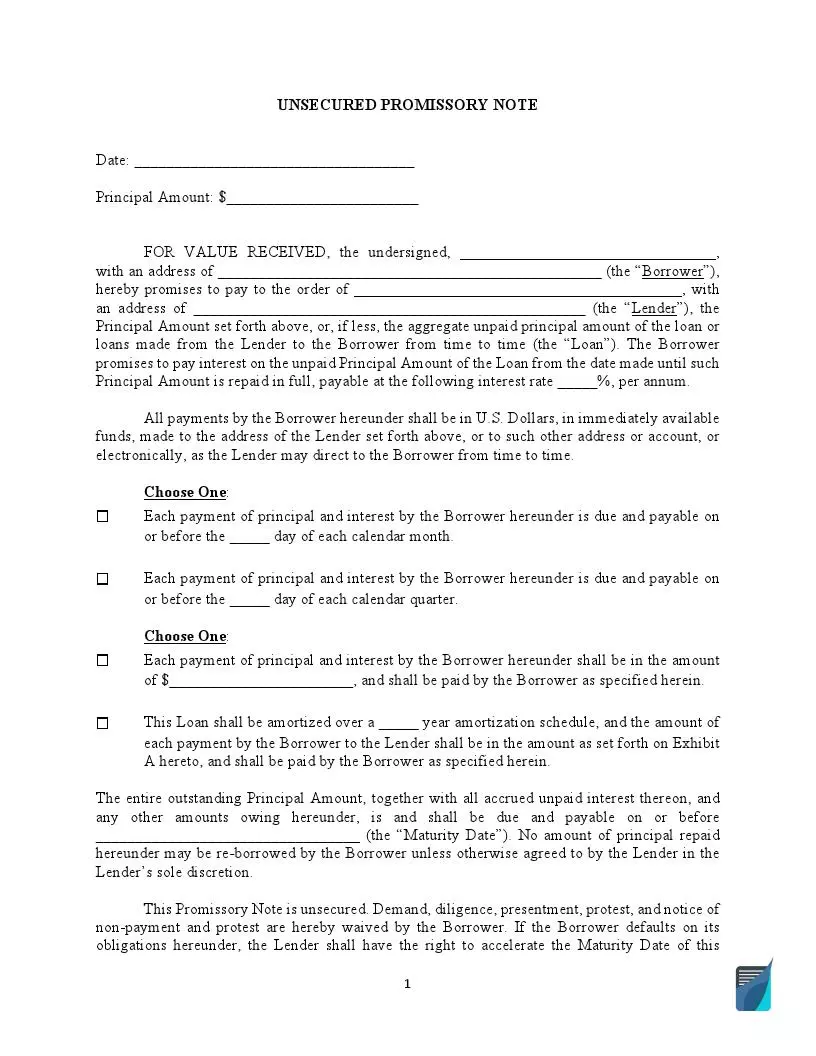
The unsecured promissory note on this page has six parts to complete in order, from the date line at the top to the lender's signature block. Fill it in on screen with the online PDF editor, or print it and write in the blanks by hand.
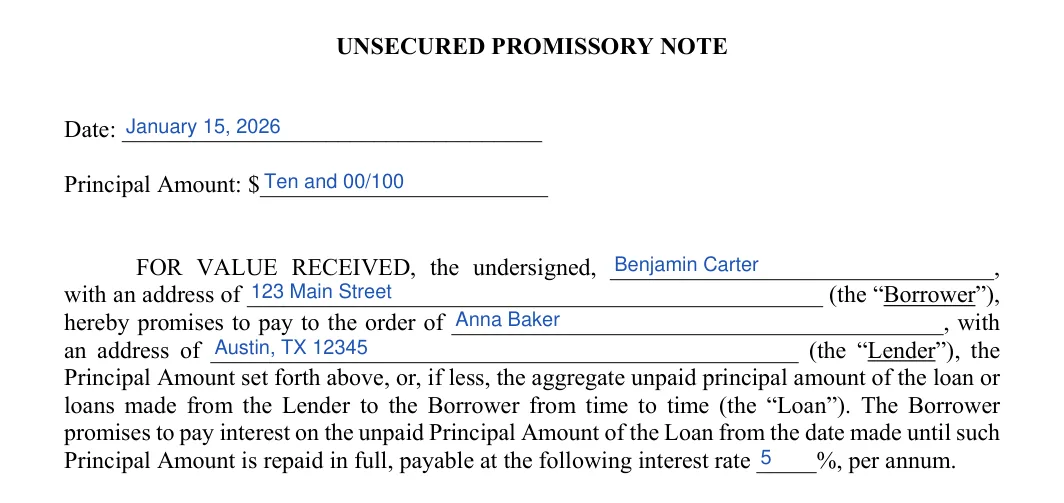
The screenshots under each step show the FormsPal Unsecured Promissory Note template filled with sample entries in blue, so you can see where each answer goes. The names, addresses, dates and amounts are examples only.
Enter the date, principal amount, parties and interest rate
Write the full date of the loan on the Date line at the top left, for example November 20, 2026. Write the amount being lent after the $ sign on the Principal Amount line, for example 10,000. Enter the full names and addresses of both parties including city, state, and zip code. Write the interest rate as a yearly percent on the interest rate line. It should be in accordance with the maximum state limits; the state rate table lists the caps.
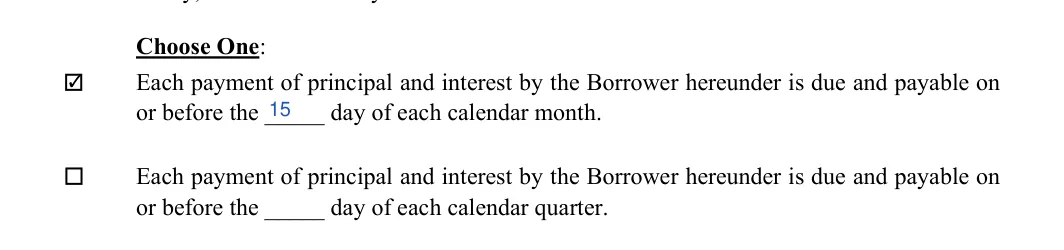
Choose the payment day: monthly or quarterly
Check one box only. For monthly installments, check the first box and write the day of the month, for example "27th day of each month." For quarterly installments, check the second box and write the day of the quarter. A quarter is three months.
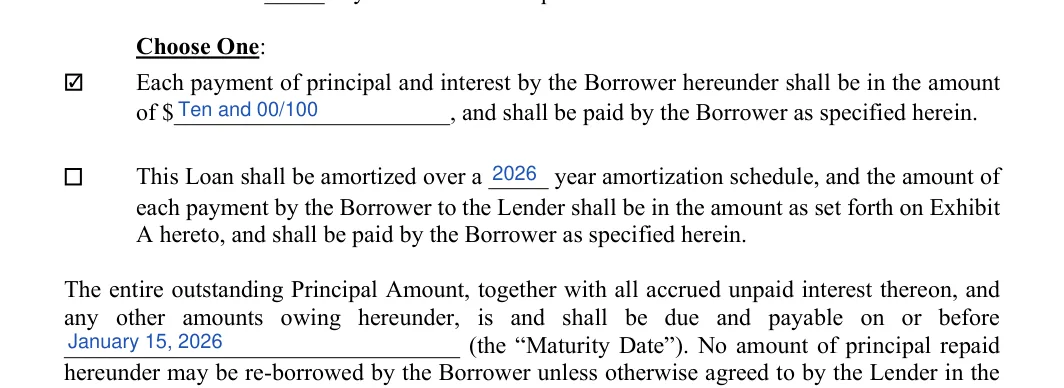
Pick fixed payments or amortization, then add the maturity date
Check one box only. For fixed installments, check the first box and enter the installment amount, principal and interest together. For an amortized loan, check the second box, enter the number of years and attach the amortization schedule to the note. For a balloon note, enter the agreed installment in the first box.
Then write the maturity date of the loan on the Maturity Date line. All payments due must be made by this date by the borrower.
Check the maturity date and name the governing law
Look back at the Maturity Date line from the last step to make sure it is filled in. On page 2, find the State line near the end of the note. Then, enter the state name whose code will be the governing law in case there are disputes between the parties.

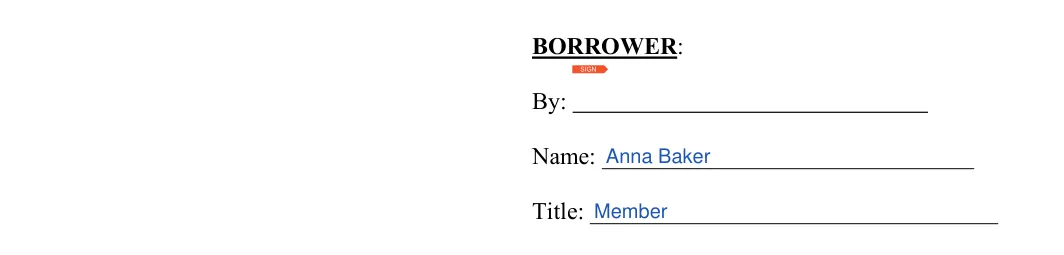
Sign the borrower block
Under BORROWER, sign on the By line, then print the Name and Title.
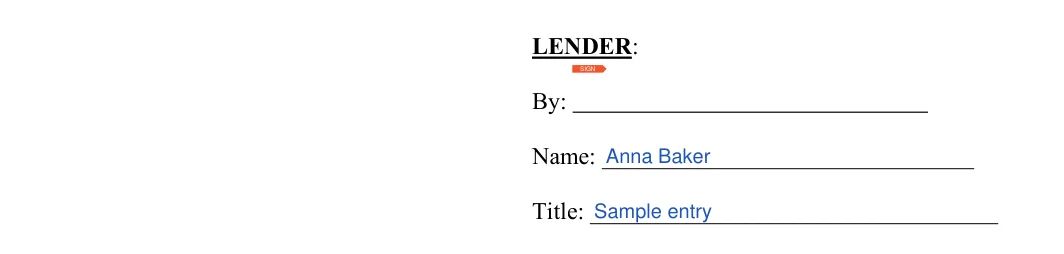
Sign the lender block
Under LENDER, sign on the By line, then print the Name and Title.
A completed note becomes a signed record of the loan once both parties check it, sign it and keep a copy:
A signed note works best with a simple payment routine that both the borrower and the lender follow from the first payment to the last:
These answers cover what an unsecured note means, what happens after a missed payment, what can void a note and whether a note counts as a security.
An unsecured note is a debt that no collateral backs. The lender holds only the borrower's written promise to pay, not a claim on any particular asset.
Yes, unsecured promissory notes can be enforced under the law. The missing collateral does not cancel the borrower's promise. After a default, the lender can take these steps:
A rate above the state cap voids a note only where the state's code says so: a contract made in violation of Va. Code Ann. § 6.2-303 is void, and no person has the right to collect, receive or retain any principal, interest, fees or other charges in connection with it. When a lender contracts for a greater rate than Kan. Stat. Ann. § 16-207 authorizes, the lender forfeits all interest contracted for in excess of the authorized amount, plus a further sum; Kan. Stat. Ann. § 16-207 sets that penalty and does not, in the words quoted here, void the note. If a borrower pays a rate greater than Mo. Rev. Stat. § 408.030 permits, the borrower can recover twice the interest paid, provided that the action is brought within five years; Mo. Rev. Stat. § 408.030 gives that recovery and does not, in the words quoted here, void the note.
An unsecured promissory note can be a security, depending on why it is issued and to whom. In 1990, the United States Supreme Court decided that unsecured demand notes sold by a farmer cooperative to raise capital are considered securities. A note sold to many investors to raise money looks like an investment, while a personal loan between two people does not. A note found to be a security falls under securities rules, so an issuer selling notes to investors should get advice first.
A loan is the money lent; a loan note is the document that records it. A promissory note is a short loan note: it states the promise to pay and the terms. A longer loan agreement can add clauses such as covenants, events of default and representations.
An example shows how the terms fit together on one note:
Example only: Alex Morgan (borrower) promises to repay Casey Reed (lender) 6,000 dollars at 6 percent a year, in monthly installments on the 15th day of each month, with a maturity date of June 15, 2028. No collateral backs the loan. Both parties sign, and each keeps a copy.
The maturity date is the day by which the whole loan, with any interest, is to be paid off. It sits on page 1 of the template, right after the payment choices.
General information, not legal or tax advice.
