
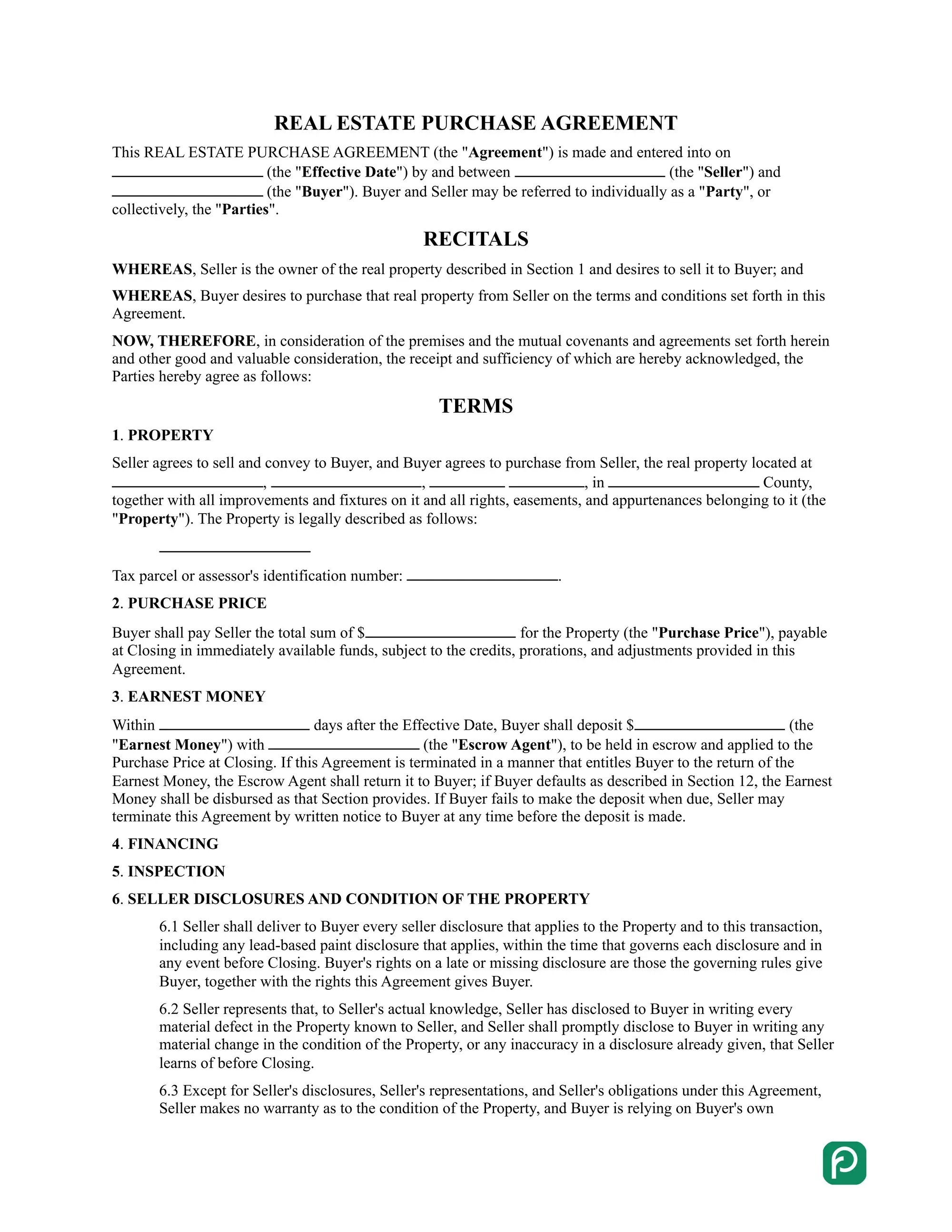
An Alabama real estate purchase agreement is a written contract for the sale of a home or other real property. The buyer agrees to pay a set price, and the seller agrees to transfer the property. A contract to sell land must be in writing and signed by the party it is enforced against.[1] Use this free Alabama real estate purchase agreement template to fill in the parties, the property, the price and the closing terms, then print or download it.
Last Updated: October 2026. This guide is reviewed and updated regularly to reflect current Alabama law. If you notice an error or outdated information, please contact us.
Build Your Document
Answer a few simple questions to make your document in minutes
Save and Print
Save progress and finish on any device, download and print anytime
Sign and Use
Your valid, lawyer-approved document is ready
A residential purchase and sale agreement is the contract for the sale of a home. The buyer fills out the purchase agreement to make an offer. The seller can accept it, turn it down or negotiate.
When both sides agree on the terms, they sign one final version. Our printable real estate sales contract pages cover other states too.
Purchase agreements differ, but the main parts are the same:
A few habits make a real estate purchase agreement easier to finish and easier to read later:
If you work with a real estate licensee, the licensee must give you a written disclosure form for your signature that describes the types of brokerage services available. This happens as soon as reasonably possible and before the licensee discloses any confidential information to another person (Ala. Code § 34-27-82).[2]
Each offer to purchase must also prominently display a completed and initialed representation disclosure clause. The clause shows whether the listing licensee is the seller's agent, a dual agent or a transaction facilitator assisting the seller, and whether the selling licensee is the buyer's agent, a dual agent or a transaction facilitator assisting the buyer (Ala. Code § 34-27-82).[2]
A contract for the sale of land must be in writing. Under Ala. Code § 8-9-2, the agreement, or a note or memorandum of it, must be written and must state the consideration. The party it is enforced against must sign it, or a person that party authorized in writing.[1]
Here is the statute's own wording on that point:
Every agreement is void unless such agreement or some note or memorandum thereof expressing the consideration is in writing and subscribed by the party to be charged therewith or some other person by him thereunto lawfully authorized in writing
In plain words, a valid Alabama land contract needs three things:
The rule covers every contract for the sale of land and any interest in land. A lease for a term of one year or less falls outside it.[1] Because it covers every land sale, it reaches commercial deals as well.
For questions about your own sale, ask a licensed attorney.
A commercial purchase and sale agreement covers the sale of business or investment property. It works like the residential version, but buyers often ask for stricter terms. The writing and signature rule in Ala. Code § 8-9-2 applies here too.[1]
A commercial agreement usually includes:
Commercial buyers often want an inspection clause. Set the date and time of the inspection in the contract and name the specialist who will do it. You can also say what happens after the results, for example that the owner will fix specific defects at their cost.
If a real estate agent is involved, ask early which side the agent represents and get the answer in writing. Do not rush to sign the first draft. Once signed, it is hard to change, so read it closely, get legal advice, and sign only when every condition is clear and fair to you.
Alabama statutes are silent on several disclosure points. There is no Alabama statute on when or how a seller delivers a disclosure, or on which transfers are exempt. Federal law requires the seller of housing built before 1978 to give the buyer a lead hazard information pamphlet and disclose any known lead-based paint or lead-based paint hazards before the buyer is bound by the contract (42 U.S.C. § 4852d).[4] Housing for the elderly or persons with disabilities and 0-bedroom dwellings are exempt if no child under 6 lives there and none is expected to live there (42 U.S.C. § 4851b).[5]
Alabama courts apply caveat emptor (let the buyer beware) to sales of used real estate. The Supreme Court of Alabama has held that the doctrine ordinarily relieves a seller of any duty to disclose defects to a buyer, with three exceptions. A seller must disclose known defects when a fiduciary relationship exists between the buyer and the seller, must disclose material defects affecting health or safety that the buyer does not know about and cannot readily observe, and must disclose when the buyer asks directly about a material defect or condition of the property (Kidd v. Benson, 2020).[6]
Without a statute to follow, put what matters in the purchase agreements you sign. Ask in writing about known defects, attach the answers to the agreement, and have an inspector check the property.
Hiding a material fact that a party is obliged to share is fraud under Alabama law. That obligation can come from a confidential relationship between the parties or from the particular circumstances of the case (Ala. Code § 6-5-102).[3]
These short answers cover the writing rule for land contracts in this state. Each one follows Ala. Code § 8-9-2, and the source is listed at the end of the page so you can read the statute yourself.
The contract to buy a house must be in writing. The statute covers any contract for the sale of land or an interest in land, except leases for a term of one year or less. The writing needs three things:[1]
Only in a narrow case. An unwritten agreement to sell land is void unless the buyer has paid the purchase money, or a portion of it, and has been put in possession of the land.[1] A signed written contract is the safer route.
Yes. The statute covers every contract for the sale of land, so a commercial purchase agreement needs a signed writing too.[1] A free template is a good starting point, and an attorney can adapt it to the deal.
General information, not legal or tax advice.
