
An Arizona purchase agreement is a written contract in which a seller agrees to transfer real property to a buyer for a stated price and on stated terms. People use it for house, condo, land and business real estate sales to set the price, the earnest money, the closing terms and the conditions. It is separate from the seller disclosure, which Ariz. Rev. Stat. § 33-422 describes for some sales.[1]
Last Updated: October 2026. This guide is reviewed and updated regularly to reflect current Arizona law. If you notice an error or outdated information, please contact us.
Build Your Document
Answer a few simple questions to make your document in minutes
Save and Print
Save progress and finish on any device, download and print anytime
Sign and Use
Your valid, lawyer-approved document is ready
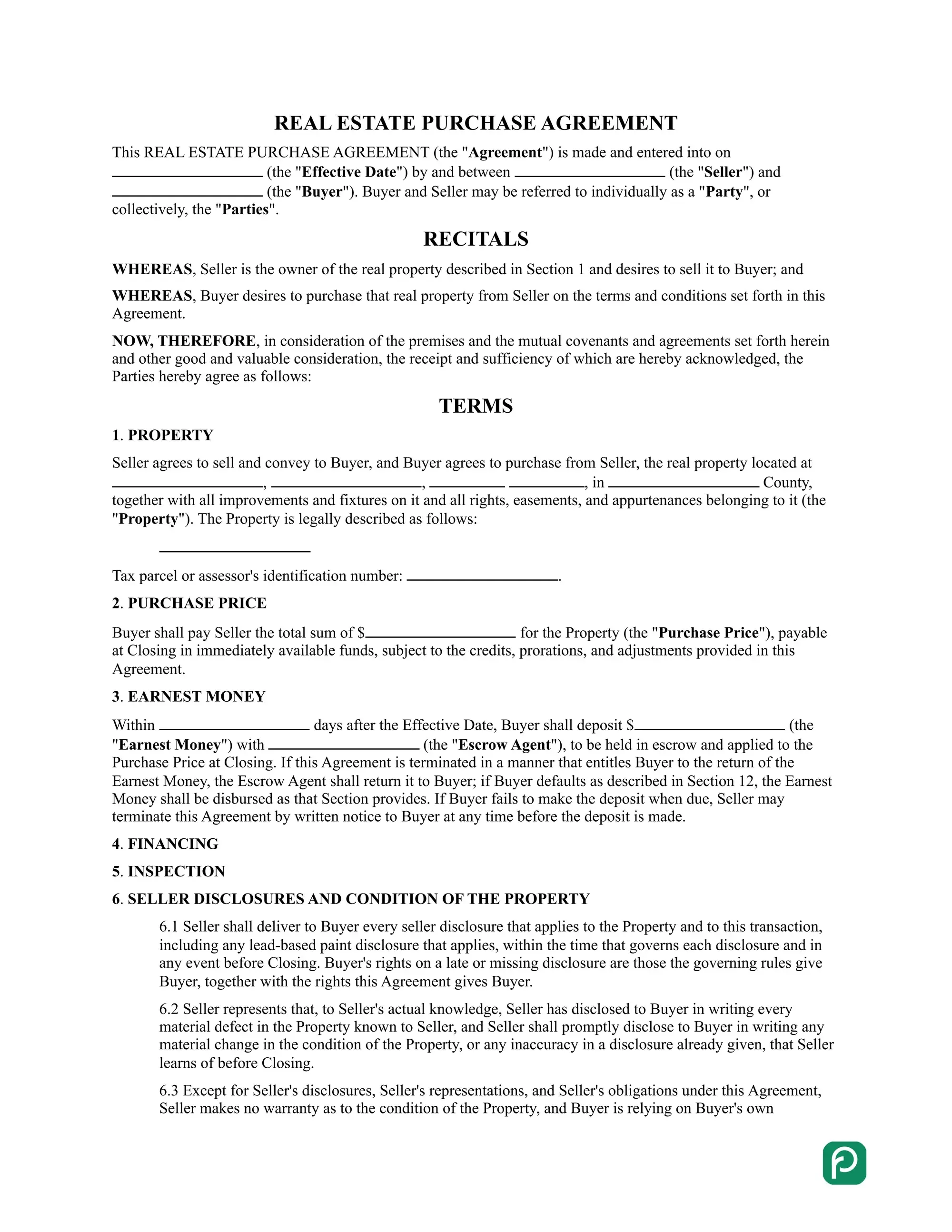
A residential purchase agreement for an Arizona home, condo or lot records who is buying and selling, what is being sold, the price, and the terms to meet before closing. Do not use the first sample you find online. Edit the purchase agreement so it fits both sides and the deal itself, then have both parties date and execute it.
Start from a printable real estate purchase agreement and change what the deal needs. You can create the FormsPal template online for free and download it as a PDF or Word file. It costs nothing to review, edit and print the agreement.
A complete real estate purchase agreement in Arizona usually includes:
Before you finalize the agreement, check that the seller really owns the home or land. A title company can confirm this.
The Arizona Association of Realtors publishes its own residential and commercial contract forms. You can compare them with our free Arizona real estate purchase agreement before you decide which one fits your sale. See the seller disclosure section below for one rule that applies to some Arizona sales.
A commercial purchase agreement for Arizona office, retail, industrial or investment real estate has the same basic structure as a residential one. It names both parties, the property, the price and payment terms, and the conditions each side must meet. It also gives the buyer time to check that the property fits its plans.
This kind of agreement usually covers:
The inspection period matters most in business deals. Buyers usually buy with one purpose in mind, so they need time to confirm the site can serve it. State the length of that period in the agreement.
Both sides should date the last page. Treat the agreement as unfinished until every signature is on it.
A residential purchase agreement covers a home, condo or lot, while a commercial purchase agreement covers office, retail, industrial or investment real estate. The structure of the two agreements is similar. The main differences are in the checks the buyer makes before closing and in the extra terms a business deal tends to need.
| Point | Residential purchase agreement | Commercial purchase agreement |
|---|---|---|
| What is sold | A house, condo, duplex or lot | Office, retail, industrial or investment real estate |
| Buyer's main concern | The condition and price of a place to live | Whether the site can serve the planned business use |
| Checks before closing | Home inspection and a title check | A longer inspection period and a title check |
| Extra terms | Disclosures given to the buyer | An agency disclosure and election, plus any lease terms that come with the site |
If you are unsure which agreement fits your sale, start with the real estate purchase agreement and add the terms your deal needs.
Arizona's seller disclosure statute applies to a seller of five or fewer parcels of land, other than subdivided land, in an unincorporated area of a county. That seller must complete a written affidavit of disclosure and give it to the buyer at least seven days before the transfer of the property. The buyer must acknowledge receipt.[1]
A seller of five or fewer parcels of land, other than subdivided land, in an unincorporated area of a county and any subsequent seller of such a parcel shall complete and furnish a written affidavit of disclosure to the buyer at least seven days before the transfer of the property and the buyer shall acknowledge receipt of the affidavit.
The rule applies to the original seller and to any later seller of such a parcel. A trustee of a deed of trust who sells at a trustee's sale is not counted as a seller here. Neither is an officer who sells at an execution sale. If the seller is a trustee of a subdivision trust, the beneficiary of the trust must provide the affidavit.[1]
This statute covers one kind of sale. If your sale does not fit that description, this affidavit rule may not be the one that applies to you. Ask an Arizona real estate attorney or agent which disclosures your sale needs.
The affidavit must contain all of the disclosures the statute lists. The seller completes it. It must meet the requirements of section 11-480 and follow substantially the form in the statute. It must be written in twelve-point type.[1]
The statute also sets what happens after the buyer receives the affidavit:
Keep proof of the date the buyer received the affidavit. The five-day rescission period counts from that date, and the seven-day delivery period counts back from the transfer.[1] To count days, use our deadline calculator.
Sellers often give buyers more than the affidavit. Ask your agent or attorney which of these documents fit your property:
Before you finalize an Arizona real estate purchase agreement, read every term twice and compare it with the deal you actually made. Confirm who owns the real estate, what is included in the sale, and who pays for each cost. A short review now is cheaper than a dispute after closing.
After closing, ownership is usually transferred with a deed. FormsPal offers an Arizona quitclaim deed and an Arizona general warranty deed for that step. If appliances or other personal items change hands with the home, an Arizona bill of sale can record that part of the deal. Ask an Arizona real estate attorney or agent how Arizona law applies to your sale.
Two more tools can help with the paperwork. If a party cannot attend closing, a real estate power of attorney can let a trusted person act for them. If you want extra proof of who executed a document, an Arizona notary acknowledgement adds a notary's confirmation to it.
These short answers cover the Arizona seller disclosure affidavit in Ariz. Rev. Stat. § 33-422. The statute covers one type of sale, so ask an Arizona real estate attorney or agent about any other disclosure duty.
A seller of five or fewer parcels of land, other than subdivided land, in an unincorporated area of a county must complete a written affidavit of disclosure for the buyer. The affidavit must:
For a sale the statute covers, the seller must furnish the affidavit to the buyer at least seven days before the transfer of the property. The buyer must acknowledge receipt of it.[1]
For a sale the statute covers, the buyer has the right to rescind the sales transaction for five days after the affidavit of disclosure is furnished to the buyer.[1]
General information, not legal or tax advice.
