
A Colorado purchase agreement for real estate is a written contract in which a seller agrees to transfer a home, land or commercial property to a buyer. It records the buyers, the sellers, the home or land, the price, the earnest money and the final terms. State law adds disclosure rules for residential sales, such as a special taxing district notice and radon test results.[1.1][1.5]
Last Updated: October 2026. This guide is reviewed and updated regularly to reflect current Colorado law. If you notice an error or outdated information, please contact us.
Build Your Document
Answer a few simple questions to make your document in minutes
Save and Print
Save progress and finish on any device, download and print anytime
Sign and Use
Your valid, lawyer-approved document is ready
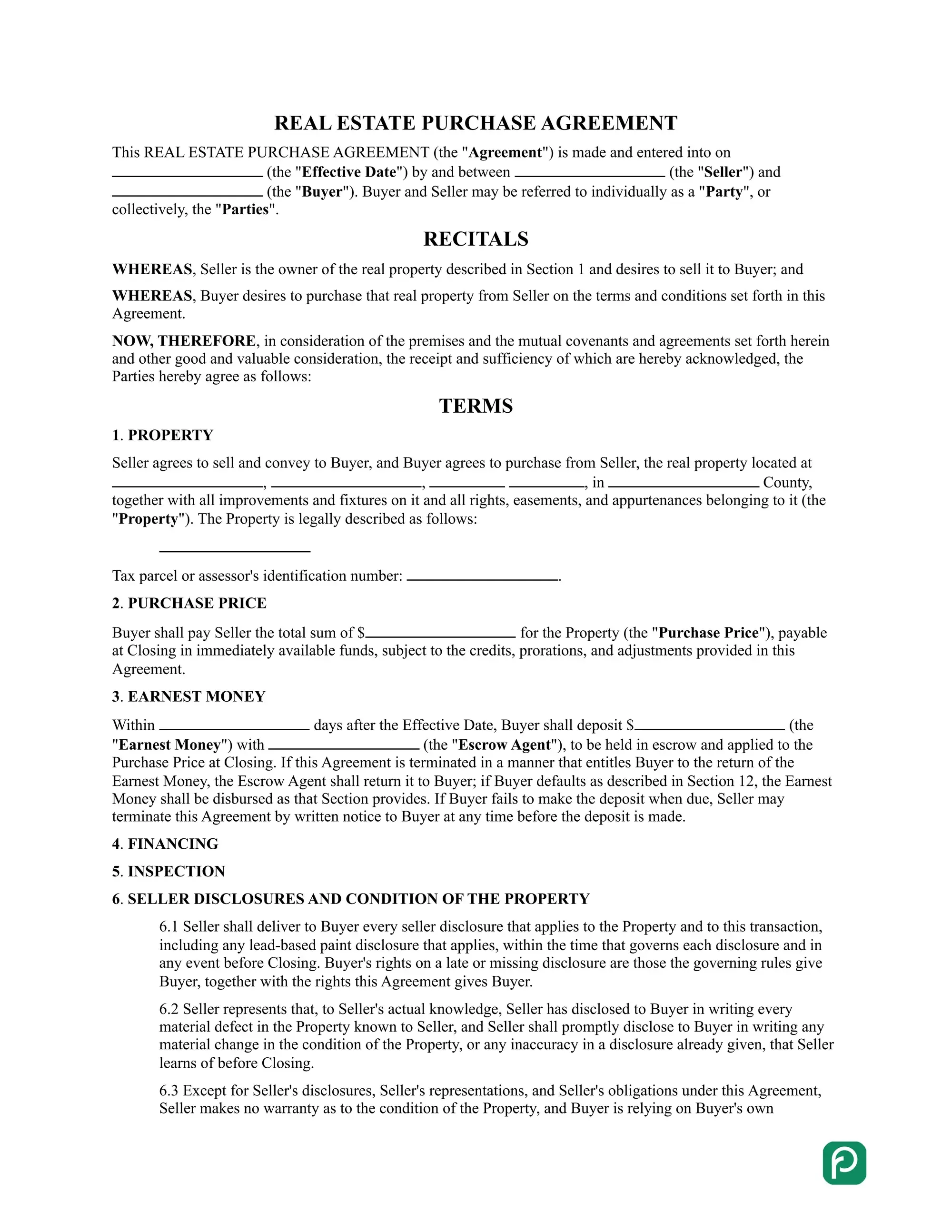
A residential purchase agreement is the contract for buying or selling a home, condo or lot in Colorado. It names the buyers and the sellers, describes the home or land, and sets the price and the terms both sides meet before the deal closes. You can create the FormsPal template online and download it as a free PDF or Word file.
A standard real estate sales contract usually includes:
An earnest money deposit shows the buyer's interest in the deal. The amount is agreed between the buyer and the seller and written into the contract. Ask a local title company or real estate agent how deposits are usually held. After you download the PDF, you can fill it in with our online PDF editor.
A commercial purchase and sale agreement covers office, retail, industrial and investment real estate. It has the same basic structure as a residential contract. It names the buyer and the seller, the site, the price and payment terms, and the conditions each side meets before the deal closes. The disclosure rules in the next section concern residential real property.
Commercial agreements usually cover:
Buyers of commercial real estate usually have a specific use in mind. Many agreements give the buyer time for an inspection to confirm that the site fits that use. If you are not comfortable negotiating the terms yourself, a local real estate agent or attorney can help. Both sides then sign and date the agreement. Commercial transactions often involve related documents, so ask your attorney which ones to include.
Colorado real estate disclosure laws set several requirements for sellers of residential real property. They reach contracts, listing agreements and the seller's disclosure statement. Each rule below comes from Colorado Revised Statutes sections 38-35.7-101 to 38-35.7-112.[1]
The rules cover:
Every contract for buying a home or other residential real estate must carry a special taxing district disclosure in bold-faced type. The statement must be clearly legible and follow the form in the statute. A seller who fails to provide it is liable to the buyer for the resulting damages.[1.1]
Every contract for the purchase and sale of residential real property shall contain a disclosure statement in bold-faced type which is clearly legible and in substantially the following form: special taxing districts may be subject to general obligation indebtedness
A listing contract, contract of sale or seller's property disclosure for residential real property must disclose the source of potable water. The Colorado Real Estate Commission requires this by rule, and the disclosure follows substantially the form in the statute.[1.3]
A residential contract of sale or seller's disclosure must carry a notice. The notice says the surface estate may be owned separately from the underlying mineral estate. It also says oil and gas activity may occur on or adjacent to the land.[1.4]
The seller of residential real property must give the buyer any known information on radon test results for it.[1.5] If you are buying, ask the sellers whether a radon test has ever been done.
A buyer of residential real property has the right to test it to find out whether it was ever used as a methamphetamine laboratory. If testing finds contamination that has not been remediated to the state standard, the buyer may terminate the contract.[1.2]
This list covers the requirements in the statutes above. Your sale may involve other disclosures, so ask a Colorado real estate agent or attorney which ones apply before you sign.
Buyers often ask about more than the law lists. Common questions cover lead-based paint in an older home, the rules and fees of a homeowner association, and the details of solar panels or other energy features. Put each answer in writing, name the sellers who gave it, and keep it with your signing documents.
The state's disclosure rules for residential sales cover special taxing districts, water source, the mineral estate, radon results and methamphetamine testing. Colorado has no statute that sets when or how a seller delivers a disclosure to the buyer. Buyers and sellers should read every disclosure before signing so they understand what applies, and keep copies of all documents with the signed agreement. A title company or an attorney can review the documents if anything is unclear.
This short answer covers what happens when a Colorado seller does not disclose a known problem. For any other disclosure question, ask a Colorado real estate attorney or agent before you sign the contract.
A seller's failure to disclose a known adverse material fact affecting the property or an occupant may result in legal liability. That warning appears on the Colorado seller disclosure form for residential property from the Colorado Division of Real Estate. Whether you have a claim depends on your facts, so talk to a Colorado real estate attorney.[2]
General information, not legal or tax advice.
