
An Iowa purchase agreement is a written real estate contract in which a seller agrees to sell and a buyer agrees to buy a specific property for a set price. It records the parties, the property, the purchase price, and the earnest money deposit. Many Iowa home sales also involve a seller disclosure statement under Iowa Code chapter 558A, which is explained below. You can fill out the form online and download it as a PDF or Word file.[1]
Last Updated: October 2026. This guide is reviewed and updated regularly to reflect current Iowa law. If you notice an error or outdated information, please contact us.
Build Your Document
Answer a few simple questions to make your document in minutes
Save and Print
Save progress and finish on any device, download and print anytime
Sign and Use
Your valid, lawyer-approved document is ready
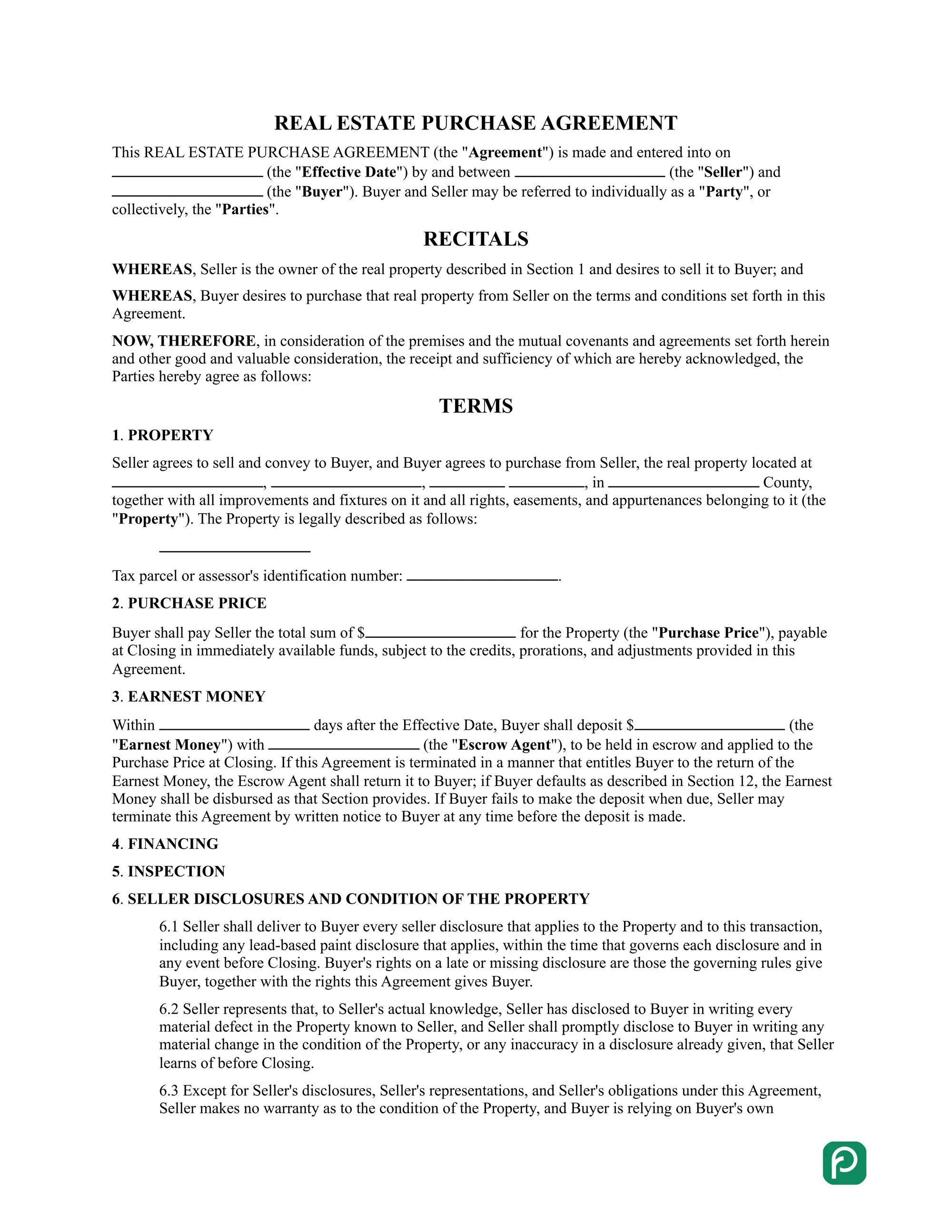
An Iowa residential purchase and sale agreement is the contract a buyer and seller sign to transfer a home. This Iowa purchase agreement form sets the price, the deposit, the closing date, and the conditions for closing. Once signed, the Iowa purchase agreement is meant to be a binding contract, so read every line first.
The PDF form is written for residential property. Its numbered sections cover:
Most buyers make the purchase price depend on conditions called contingencies. Common contingencies are a home inspection, loan approval, and an appraisal that supports the price. If a contingency is not met, the buyer may be able to end the deal, depending on how the Iowa purchase agreement is worded. Whether the property is a house, a condo, or a small rental building, the same basic terms apply.
Write N/A on any line that does not apply. That way no blank line can be read two ways.
In practice, the seller can accept the offer, decline it, or send back a counteroffer. When both sides agree on the terms, they sign and date the agreement. Buyers and sellers in other states can start from our purchase agreement pages or the fillable real estate sales contract hub.
An Iowa commercial purchase and sale agreement is the contract for buying commercial real estate, such as an office building, a store, or a warehouse. It sets the price, the earnest money deposit, and the terms both sides accept. The form on this page is written for residential property, so a commercial deal needs terms drafted for that kind of property.
In practice, the buyer posts the earnest money deposit, and the agreement states when the deposit is returned and when the seller may keep it. Many parties to a commercial sale also have a real estate lawyer review the agreement before they sign.
Commercial deals often add terms that a home sale rarely needs. Examples include:
When the sale closes, the seller transfers title with a deed. Some Iowa transfers use an Iowa quitclaim deed form for that step, while others use a different type of deed.
Iowa Administrative Code rule 193E-14.1 sets the rules for the seller's property disclosure statement. It applies to transfers of real estate subject to Iowa Code chapter 558A. It also reaches property with at least one but no more than four dwelling units, unless Iowa Code section 558A.1 exempts the transfer.[1]
A licensee here means a licensed real estate agent or broker. The rule sets these requirements:
The PDF form has sections for lead-based paint disclosures and for the property disclosure statement, so the buyer and seller can complete them with the agreement. A separate Iowa seller disclosure form is also available on FormsPal.
The seller's licensee must deliver the signed (executed) disclosure statement to a potential buyer, a potential buyer's agent, or any other third party who may represent a potential buyer. This must happen before the seller makes a written offer to sell or accepts a written offer to buy.[1]
The executed statement must be delivered to the buyer or the buyer's agent by one of these methods:[1]
Electronic delivery has an extra step. It is not complete until the transferee (the buyer) or the transferee's agent gives the transferor (the seller) written acknowledgment of receipt.[1]
A read receipt does not count. A computer-generated read receipt, facsimile (fax) delivery confirmation, or other automated return message is not acknowledgment of receipt.[1]
Yes. A buyer who does not receive the disclosure statement when it is required may revoke or withdraw the offer. The licensee must notify the buyer of that right in these words from the rule.[1]
If the disclosure statement is not delivered when required, the licensee shall notify the buyer that the buyer may revoke or withdraw the offer.
The licensee must obtain a written revocation or withdrawal from the buyer and deliver it to the seller within:
After the offer is revoked or withdrawn, any earnest money deposit must be promptly returned without liability.[1]
Before you sign an Iowa purchase agreement, check each term against your documents. A careful read helps both the buyer and the seller avoid disputes about the purchase price, the deposit, or the closing date later.
Most problems with an Iowa purchase agreement come from missing details, not from the law. Small gaps can lead to a disagreement over who owes what at closing. These are the mistakes buyers and sellers make most often.
If a buyer cannot attend the closing, an Iowa power of attorney may let a trusted person sign for them. Personal property that changes hands with the home, such as appliances, can be recorded with an Iowa bill of sale.
The Iowa rule on the seller's property disclosure statement applies to transfers of real estate subject to Iowa Code chapter 558A. The seller's licensee delivers the executed statement before the seller makes or accepts a written offer. If it is not delivered when required, the buyer may revoke or withdraw the offer, and any earnest money deposit must be promptly returned without liability.[1]
General information, not legal or tax advice.
