
A Kentucky purchase agreement is a written contract where a seller agrees to sell and a buyer agrees to buy real estate at a set price. Kentucky also has a seller disclosure statute for sales of single-family residential dwellings when a licensed professional receives compensation.[1] Use this free template to fill in the parties, the property, the price and the closing terms, then print or download it.
Last Updated: October 2026. This guide is reviewed and updated regularly to reflect current Kentucky law. If you notice an error or outdated information, please contact us.
Build Your Document
Answer a few simple questions to make your document in minutes
Save and Print
Save progress and finish on any device, download and print anytime
Sign and Use
Your valid, lawyer-approved document is ready
A residential purchase and sale agreement is the contract for the sale of a home in Kentucky. This Kentucky purchase agreement names the buyer and the seller, describes the real estate, and fixes the price and the closing terms. Once both sides sign it, it records the deal they agreed on.
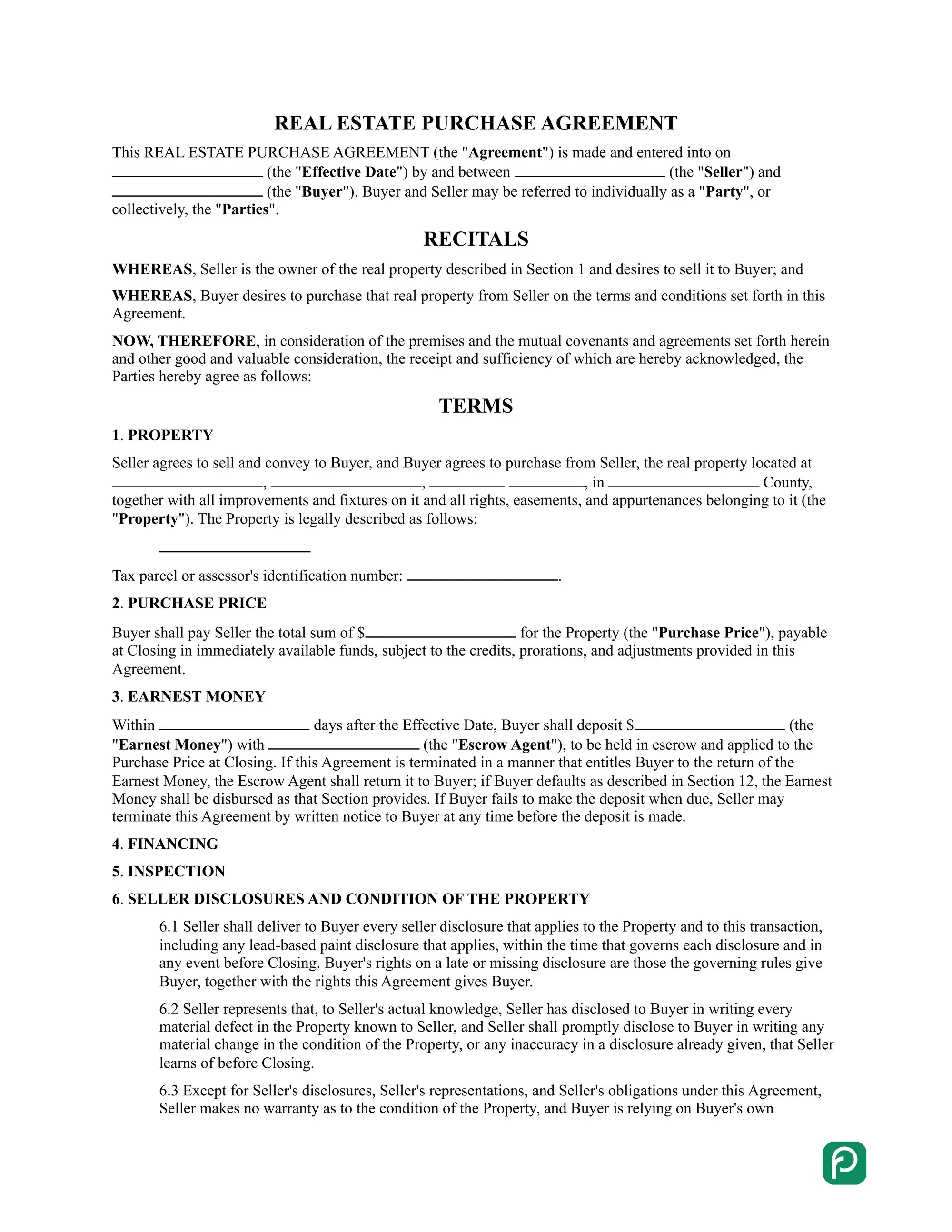
Because real estate sale contracts follow a familiar structure, you can start from a template and adapt it to your deal. Our fillable purchase agreement template shows the general layout.
Purchase agreements differ, but a residential real estate agreement usually covers the same eight points:
A few habits make a purchase agreement easier to finish and easier to read later:
Kentucky's seller disclosure rule is in Ky. Rev. Stat. § 324.360. It applies to sales and purchases involving single-family residential real estate dwellings if any person licensed under the chapter receives compensation. The statute also points to a "seller's disclosure of conditions form" that the real estate commission authorizes by regulation.[1]
Here is the statute's own wording on its scope:
This section shall apply to sales and purchases involving single-family residential real estate dwellings if any person licensed under this chapter receives compensation.
The form provides for the seller to disclose the condition of the basement and whether it leaks, the condition of the roof and whether it leaks, the source and condition of the water supply and of the sewage service, the working condition of component systems, and other matters the commission deems appropriate (Ky. Rev. Stat. § 324.360(3)).[2]
The seller completes and signs the form at the time the seller executes any listing agreement or similar agreement by which a licensee intends to market the property.[1]
Delivery has its own clock. The listing agent must deliver a copy of the form to any prospective purchaser or the purchaser's representative within 72 hours of the listing agent's receipt of a written and signed offer to purchase.[1]
If the property's owner completes and signs the form, the licensee must deliver it to the buyer or potential buyer. The deadline is not later than 120 hours after the creation of any executory contract for the sale of the property.[1]
A seller can refuse to complete and sign the form. If that happens, the broker or sales associate involved in the transaction must tell the purchaser or prospective purchaser in writing, without unreasonable delay.[1]
A licensee also has limits. A licensee may not complete any portion of the form unless the licensee is the owner of the property or the owner has asked the licensee to complete it. Doing so is a violation of the licensing chapter.[1]
The form is not required for:
You can read the full statute on the Kentucky legislature's site, linked under Sources. For questions about your own sale, ask a licensed attorney you trust.
A commercial purchase and sale agreement covers the sale of an industrial, office, mixed-use or other business property. It follows the same basic structure as the residential agreement, plus terms for how the buyer will use the property. The disclosure statute above is written for single-family residential dwellings, so a commercial sale does not need the seller's disclosure of conditions form.[1]
Besides the basics, many commercial buyers add:
A buyer can also ask the seller questions about the property in writing. Keep the answers with the signed agreement so both sides can find them later.
Most problems with a purchase agreement come from small gaps, not big disputes. A Kentucky real estate agreement is easier to rely on when every blank is filled in and every promise is written down.
These short answers cover the Kentucky seller disclosure statute that applies to residential sales. Each one follows Ky. Rev. Stat. § 324.360, and the source is listed at the end of the page so you can read the statute yourself.
Fill in the parties, the property, the price and the closing terms in the template on this page. Then print it or download it, and have both parties sign and date it.
Kentucky has a seller disclosure statute. It applies to sales and purchases involving single-family residential real estate dwellings if any person licensed under the chapter receives compensation.[1]
In Kentucky, the disclosure statute covers single-family residential real estate dwellings when a licensed person receives compensation. It also provides for a state-authorized "seller's disclosure of conditions form."[1]
The broker or sales associate involved must tell the purchaser or prospective purchaser about the refusal in writing, without unreasonable delay.[1]
Yes. The form is not required for these sales:[1]
General information, not legal or tax advice.
