
A Louisiana real estate purchase agreement is a written contract to sell and buy a home or other property at a set price and on set terms. State law adds one step for homes: the seller of residential real property must complete a property disclosure document.[1] This free Louisiana purchase agreement template covers the parties, the property, the price and how the buyer pays. It does not replace the seller's disclosure, which is a separate form.
Last Updated: October 2026. This guide is reviewed and updated regularly to reflect current Louisiana law. If you notice an error or outdated information, please contact us.
Build Your Document
Answer a few simple questions to make your document in minutes
Save and Print
Save progress and finish on any device, download and print anytime
Sign and Use
Your valid, lawyer-approved document is ready
A Louisiana real estate purchase agreement is the contract in which a seller agrees to sell, and a buyer agrees to buy, a specific property for an agreed price. It names the parties, describes the property and sets out the price, the way the buyer pays and the closing terms. Both sides sign it, and each keeps a copy.
Buyers use it to fix the price and terms before closing. Sellers use it to record what they agreed to deliver. Because the agreement sets out each side's duties, both sides should read every section before they sign.
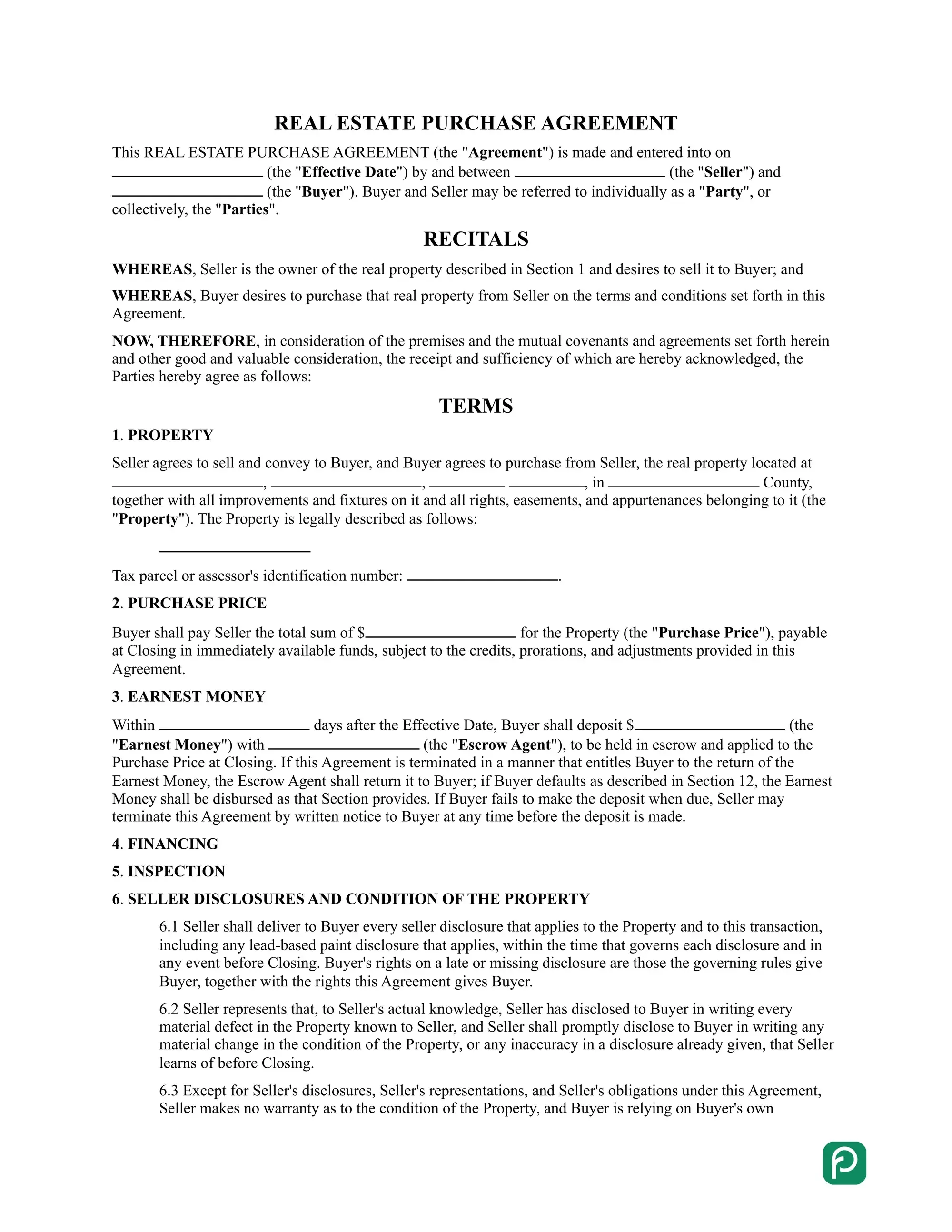
This fillable purchase agreement template is a residential purchase and sale agreement for a Louisiana home. It records who the buyer and the seller are, which property is sold, the price, how the buyer pays and what happens at closing. Fill it out online or download it as a PDF or Word file. Other states have their own pages, listed in our real estate purchase agreement overview.
The template has sections for:
In practice, the buyer and the seller each sign, print their names and date the agreement. Agents who act for either side often sign too. If licensed agents are involved, their fees are usually set in a separate written agreement.
If the seller wants different terms after an offer, a Louisiana counter offer form can record the change. Furniture and other personal property sold on the side can go on a Louisiana bill of sale. If the seller stays in the home for a time after closing, a Louisiana lease agreement can cover that period. The Louisiana PDF forms library lists more state documents.
A commercial purchase agreement covers property such as offices, shops or land, and it is usually longer than a home contract. The buyer and the seller describe the property, the price, how the buyer pays, a review period, the closing and any documents to attach. Many parties ask a lawyer to review a commercial agreement before they sign.
Buyers and sellers often attach documents such as:
A commercial buyer usually has a set review period to inspect the property and judge its condition. If the buyer is not satisfied, the agreement can let the buyer end the deal in writing.
The buyer can pay in cash, with a bank loan or with seller financing. With cash, the buyer needs no loan. With a bank loan, the buyer repays the lender over an agreed period. With seller financing, the seller lends part of the price and the buyer repays the seller on the agreed terms.
The template includes a severability clause, so if one part turns out to be unenforceable, the rest is meant to stay in effect. It also has an earnest money dispute section and a dispute resolution section. Read both before you sign.
In commercial deals, licensed agents often give an agency disclosure that explains whom each agent represents. If one agent acts for both sides, ask what that agent can and cannot do for each party. Consider speaking with an independent advisor or attorney first.
Louisiana requires the seller of residential real property to complete a property disclosure document. The seller must use a form prescribed by the Louisiana Real Estate Commission, or a form that contains at least the minimum language the commission prescribes.[1]
The seller must deliver the completed and signed document to the buyer no later than the time the buyer makes an offer to purchase, exchange or option the property. The same deadline applies when the buyer exercises an option to purchase under a lease with an option to purchase.[1]
The statute required the form to be promulgated under the Administrative Procedure Act no later than April 1, 2004. Forms used on and after April 1, 2005 must also include a clause where the seller says whether the property has been zoned commercial or industrial.[1]
Federal law requires the seller of most housing built before 1978 to give the buyer a lead hazard information pamphlet and to disclose any known lead-based paint or lead-based paint hazards before the buyer is bound by the purchase contract (42 U.S.C. § 4852d).[2][3]
If the seller delivers the disclosure after the buyer makes an offer, the buyer may terminate any resulting real estate contract or withdraw the offer. The buyer has no later than seventy-two hours after receiving the property disclosure document to do so. Weekends and federal and state holidays do not count.[1]
A buyer who ends the contract or withdraws an offer this way owes no penalty. Any deposit or earnest money must be promptly returned to the buyer, even if the buyer and the seller agreed to something different.[1]
Act before the buyer takes title or moves in. In a sale or exchange, the right to terminate is waived if it is not exercised before the transfer of title or occupancy, whichever is earlier. In a purchase under a lease with an option to purchase, the cutoff is the transfer of title.[1]
A property disclosure document is not a warranty by the seller. A seller is also not liable for an error, inaccuracy or omission in the information the document must contain if either of two conditions exists:
Most problems with a purchase agreement start with missing or mismatched details, not with the law itself. A short check before signing catches most of them, and it takes only a few minutes.
The seller's disclosure must tell the buyer several specific things about the property. The statute requires a statement on each of the following points, and the form must also include the zoning clause described above:
General information, not legal or tax advice.
