
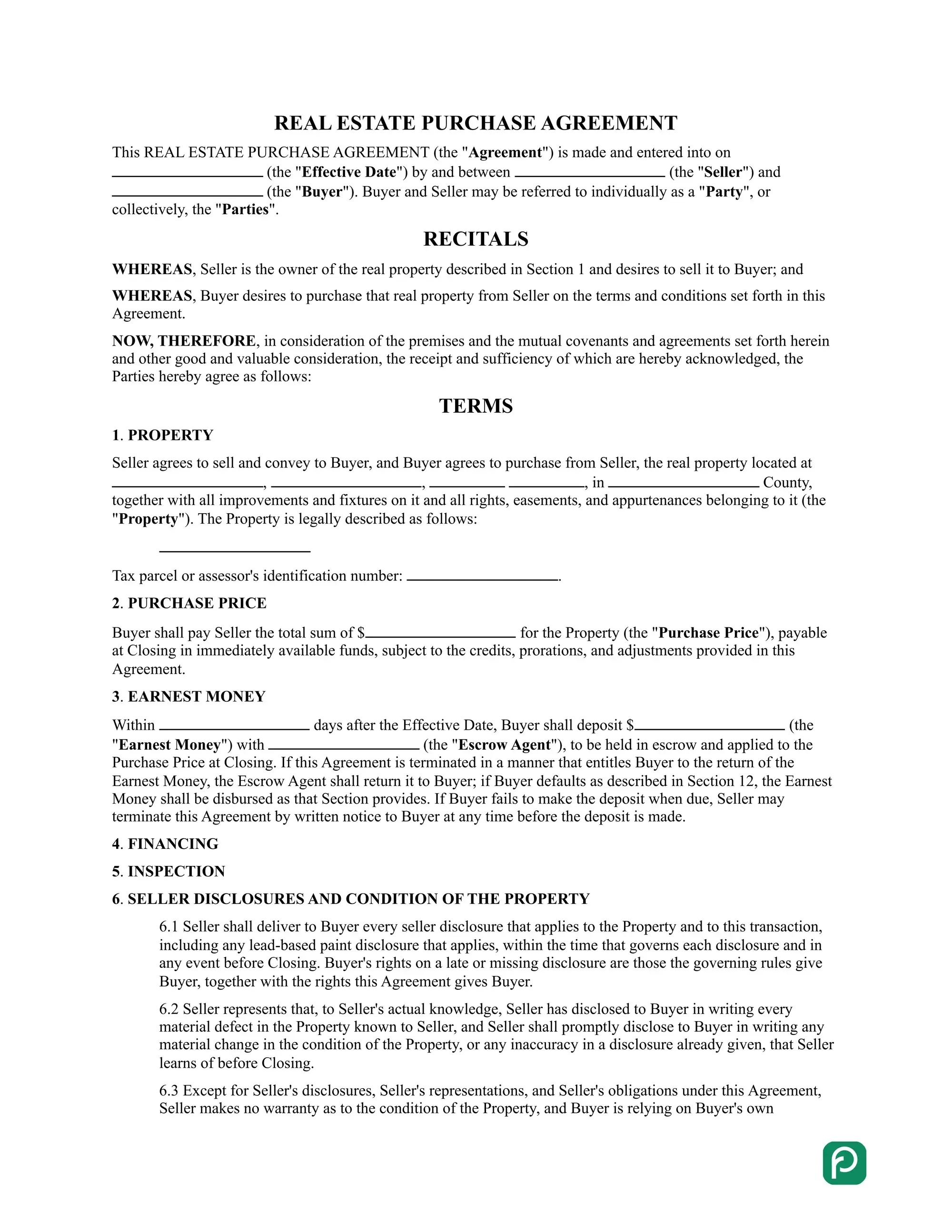
A Michigan real estate purchase agreement is a written contract in which a seller agrees to sell, and a buyer agrees to buy, a property on stated terms. Our free Michigan real estate purchase agreement template lets you fill in the details online and download a PDF or Word file. Michigan's Seller Disclosure Act prescribes the form for a seller's disclosures in Mich. Comp. Laws § 565.957.[1]
Last Updated: October 2026. This guide is reviewed and updated regularly to reflect current Michigan law. If you notice an error or outdated information, please contact us.
Build Your Document
Answer a few simple questions to make your document in minutes
Save and Print
Save progress and finish on any device, download and print anytime
Sign and Use
Your valid, lawyer-approved document is ready
A Michigan residential purchase and sale agreement records the deal between the buyer and the seller of a home. It names the parties, identifies the property, and fixes the price and how it is paid. Seven items belong in nearly every version, whether you start from the FormsPal template or from another form.
The agreement also states the conditions on which the property passes from the seller to the buyer. Real estate deals involve a lot of money, so it is common to have a real estate agent or an attorney review the agreement before signing. The Michigan Realtors association publishes forms for its members, and an agent can tell you whether one fits your sale.
A sale often comes with other documents. Appliances or furniture that stay with the home can be listed in a Michigan bill of sale. In practice, ownership of the property itself moves with a separate deed, for example a Michigan quitclaim deed.
For a general contract that is not about real estate, see our fillable purchase and sale agreement. Other states have their own pages in our real estate purchase agreement collection.
A Michigan commercial purchase and sale agreement covers the sale of an office, shop, warehouse or other business property. It has the same basic parts as a residential agreement: the parties, the property, the price and the payment plan. Commercial deals vary more than home sales, so many agreements add a few practical items.
Brokers often keep their own commercial forms, and an attorney can adapt any of them to your deal. Whichever forms you use, read the finished document with the property and the price in front of you before you sign.
Michigan's Seller Disclosure Act prescribes the form for these disclosures, printed in Mich. Comp. Laws § 565.957. The seller's property disclosure statement describes the condition of the property in compliance with the act, based on what the seller knows.[1] The sections below explain what it covers and what happens if the buyer never receives it.
The form tells the seller to answer all questions, to report known conditions that affect the property, and to check "unknown" when the facts are not known. It groups its questions into three parts.[1]
The seller also lists the dates they lived in and owned the home and certifies that the information is true to the best of their knowledge. The buyer then signs to acknowledge receipt.[1]
Lead-based paint is named on the Michigan disclosure statement. The form asks whether the seller is aware of environmental hazards on the property, such as asbestos, radon gas, formaldehyde, lead-based paint, fuel or chemical storage tanks and contaminated soil. The seller answers yes, no or unknown and explains any yes.[1]
Homes built before 1978 may contain lead-based paint. If you do not know the year your home was built, the county assessor's office can tell you.
When the seller's agent receives the signed statement from the seller, the agent must give a copy to the buyer or the buyer's agent. The form itself says what follows when a buyer never receives a signed statement:
Failure to provide a purchaser with a signed disclosure statement will enable a purchaser to terminate an otherwise binding purchase agreement.
In plain terms, a seller who does not give the buyer a signed statement leaves the buyer free to end an agreement that would otherwise bind both sides.[1]
If the structural, mechanical or appliance systems change between the date of the form and closing, the seller must immediately disclose the changes to the buyer.[1]
Sellers and buyers in Michigan mostly ask about the disclosure statement: what goes on it, what happens without it, and whether it changes the contract. The answers below follow the statutory form in Mich. Comp. Laws § 565.957 and apply to the residential disclosure statement described above.
A seller makes the required disclosures on the statutory form, which is a statement of the property's condition in compliance with the Seller Disclosure Act. Three points are worth knowing.
The statutory form says that failure to provide a purchaser with a signed disclosure statement will enable the purchaser to terminate an otherwise binding purchase agreement.[1] A seller who wants a firm deal should hand over the signed statement early.
The statutory form describes itself as a disclosure only. It states that the information is not intended to be a part of any contract between the buyer and the seller.[1] The purchase agreement itself still sets the price, the payment plan and the property details.
General information, not legal or tax advice.
