
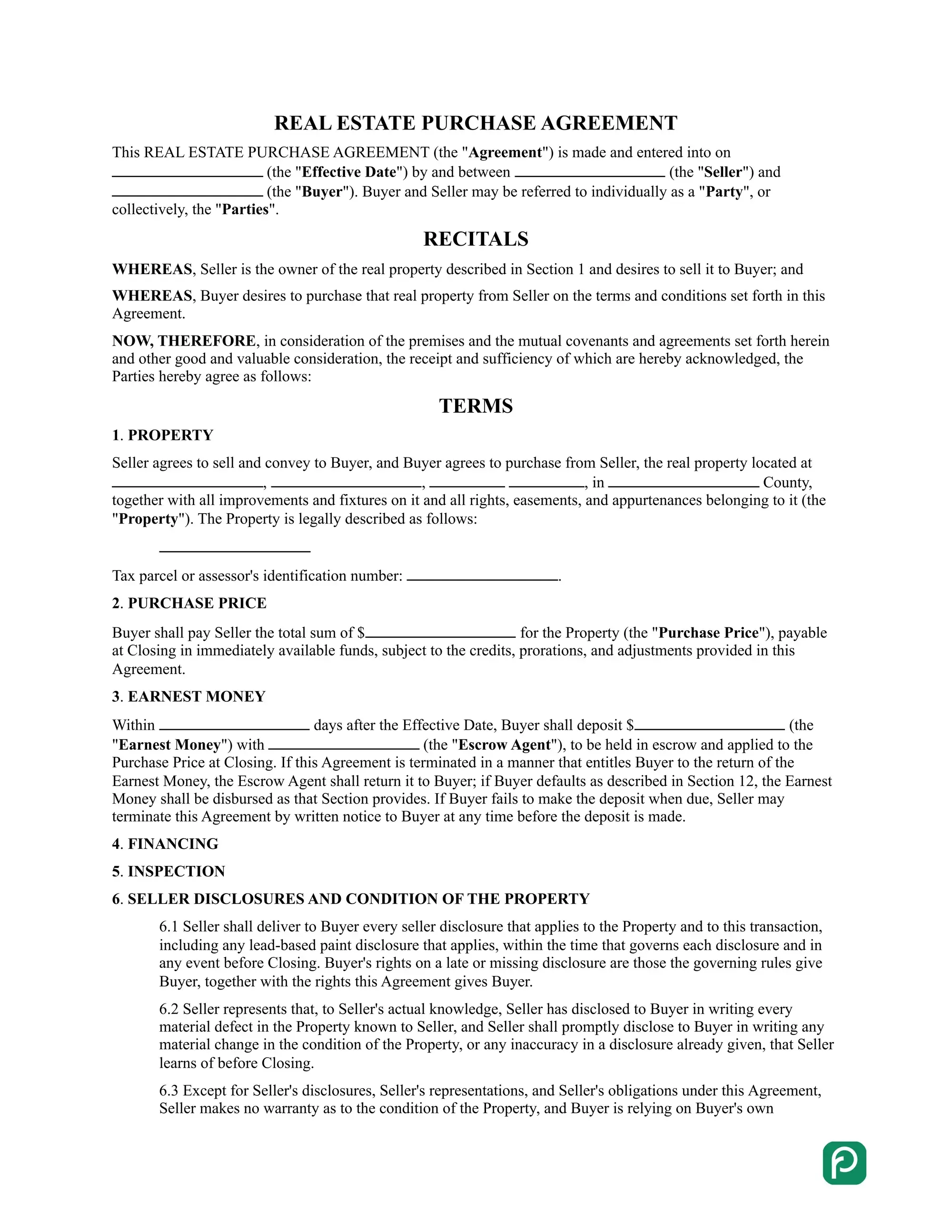
A New Jersey real estate purchase agreement is a written contract in which a seller agrees to sell and a buyer agrees to buy real estate on stated terms. This template records the parties, the property, the price, the deposit and the closing date. New Jersey law also asks the seller of real property to disclose flood information on a property condition disclosure statement.[3] Download the form below or fill it out online.
Last Updated: October 2026. This guide is reviewed and updated regularly to reflect current New Jersey law. If you notice an error or outdated information, please contact us.
Build Your Document
Answer a few simple questions to make your document in minutes
Save and Print
Save progress and finish on any device, download and print anytime
Sign and Use
Your valid, lawyer-approved document is ready
A New Jersey real estate purchase agreement, also called a purchase and sale agreement, is the contract that sets the terms of a real estate sale. It names the buyer and the seller, describes the property and states the price. Once both sides sign, it guides the transaction through the closing process, and the buyer typically orders a home inspection along the way.
A purchase agreement usually records these points:
The buyer signs first, as an offer. Section 27 of the template treats the form as an offer to purchase, and Section 32 is where the seller accepts by signing. The signed copy must reach the buyer before the offer expires under Section 31.
The residential form lists single family homes, condominium units, apartment units, townhouse units, duplexes and triplexes (Section 2). A seller who sells without an agent, often called a for-sale-by-owner deal, can use the same form. If some personal property is sold on its own, FormsPal also has a New Jersey bill of sale.
A New Jersey residential purchase and sale agreement is the contract for selling a home. The template on this page has 38 numbered sections that cover the parties, the property, the deposit, the price, the buyer's contingencies, the closing and the signatures. Read every section before anyone signs. The real estate purchase agreement overview compares the forms for other states.
The sections fall into these groups:
Section 5 asks for an earnest money deposit, which is money the buyer puts down to show the offer is serious. The deposit is credited to the purchase price at closing.
Section 6 has check boxes for the buyer's contingencies. A contingency is a condition the deal depends on. You can mark whether the purchase depends on the buyer getting financing, and whether it depends on the buyer selling another property.
If the buyer is getting a mortgage, Section 7 asks for a good faith loan application. By a date you fill in, the buyer gives the seller a lender letter. The letter verifies the source of the down payment and the funds to close. Without that letter, the seller can end the agreement by written notice within five business days of that date.
Sections 8 and 9 cover the buyer's checks before closing. The buyer can order an appraisal, a survey and a property condition assessment at the buyer's cost. The seller orders a title report, and the buyer has a set number of business days to object to anything in it. If the seller cannot fix a defect, the buyer can cancel and get the full deposit back.
Section 11 ties the deal to an appraisal. If the home appraises for less than the price, the parties get a set number of business days to renegotiate. If they cannot agree, the agreement ends and the buyer gets the deposit back.
Section 10 has the seller keep the property in its current condition until closing, apart from ordinary wear and tear. Section 17 says the buyer takes the property as is, with all defects, except as the agreement or the seller's property disclosure document says otherwise. In the same section, the seller promises to cover the buyer's damages from a materially inaccurate or misleading statement. This promise is called indemnification.
Section 31 makes the offer expire at 5 pm on a date you fill in, unless the seller has signed and delivered a copy to the buyer by then. If the offer expires, the deposit goes back to the buyer. To fill in the downloaded PDF on your screen, use the PDF editor, then print the agreement for signing.
This example uses made-up names, addresses and amounts, so none of it describes a real sale or a recommended term. It shows how the first blanks of the New Jersey form might look once they are filled in.
Your own entries will differ. Replace every sample entry before you sign.
Closing is the day the buyer pays and the seller hands over the property. Section 13 of the New Jersey form sets the closing date. The closing takes place in the escrow agent's office unless the parties choose another place. Before that day, the buyer makes sure all the funds reach the escrow agent.
Here is what the form says about the closing and what comes with it:
Section 16 lets the buyer end the contract and get the full deposit back if the improvements are materially damaged or destroyed before closing. Section 33 says the buyer takes possession at closing, and the home is delivered free of tenants, occupants and debris.
Section 34 gives the buyer a walk-through within the 48 hours before closing. If the home has been damaged since signing, the buyer can require an extension of the closing. The seller then repairs the damage promptly.
FormsPal has a general warranty deed form for the deed named in Section 9. If your sale needs a different type of deed, there is also a New Jersey quitclaim deed. A document that needs a notary can use FormsPal's New Jersey notary acknowledgement.
The form sets out what happens when one side breaks the contract. Under Section 22, if the buyer defaults, the seller's only remedy is liquidated damages equal to the deposit. Under Section 23, if the seller defaults, the buyer can ask a court to make the seller complete the sale, or can cancel and get the deposit back.
Disputes start with mediation. Section 25 has the parties mediate in good faith and share the mediator's cost, then go to binding arbitration if mediation fails. Under that section the arbitrator is a retired judge or an attorney with at least five years of residential real estate law experience, unless the parties agree on someone else.
Section 25 keeps these matters outside mediation and arbitration:
Section 21 says time is of the essence for every date in the contract, so a missed deadline matters. It also says the written contract replaces earlier talks and that any change must be in writing and signed by both parties. Section 29 counts business days as every day except Saturdays, Sundays and federal or state holidays.
Section 27 treats the form as an offer to buy. If only some of the parties initial the pages, a counteroffer is needed. The seller can keep offering the property until the buyer is told the offer is accepted. Section 32 has the seller confirm ownership or authority to sell. It allows delivery by hand, by email with electronic confirmation or by overnight courier.
Section 35 says an agent's fee follows that agent's own written agreement. Because a real estate sale involves a large sum, many buyers and sellers ask an attorney to look over the contract before they sign.
Most problems with a purchase agreement come from blanks and dates, and the New Jersey form has many of both. A few habits prevent most of the trouble. Each one ties back to a section of the template.
When the form is complete, print it for signing and give each party a copy. Section 21 asks for any later change to be in writing and signed by both parties, and FormsPal has real estate purchase agreement addendums for that. You can find other New Jersey documents in the New Jersey PDF forms library.
A commercial purchase and sale agreement covers property that is not a home, such as an office building, a retail space or vacant land. It typically involves more documents, more review and more local requirements than a home sale, so it is longer and more detailed than a residential agreement.
The template on this page is the residential form. A commercial deal often calls for a contract written for that type of property, such as the commercial real estate purchase agreement.
Commercial contracts commonly cover these points in detail:
In practice, buyers of commercial property usually hire a certified inspector to check the systems and the general condition of the building. The contract can then say which defects allow the buyer to cancel. Because the amounts are large, many buyers and sellers ask an attorney to review the contract before anyone signs.
In New Jersey, a seller of real property must disclose flood information on the property condition disclosure statement. The seller gives that statement to the buyer before the buyer becomes obligated under any contract to buy the property. The form of the statement must follow state regulations.[2][3]
The statute's own wording:
A seller of real property located in this State shall disclose, on the property condition disclosure statement, whether the property is located in the FEMA Special or Moderate Risk Flood Hazard Area and any actual knowledge of the seller concerning flood risks of the property.
In plain words, the statement covers these flood items:[3]
If an elevation certificate is available, the elevation certificate must be shared with the buyer.[3]
Properties in the special flood hazard area, also known as high-risk flood zones, on FEMA's flood insurance rate maps are required to obtain and maintain flood insurance. That applies when they have mortgages from federally regulated or insured lenders. For properties that have received federal disaster assistance, the requirement to obtain flood insurance passes down to all future owners.[3]
New Jersey's radon law protects the privacy of a building that has been tested or treated for radon gas. It says:
No person shall disclose to any person, except to the Department of Environmental Protection or the Department of Health, the address or owner of a nonpublic building that the person tested or treated for the presence of radon gas and radon progeny, unless the owner of the building waives, in writing, this right of confidentiality.
In short, a person who tested or treated a nonpublic building for radon gas and radon progeny may not share the building's address or owner. The law makes an exception for the Department of Environmental Protection and the Department of Health, and for an owner's written waiver.[1]
The owner of the building can give up this right of confidentiality by waiving it in writing.[1]
Three sections of the FormsPal template point to attachments:
These two short answers cover the New Jersey seller disclosure statement. They come from N.J. Stat. Ann. § 56:8-19.1 and § 56:8-19.2, which are listed in Sources so you can read the statutes yourself.
Yes, for the items the statute names. A seller of real property located in New Jersey must disclose two things on the property condition disclosure statement:
The seller gives the statement to the buyer before the buyer becomes obligated under any contract for the purchase of the property.[3]
Yes. New Jersey law has a property condition disclosure statement for real property. Its form must comply with regulations promulgated by the director in consultation with the New Jersey Real Estate Commission.[2] On the statement, the seller discloses the flood hazard area status of the property and any flood risks the seller actually knows about.[3]
General information, not legal or tax advice.
Unless noted otherwise, the sources below are from the N.J. Stat. Ann..
