
Updated:
A New Mexico real estate purchase agreement is a property sale contract. The agreement sets the price, earnest money, inspection terms and closing date for both sides. This page covers each clause, New Mexico's disclosure statutes, and how to sign.
Key facts
Build Your Document
Answer a few simple questions to make your document in minutes
Save and Print
Save progress and finish on any device, download and print anytime
Sign and Use
Your valid, lawyer-approved document is ready
A New Mexico real estate purchase agreement is a written contract in which the seller agrees to sell a property and the buyer agrees to pay for it on the terms the document states.
The agreement is one kind of purchase agreement, written for land and buildings rather than goods. It names the parties, describes the property, fixes the price and sets the dates both sides work to.
The purchase agreement sits at the center of a New Mexico home sale. Other New Mexico real estate forms, such as the seller disclosures and the assessor's tax estimate, attach to it or travel with it to closing.
A residential purchase and sale agreement is the contract in which a seller agrees to sell a home and a buyer agrees to pay for it. Keep every draft, counteroffer, and signed page in one place while you negotiate. The signed contract binds both sides, so many buyers and sellers ask a New Mexico attorney or their broker to read it first.
A New Mexico commercial real estate purchase agreement covers the sale of an office, a store, a warehouse or other business property, and it follows the same offer, counteroffer and acceptance steps as a home sale.
The commercial agreement differs from a residential one in its schedule. It usually sets separate deadlines for financing, for the buyer's review of the property and for each decision, because commercial deals run on tight budgets and dates.
The buyer's review in a commercial deal often reaches past a home inspection: zoning, leases already in place, and whether the building suits the planned business. The agreement lists each review and the date it ends.
The property tax levy estimate of N.M. Stat. Ann. § 47-13-4(B) applies only when the property is residential real property.
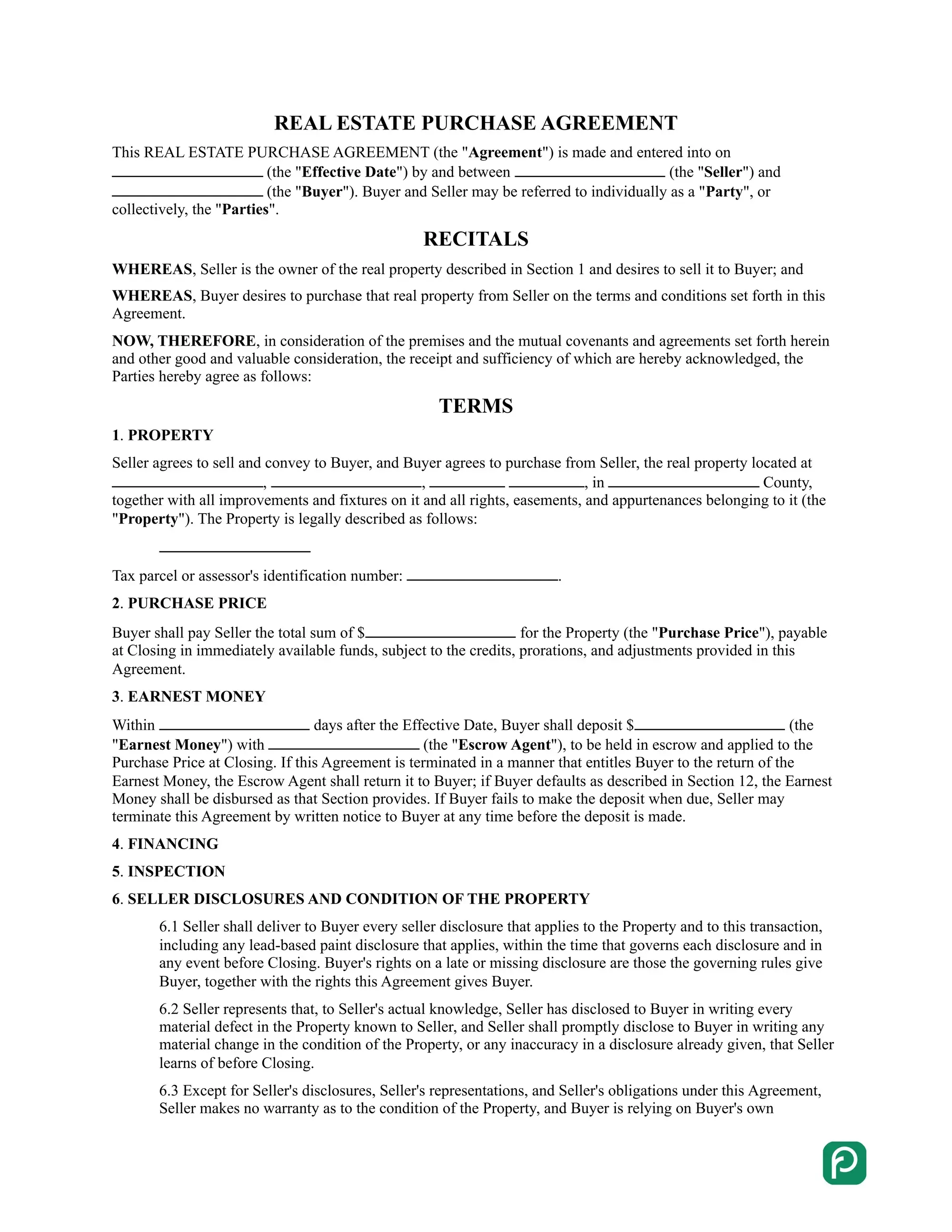
A New Mexico real estate purchase contract lists the parties, the property, the price and the closing terms, plus every condition either side sets before the sale closes.
The legal description identifies the land the way the county's land records do, not only by street address. Copy it from the seller's deed or title report rather than retyping it from memory.
The general real estate sales contract page covers the same clauses outside New Mexico.
The earnest money clause of a New Mexico purchase agreement states how much the buyer deposits, who holds the deposit and when it is released to either side.
The deposit shows the buyer's good faith while the sale moves toward closing. At closing, the agreement usually credits it toward the purchase price.
The release terms of the earnest money clause decide which side keeps the deposit if the sale falls through, so the clause ties each release to a named event. Common release events in the agreement:
The clause names the holder, often a title company or a broker, and how the holder pays out the deposit once the release event happens.
The New Mexico disclosure sections cited on this page give the seller one written step, the assessor's tax levy estimate, only when the property is residential real property, before the seller accepts an offer, N.M. Stat. Ann. § 47-13-4(B). The same sections list facts the seller has no duty to disclose. A federal lead-based paint disclosure and a broker's own duties sit outside these sections. The table sets out each rule with its condition and section.
| Rule | When it applies | Citation |
|---|---|---|
| The seller or the seller's broker requests the county assessor's estimated property tax levy, using the listed price as the value, and gives the buyer or the buyer's broker a copy of the response in writing | When the property is residential real property, before the seller accepts an offer to purchase | N.M. Stat. Ann. § 47-13-4(B) |
| The seller has no duty to disclose, and no liability for not disclosing, the listed facts | Only for the fact or suspicion that the property was the site of a natural death, a homicide, a suicide, an assault or another felony, or was owned or occupied by a person with HIV or AIDS | N.M. Stat. Ann. § 47-13-2 |
| Not disclosing one of those facts is not grounds for termination or rescission of the sale | Only when the fact left out is one that § 47-13-2 lists | N.M. Stat. Ann. § 47-13-3(B) |
The sections cited on this page set no rule on a general statement of property defects; the seller's property disclosure statement below explains that document.
The estimated property tax levy disclosure gives the buyer the county assessor's estimate of the property tax; when the property is residential real property, the seller or the seller's broker obtains it before accepting an offer, N.M. Stat. Ann. § 47-13-4(B).
This page gives no fee or processing time for the estimate; the county assessor's office can state both.
A New Mexico seller has no duty to disclose a death or a crime at the property only for the facts the statute lists: the fact or suspicion that the property was the site of a natural death, a homicide, a suicide, an assault or another felony, N.M. Stat. Ann. § 47-13-2.
The same section reaches one more fact: when the property was owned or occupied by a person exposed to, infected with or suspected to be infected with HIV, or diagnosed with AIDS, the seller has no duty to disclose it and no liability for leaving it out, N.M. Stat. Ann. § 47-13-2.
Defects in the house itself fall outside this section. A known roof leak or mold in the bathroom is a property condition, not a fact of the kind this section lists.
A seller's property disclosure statement lists the defects the seller knows about, such as a leaking roof or mold in the bathroom, and leaves a signed record of what the buyer was told.
The sections cited on this page set no rule that calls for the statement, so this page states none. Many sellers give one anyway, for three reasons:
The statement reports what the seller knows; it is not an inspection report. Health hazards belong at the top of it, such as hazardous building materials or a past methamphetamine laboratory in the house. An attorney can say whether a given fact belongs on it.
A lead-based paint disclosure is a separate federal form for older housing, and its scope and contents come from federal rules, not from the New Mexico sections cited on this page. The purchase agreement can list it among the attachments, and a broker or attorney can confirm whether the home calls for one.
The inspection clause of a New Mexico purchase agreement gives the buyer a set period to have the property inspected, usually at the buyer's own expense, and to object to what the inspector finds.
The buyer hires an inspector who checks whether the house matches the condition the agreement describes and looks for other defects.
The repair terms of the agreement give the parties three outcomes after an inspection: the seller repairs, the price drops, or the contract ends. The agreement states the date by which the buyer objects and the date by which the seller answers, so the review does not drag on.
A contingency is a condition that lets a party end the agreement if it fails, such as the buyer's financing, an appraisal at the price, or a clear title search. Each contingency in the agreement carries its own deadline and says what happens to the earnest money if the condition fails.
A New Mexico real estate purchase agreement is filled out clause by clause, then signed and dated by the buyer and the seller once both accept the final terms.
A counteroffer changes the agreement's terms and sends it back to the other side, who accepts, rejects or counters again. The deal stands on the version that carries both signatures. Write every deadline into that version so discussions and reviews do not drag on.
This page states no New Mexico notarization or witness rule for the purchase agreement; the title company or an attorney can confirm what the closing calls for.
The agreement draws on these details, so have them ready first:
The buyer and the seller sign the agreement, each with the signing date. When the seller is married, the title company or an attorney can confirm whether the spouse signs as well. When a party is a company or a trust, the person with authority to act for it signs and gives that role next to the signature.
Not on that ground: when the seller leaves out a fact listed in N.M. Stat. Ann. § 47-13-2, such as a natural death or a felony at the property, the failure is not grounds for termination or rescission of the sale, N.M. Stat. Ann. § 47-13-3(B).
No. The purchase agreement sets the terms of the sale, and the deed transfers ownership of the property at closing.
Yes, by a written amendment that both the buyer and the seller sign. The amendment names the clause it changes and states the new terms.
Keep a signed copy of the contract and every attachment together, such as the property disclosure statement. Save a scan too, so you can find it quickly later.
General information, not legal or tax advice.
