
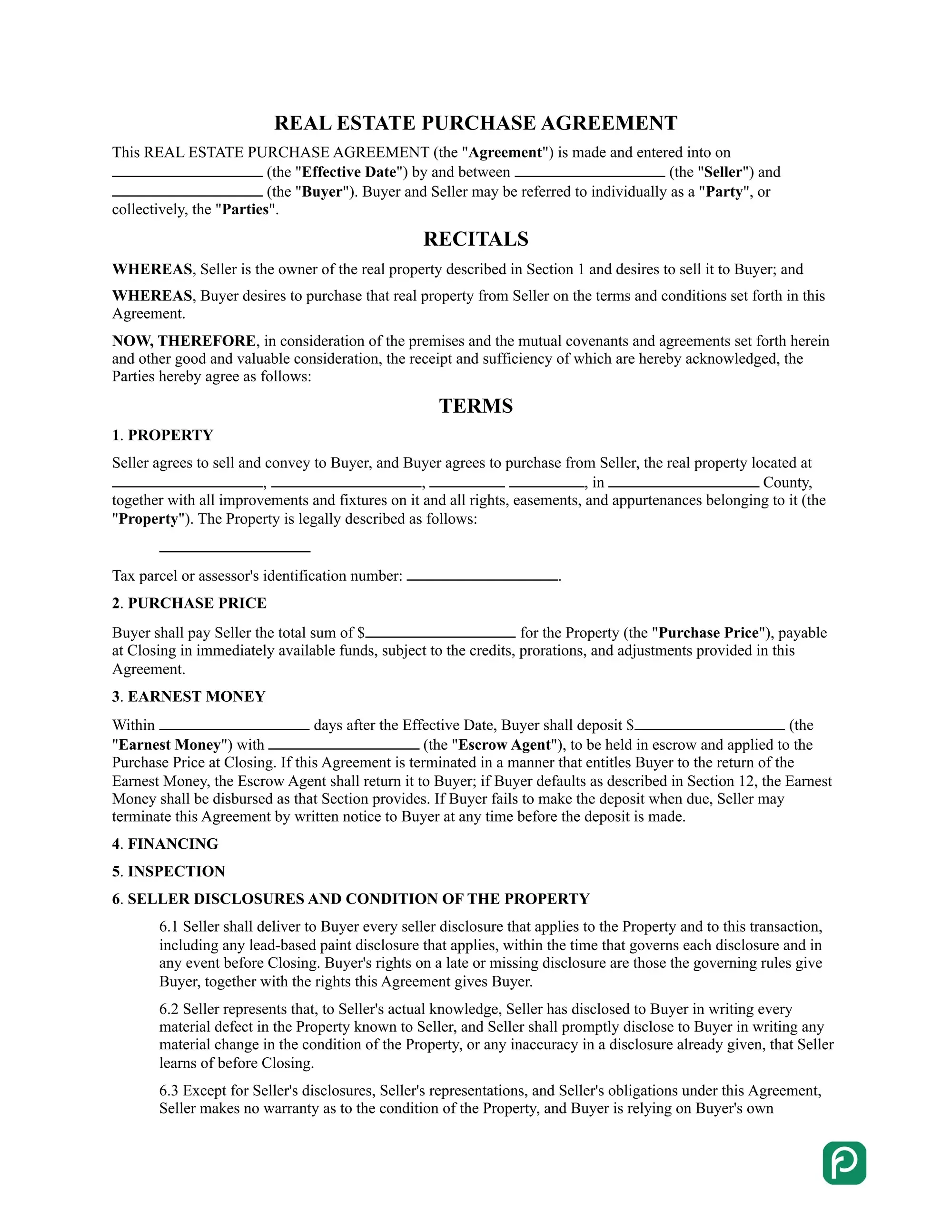
A Pennsylvania real estate purchase agreement is a written contract in which a seller and a buyer agree on the terms for the sale of a home or other property. In Pennsylvania it is often called an agreement of sale. This Pennsylvania real estate purchase agreement template covers the price, the deposit, the closing date and the condition of the home, and it includes a lead-based paint disclosure.
Last Updated: October 2026. This guide is reviewed and updated regularly to reflect current Pennsylvania law. If you notice an error or outdated information, please contact us.
Build Your Document
Answer a few simple questions to make your document in minutes
Save and Print
Save progress and finish on any device, download and print anytime
Sign and Use
Your valid, lawyer-approved document is ready
This printable purchase and sale agreement is written for residential sales. It puts the price, the deposit, the closing date and the condition of the home into one signed document. The form has a checklist for these kinds of homes:
The real estate purchase agreement template walks through the deal in numbered sections. These are the main ones:
Read each section before you sign and fill in every blank that applies. If you download the PDF, you can complete it on screen with our PDF editor or print it.
A few quick checks catch the most common mistakes in a FormsPal purchase agreement:
You can use the real estate purchase agreement in several ways once the blanks are filled in:
The FormsPal template on this page is a residential form. A commercial sale usually needs more detail, so commercial buyers and sellers often have a real estate attorney draft or review the agreement. A commercial agreement usually covers these terms:
The buyer's offer also sets the possession date and any financing conditions. In practice, the seller can accept the offer, reject it or answer with a counteroffer. Both sides should read every term before signing.
Use the residential agreement when the sale involves a home. Use an agreement drafted for the deal when a business is the buyer or the seller, or when the sale covers an office, a shop, a warehouse or land. Plan for these differences in a commercial sale:
A residential agreement is simpler, but it still works best when both sides agree on every term in writing. Settle the price, the deposit and the closing date first, then add the other terms of the sale.
Pennsylvania sets rules for the seller's property disclosure statement. A seller must disclose to a buyer all known material defects about property being sold that are not readily observable. The statement must also contain, at a minimum, the disclosures that Section 35.335a of the 49 Pa. Code lists.[1]
The statement asks whether the seller knows of underground tanks or hazardous substances on the property, in the structure or in the soil.[1] The substances it names include:
The FormsPal template has its own lead-based paint disclosure for homes built before 1978.
The seller has two more duties tied to the statement. The seller must cause the buyer to be notified in writing of any information on the form that a change in the condition of the property makes inaccurate. By signing, the seller also authorizes any agent for the seller to give the information to prospective buyers and to other real estate agents.[1]
The regulation also gives the buyer an option to cancel. Its wording is:
The buyer will have the option of canceling the agreement with return of all deposit moneys until the certificate has been provided to the buyer and for 5 days thereafter or until conveyance, whichever occurs first.
In plain words, the buyer can cancel and get all deposit money back. That option lasts until the certificate named in the regulation has been provided to the buyer, and for 5 days after that. It also ends at conveyance (the transfer of ownership) if that comes first.[1]
These short answers cover the seller's disclosure form in Pennsylvania. Each one follows Section 35.335a of the 49 Pa. Code, which is listed under Sources so you can read the regulation yourself. For help with your own sale, talk to a Pennsylvania real estate attorney.
A seller must disclose to a buyer all known material defects about property being sold that are not readily observable. The seller's property disclosure statement is where those details go.[1]
The seller alone is responsible for the accuracy of the information in the statement.[1] A buyer should still read it closely and compare it with the home inspection.
No. The statement is not a warranty of any kind by the seller. It is also not a warranty or representation by any listing or selling real estate broker or their agents.[1]
General information, not legal or tax advice.
