
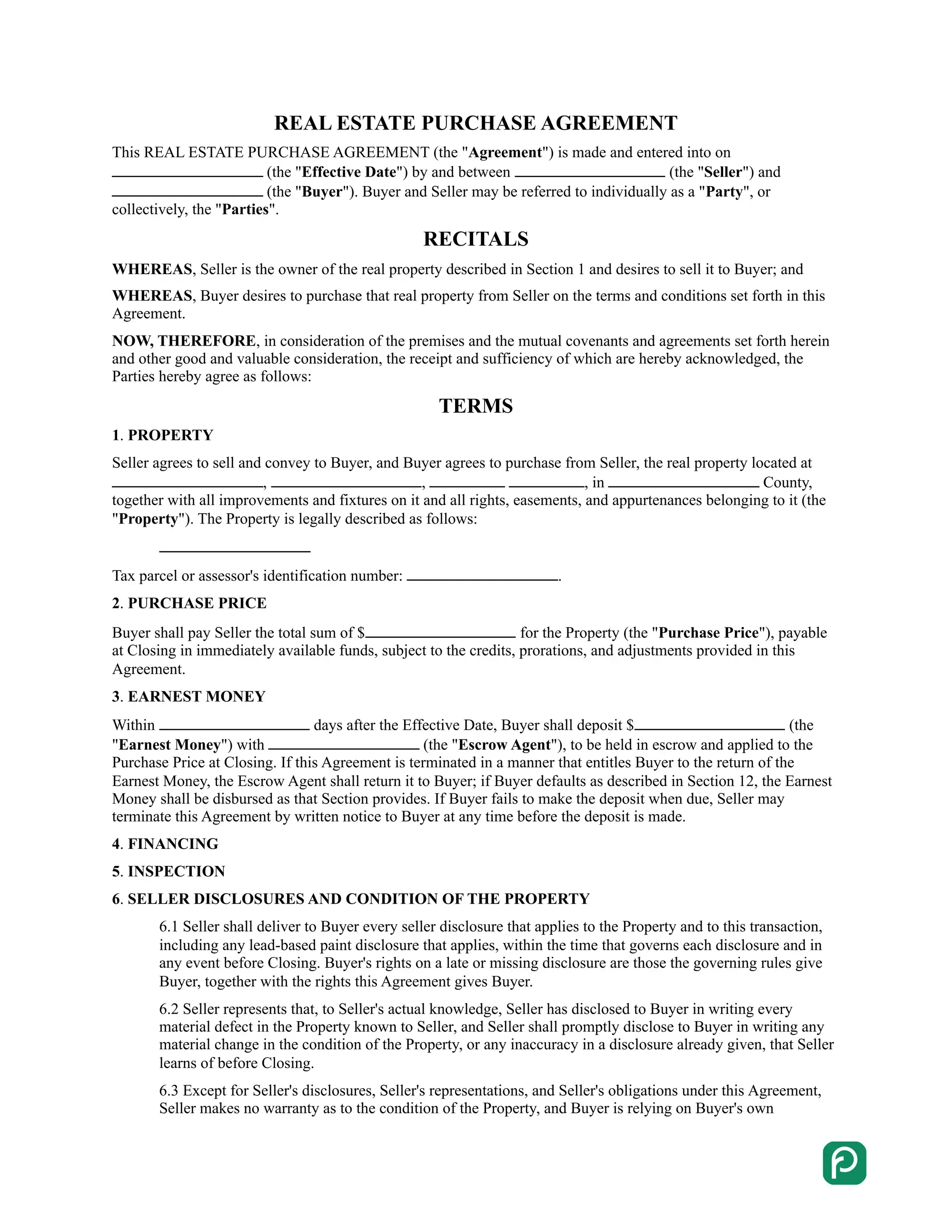
A South Carolina real estate purchase agreement is a written contract for the sale of a home or other real property. This free South Carolina real estate purchase agreement template helps you fill in the parties, the property, the price and the closing terms. When a home has one to four dwelling units, the owner must also give the buyer a written disclosure statement, unless the transfer is exempt.[1.3]
Last Updated: October 2026. This guide is reviewed and updated regularly to reflect current South Carolina law. If you notice an error or outdated information, please contact us.
Build Your Document
Answer a few simple questions to make your document in minutes
Save and Print
Save progress and finish on any device, download and print anytime
Sign and Use
Your valid, lawyer-approved document is ready
A residential purchase and sale agreement is the contract for the sale of a home. It records who the buyer and the seller are, what property changes hands, the price, and the dates both sides agree on. Use it for a house, a condo, a duplex or any other home.
The agreement fits the property type you are buying or selling. In South Carolina, the agreement may cover:
Most agreements spell out the same points. Fill in each one before you sign:
Our printable real estate purchase agreement pages cover other states, and the general purchase agreement form works for other kinds of sales.
Most problems with a real estate purchase agreement come from small gaps, not big disputes. A few minutes of checking before you sign can save both the buyer and the seller a delay at closing. Look for these common mistakes:
A deed is a separate document from the purchase agreement. Our South Carolina quitclaim deed page explains one common type.
A commercial purchase and sale agreement covers the sale of business or investment property, such as an office, a store or a warehouse. These deals are usually more complex than home sales, so the agreement is longer.
A commercial agreement usually includes:
Treat this list as a checklist, not a complete set of terms. Ask your attorney or title company whether anyone must sign in front of a notary public.
Chapter 50 of Title 27 of the S.C. Code Ann. sets the seller disclosure rules for residential property. The rules apply to a sale or exchange, an installment land sales contract, or a lease with an option to purchase, when the property is residential real property with at least one but not more than four dwelling units.[1.1]
Except for exempt transfers, the owner of the real property must give the purchaser a written disclosure statement.[1.3] The owner must deliver the form before the purchaser and the owner sign a real estate contract, or as otherwise agreed in the real estate contract.[1.4]
The disclosure rules do not apply to transfers made:
Each of these exempt transfers is listed in the statute.[1.2]
Suppose the owner finds a material inaccuracy after handing over the statement. The same applies if a later event makes it materially inaccurate. The owner must correct it promptly by delivering a corrected disclosure statement to the purchaser, or by making reasonable repairs necessitated by the occurrence before closing.[1.5]
An owner who knowingly violates a duty under these rules is liable for actual damages proximately caused to the purchaser, plus court costs. So is an owner who discloses material information that he or she knows to be false, incomplete or misleading.[1.6]
These short answers explain the South Carolina seller disclosure form and the duties that come with it. They are written in plain words, so a buyer, a seller or an agent can find an answer in a few seconds.
The seller and the buyer do not write this form. Here is what the statute says about it:
The disclosure statement must contain the language and be in the form promulgated by the commission and the form may be delivered electronically through the Internet or other similar methods.
In plain words, use the commission's form without changes. You can send it by email or through a website.[1.3]
Two kinds of agents must tell each owner covered by the listing agreement, in writing, about the owner's obligations under these rules:[1.7]
No. An owner is not required to disclose the fact or suspicion that a property may be, or is, psychologically affected.[1.8]
Yes, when the property is residential real property with at least one but not more than four dwelling units. The rule also covers a sale or exchange and an installment land sales contract.[1.1]
General information, not legal or tax advice.
