
A Washington purchase agreement is a written contract in which a buyer agrees to buy, and a seller agrees to sell, real estate on set terms. It names the parties and the property, and it records the price, the earnest money deposit and the closing terms.
Last Updated: October 2026. This guide is reviewed and updated regularly to reflect current Washington law. If you notice an error or outdated information, please contact us.
Build Your Document
Answer a few simple questions to make your document in minutes
Save and Print
Save progress and finish on any device, download and print anytime
Sign and Use
Your valid, lawyer-approved document is ready
In a sale of residential property, state law also requires the seller to give the buyer a completed disclosure statement, unless the buyer waives it or the transfer is exempt.[1] Fill in this free Washington real estate purchase agreement online, or download it as a PDF or Word file.
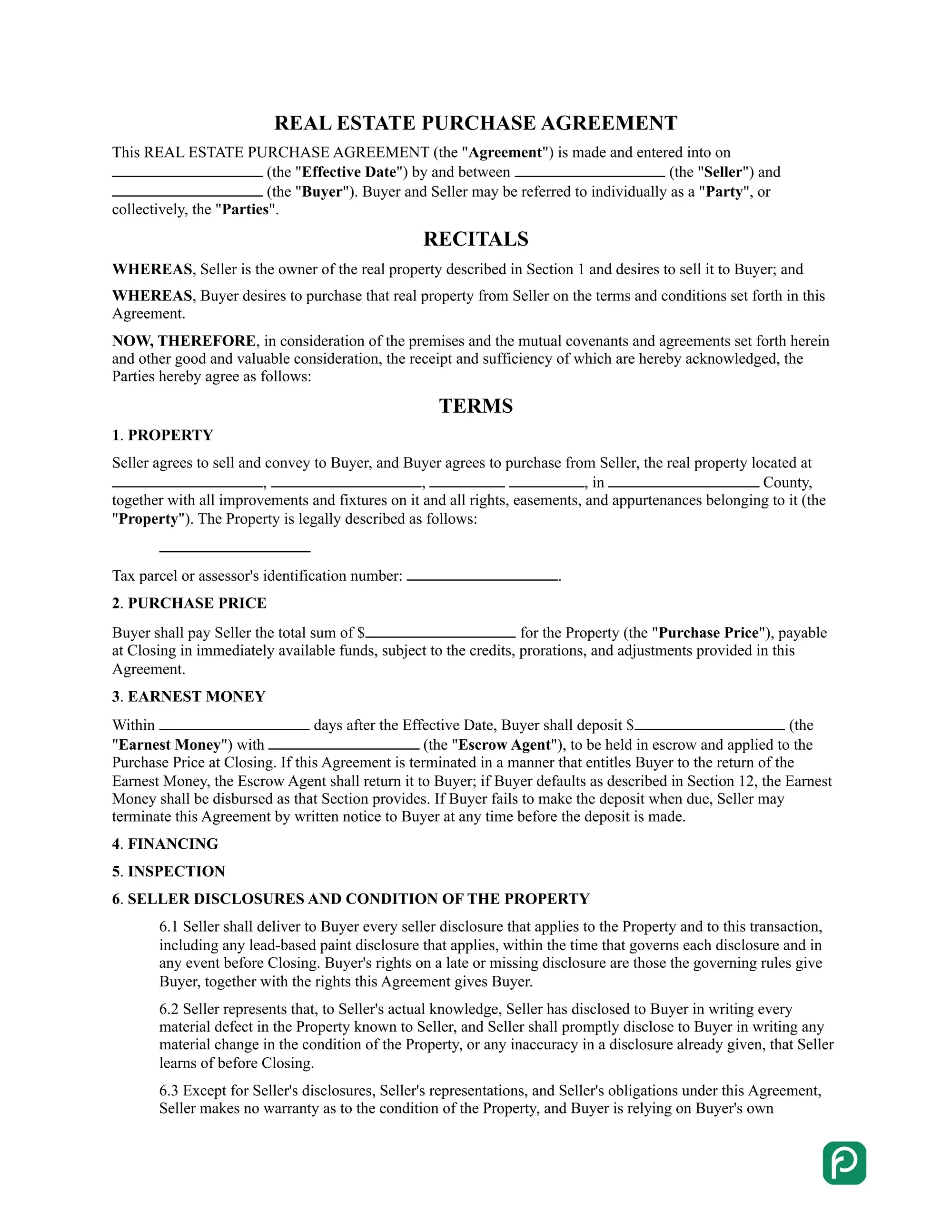
A Washington residential purchase and sale agreement is the contract for the sale of a home. This printable form is written for residential property, so it has check boxes for the type of home. It puts the buyer, the seller, the price, the earnest money deposit and the closing terms into one document.
The form also has a check box for homes built before 1978. If the property is older, the form tells both parties to sign the attached lead-based paint disclosure.
After you download the PDF, you can fill it in with the online PDF editor. Our fillable real estate purchase agreement pages cover other states, and the general purchase agreement page covers other kinds of sales.
Items that are not part of the home sale can move with a Washington bill of sale.
The Washington purchase agreement form has 38 numbered sections. They run from the parties and the property to the seller disclosure statement. Together they record who is buying and selling and what comes with the home. They also cover the price, the earnest money deposit, the conditions that let a buyer back out, and the closing.
| Part of the form | What it records |
|---|---|
| Sections 1 to 4 | The parties, the type of home, the tax parcel number, the legal description, personal property, fixtures and appliances |
| Sections 5 and 5A | The earnest money deposit and the purchase price |
| Sections 6 and 7 | Financing and sale-of-another-home contingencies, and the buyer's loan application |
| Sections 8 to 11 | Due diligence, title, property condition and appraisal |
| Sections 12 to 14 | Closing costs, the closing date and funds at closing |
| Sections 15 to 18 | Mineral rights, damage or destruction, indemnification and required documents |
| Sections 19 and 21 to 26 | Termination, time limits, default by the buyer or the seller, earnest money disputes, dispute resolution and governing law |
| Sections 27 to 32 | Terms of the offer, binding effect, business days, severability, offer expiration and the seller's acceptance |
| Sections 33 and 34 | Possession after closing and the buyer's walk-through |
| Sections 35 to 38 | Real estate agents, a swimming pool or spa, lead-based paint and the property disclosure statement |
Earnest money is a deposit the buyer pays to show good faith. In this agreement, the buyer deposits the amount with the escrow agent by a date written on the form (Section 5). The deposit is credited in full to the purchase price at closing.
The agreement returns the deposit to the buyer in several cases. One example is a title defect the seller will not fix. Another is a repair dispute the parties cannot settle. A third is a home that appraises below the purchase price when no new price is agreed.
Write the earnest money amount and the due date into Section 5 before you sign. The earnest money figure should match what the buyer and the seller negotiated.
Section 6 gives the buyer two pairs of check boxes. The buyer marks whether the purchase depends on getting financing, and whether it depends on selling another property. For a financed purchase, Section 7 adds more terms:
The agreement sets one closing date, and the parties can move it by mutual agreement. Closing takes place at the office of the escrow agent, unless the parties choose another place. Count business days with the deadline calculator before you write dates into the blanks.
The agreement spells out what happens when a deal goes wrong. It treats a buyer default and a seller default differently, and it sends most disputes to mediation first. Each remedy below is tied to a numbered section of the agreement.
For disputes, the buyer and the seller agree to mediate first and to share the mediation costs (Section 25). A dispute that mediation does not settle goes to neutral, binding arbitration. Foreclosures, evictions, mechanic's liens and matters for a probate, small claims or bankruptcy court are excluded. Section 21 adds that time is of the essence for every date, and that any amendment must be in writing and signed by both parties.
In the Washington form, the seller agrees to keep the home in its current condition until closing and to order a title report for the buyer. The seller also conveys title by warranty deed, or an equivalent instrument, and gives the buyer the disclosure statement that state law requires for a home sale.
A commercial purchase and sale agreement covers the sale of business or investment property, such as an office, a store or a warehouse. The form on this page is written for residential property. Commercial deals often need extra terms, so ask a Washington attorney or a title company to review a commercial draft.
Many commercial agreements spell out:
The seller disclosure rules in the next section are written for the sale of improved residential real property.[1]
In a transaction for the sale of improved residential real property, a Washington seller must deliver a completed seller disclosure statement to the buyer. Improved property is land with buildings or other improvements on it.
Two exceptions apply. The buyer may have expressly waived the right to receive the statement. Or the transfer may be otherwise exempt under RCW 64.06.010.[1]
Delivery of the disclosure statement must occur not later than five business days, unless otherwise agreed, after mutual acceptance of a written contract to purchase between a buyer and a seller.[1] The clock starts when both sides have accepted the written contract.
The statement gives the buyer a right to cancel. The statute puts this notice on the statement itself:
Unless you and seller otherwise agree in writing, you have three business days from the day seller or seller's agent delivers this disclosure statement to you to rescind the agreement by delivering a separately signed written statement of rescission to seller or seller's agent.
To rescind means to cancel the agreement. The buyer has three business days after the seller or the seller's agent delivers the statement, and the buyer cancels by delivering a separately signed written statement of rescission.[1]
Some transfers are exempt from the disclosure rule. Those exemptions are listed in RCW 64.06.010.[1]
New construction has its own limit. If the statement is completed for new construction that has never been occupied, it does not have to contain, and the seller does not have to complete, the questions in item 4 (Structural) or item 5 (Systems and Fixtures).[1]
The statutory disclosure form asks whether the property has carbon monoxide alarms. A note on the form says the seller must equip the residence with carbon monoxide alarms as required by the state building code. The form also asks about smoke detection devices. If the property is not equipped with at least one smoke detection device, at least one must be provided by the seller.[1]
These short answers explain what a Washington seller must disclose about a home. Both come from the state's seller disclosure law, RCW 64.06.020, and they apply to the sale of improved residential real property.
The seller must deliver a completed seller disclosure statement to the buyer. The rule covers the sale of improved residential real property, unless the buyer has expressly waived the right to receive the statement or the transfer is otherwise exempt under RCW 64.06.010.[1]
A home seller must complete the statutory disclosure statement and deliver it to the buyer. These are the main rules:
General information, not legal or tax advice.
