
The LLC Purchase Agreement is a vital legal document used when a Limited Liability Company (LLC) member intends to transfer their ownership interest, either in whole or in part, to another individual or entity. This agreement protects the interests of all parties involved and outlines the terms and conditions governing the transaction.
Last Updated: October 2026. This guide is reviewed and updated regularly to reflect current law. If you notice an error or outdated information, please contact us.
Build Your Document
Answer a few simple questions to make your document in minutes
Save and Print
Save progress and finish on any device, download and print anytime
Sign and Use
Your valid, lawyer-approved document is ready
An LLC membership purchase agreement is the contract a member signs to sell their ownership interest in a limited liability company. In a corporation, the same idea is called a stock purchase agreement. The agreement comes into play when a member leaves the company, whether the departure is voluntary or forced.
Every agreement of this kind records the same basic points:
This fillable purchase agreement template provides a clear framework for the LLC, detailing the rationale behind the sale and the destination of the ownership interest. Unlike shares in conventional corporations, which can be freely sold or gifted, LLC interests require a formal transfer process.
People often shorten the name to purchase agreement. In practice, the document records the sale of a membership interest for an agreed price and passes that interest to a new person or company.
Note that it is not the same as the LLC Membership Interest Assignment. While both documents involve the transfer of LLC membership interest, the key difference is the level of detail and the legal implications.
An LLC Membership Interest Assignment is a simpler document primarily used to record the transfer. An LLC Membership Purchase Agreement, however, is a formal contract that outlines the full terms and conditions of the sale, providing greater legal protection to both parties involved in the transaction.
An LLC Membership Interest Purchase Agreement is crucial whenever a monetary transaction is involved in transferring an LLC’s ownership interest. In short, any situation where a member is abandoning their stake in return for a financial consideration requires the creation and execution of this purchase agreement.
LLC membership purchase agreements play an instrumental role in ensuring that the transaction complies with state laws. It’s essential to note that each state has its own unique regulations governing purchase agreements, and there are no overarching federal laws. Therefore, an LLC Membership Purchase Agreement can offer a valuable tool in navigating these diverse legal landscapes, ensuring each transaction is conducted in accordance with the relevant jurisdiction’s laws.
Use this template when one person is handing a membership interest to another for payment. Our template can be used whenever there’s a need to transfer an LLC membership interest, which could be triggered by various circumstances such as:
A sale goes more smoothly when the plan comes first. Before anyone drafts the paperwork, work out what the stake is worth, how the price will be paid and who in the company needs to hear the news. Early planning keeps the final contract short, because most of the answers are already written down.
Owners who are selling often write a short plan for the handover, such as who answers questions from customers and who takes over the daily work after closing. A page of notes is enough, and it gives the incoming member a calm start. A common approach is to share the notes with the company’s management team before the sale is final.
Sellers range from a founder who is retiring to an investor who is moving on, and buyers are just as varied. A common pattern is one member buying out another, though an outsider can buy as well. Each side has its own goals, and the purchase agreement should reflect both.
An LLC stake is not the same as stock in a corporation, but selling an ownership stake follows a similar idea. Buyers who are used to purchasing stock may find that an LLC sale involves more paperwork, so it pays to read the company’s own documents first. Selling membership interests is also a good moment to ask each party what they expect after closing and what will happen to any capital left in the company.
Every sale of a membership interest has the same basic building blocks, from the names of the people involved to the day the deal closes. Comprehensive and legally sound LLC membership purchase agreements should include several key components:
Follow these steps to fill out the FormsPal template. Each step names a part of the form and says what to enter. If you downloaded the PDF, you can complete it with the online PDF editor or any PDF software, or print it and write by hand.
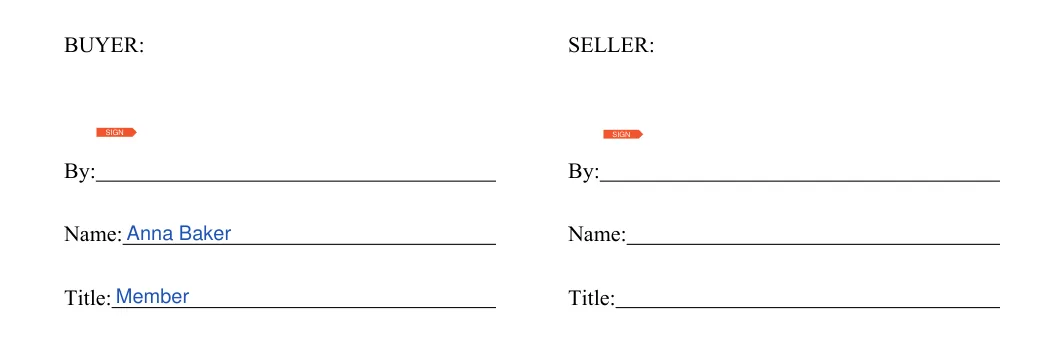
The screenshots under each step show the FormsPal LLC Purchase Agreement template filled with sample entries in blue, so you can see where each answer goes. The names, addresses, dates and amounts are examples only.
Agree on the percentage and the price with the other side before you start. The percentage appears in more than one place on the form, so keep the data the same each time.
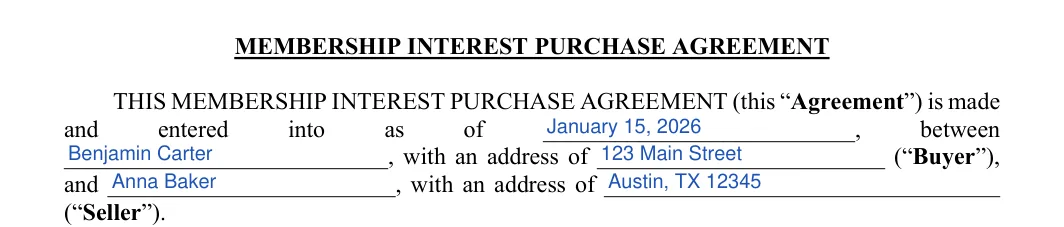

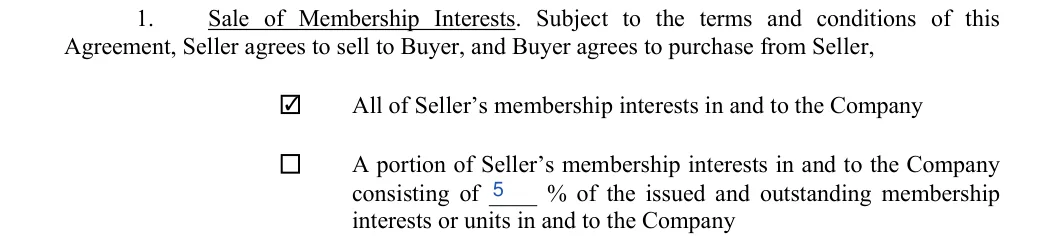



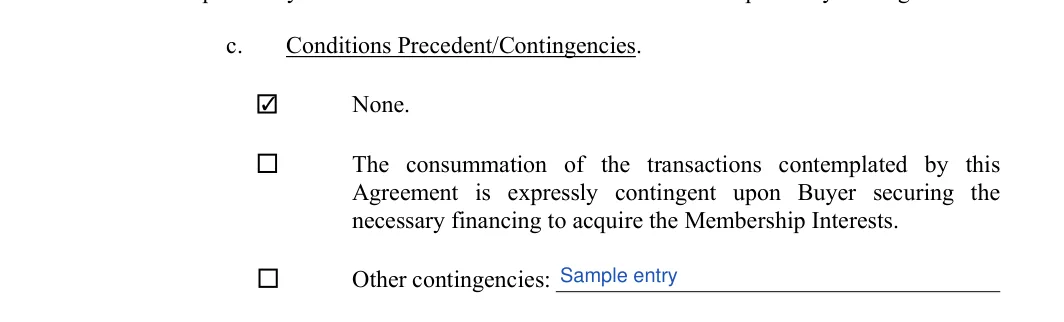
These steps wrap around the form. Some come before you fill it in and some come after, from reading the operating agreement to collecting the signatures. Work through them in order, and keep notes as you go.
At the formation of an LLC, an operating agreement is usually established to provide a roadmap for the company’s operations. This agreement becomes a crucial point of reference during any transfer of interest because it outlines the best practices and procedures for such transactions.
In this step, engaging a legal professional to review the operating agreement is typically beneficial. Sometimes, the agreement might need to be amended to accommodate a new member or transfer interest, ensuring that the updated practices are properly recorded.
The majority of states mandate that all members of the LLC be notified of any impending transfer of interest. This requirement is aimed at ensuring transparency and that everyone in the company is aware of the proposed changes.
Note that some states prohibit the transfer process entirely. In such instances, the LLC would need to be dissolved, and each member would receive their due share. The members could then establish a new LLC if they so desire. In certain scenarios, a buyout or sales agreement might be proposed to facilitate this process.
At times, disagreements among the remaining members regarding the transfer provisions may necessitate intervention by a judge or civil court to establish the interest prices, particularly in cases where no initial operating agreement exists.
Given the absence of federal laws governing this process, it is vital to familiarize yourself with your state’s laws when crafting a purchase agreement. Consult a legal professional if you have any questions or concerns.
During any transfer or transaction, the buyer and seller typically engage in negotiations. Remember that the sale and membership interest prices can have repercussions for all LLC members, so their involvement in the negotiation process is often desired.
In certain cases, a buy-sell agreement is negotiated to provide clarity on the protocols to follow if the interest owner exits the business. The operating agreement might also contain a buy-sell provision that needs to be referenced.
Negotiations are typically smoother and more equitable when facilitated by a legal professional, ensuring all parties receive what they are entitled to.
Once the details about the sale and procedures have been agreed upon, you can proceed to draft the LLC membership purchase agreement. While each agreement may vary slightly, they should all clearly outline the interest percentage, sale price, date of transfer, and terms of transfer.
To finalize the agreement, it needs to be signed by the involved parties and notarized to ensure its legality and enforceability.
Most problems with a purchase agreement come from small details, not big ones. A missing name or a percentage that changes from one part of the form to the next can cause confusion later, and a slow read-through catches most of them.
The percent now owned, the percent being sold in Section 1 and the percent in Section 4(e) should fit together. Compare all three before you sign.
Signing is not quite the end of the job. A few simple habits keep the paperwork easy to find if anyone asks about the sale later, and they take only a few minutes once the deal is done.
Sellers and buyers tend to ask the same few questions before they sign a purchase agreement. Here are short, plain answers to the most frequent ones, based on how the template works.
It is the contract used to sell an ownership stake in a limited liability company. It names both sides, shows how much of the LLC is sold, and records the price and the day the sale closes.
Yes. The form has a box for the whole stake and a box for a portion. Section 1 lets you check all membership interests or a portion, and a portion needs a percent. Section 4(e) then repeats the percent being purchased.
An assignment is a short document that records a transfer. A purchase agreement is longer and sets out the details of the sale, such as the price, the closing date and any conditions that apply.
The form has eight parts to complete:
Yes. Answer a few questions to build the document online, or download the PDF or Word file and fill it in yourself. Any PDF software that lets you type into the fields will work, and so will a printout and a pen. A basic PDF reader is software that most computers already have.
Gather the full legal name and address of each party and of the company, the percent being sold, the price and the closing date. Each address goes on the first page, so having them ready saves time. Check that the data on each page matches your records. A recent report on the company’s finances can help you agree on a fair value.
FormsPal has templates for related contracts and paperwork, such as a membership certificate and a buyout agreement form. These templates cover paperwork that often comes before or after a sale.
A lawyer can read the operating agreement and your draft side by side. That helps most when the sale is large or the operating agreement has unusual wording.
Make a copy for each side and for the company, and keep the signed original somewhere safe with the company records. Store any data you collected, such as payment records, in the same folder.
General information, not legal or tax advice.
