
Updated:
A PA school letter of recommendation is a signed professional reference. The letter comes from a supervisor, instructor or clinician and describes your patient care and character. PA program applicants need one, especially when a program asks for a PA's letter.
Key facts
This page explains who to ask, what the letter includes and how to write it, with three sample letters below. For a general version of this document, use this form.
Build Your Document
Answer a few simple questions to make your document in minutes
Save and Print
Save progress and finish on any device, download and print anytime
Sign and Use
Your valid, lawyer-approved document is ready
A PA school letter of recommendation shows admissions committees how you work with patients and people, something grades and test scores leave out. The letter gives an outside view of your skills, judgment and character from someone who watched you work.
Admissions teams read each application as a whole. Transcripts show what you studied; the letter shows how you behave in a clinic, a lab or a classroom. A strong letter answers three questions for the reader:
Detail carries more weight than praise. A line such as "calm and clear when a patient was frightened before a blood draw" tells the committee more than "excellent people skills".
The letter is part of the application packet for a physician assistant program, alongside your transcripts, your essay and your list of clinical hours. Most programs collect letters while they review applications, so the letter is ready before you submit, not after an interview invitation.
A different letter fits other goals. A job reference for a PA position or a letter for medical school follows the same structure but speaks to a different reader. For those, start from the general recommendation letter and adjust the purpose.
A PA school letter of recommendation works best when the writer has seen your work up close and can back each claim with an example. How well the person knows your work matters more than a grand job title. The person described in the letter is never its author.
A letter from a physician assistant speaks directly to the profession you want to join. Some programs ask for one, so read each program's page before you choose. A physician, nurse practitioner or nursing supervisor from your own department is also a strong choice when they oversaw your patient care.
An academic letter covers how you learn, reason and keep up with demanding coursework. A science professor, a lab instructor, a teaching assistant or a dean who knows you can describe your performance in class and your character.
A manager from a non-medical job can speak to your work ethic, reliability and teamwork. This kind of letter rounds out an application, though it rarely replaces a clinical one.
A weak letter comes from someone who barely knows you. Skip these writers:
A PA school recommendation letter covers the same core parts, whoever writes it. Use this list when you brief your writer or check a draft:
The relationship paragraph tells the committee why the writer's opinion counts. It names the writer's role, the setting where they saw you work and how long they worked with you.
The clinical paragraph describes what you did with patients: the tasks you handled, how you spoke with patients and families and how you worked within a care team. One or two concrete moments make this part credible.
The fit paragraph links your traits to the work of a physician assistant: teamwork with physicians, steady judgment, a habit of learning and care for patients. A writer who knows the PA role can say so in their own words.
A request for a PA school letter of recommendation works best when it comes early and with a clear brief. Writers are busy, and a letter with specific examples takes time to write. Follow these steps:
The brief gives the writer the facts and examples a specific letter needs:
Some applicants draft a letter for the writer to edit. Your writer signs the letter, so it should reflect their own view of you, and the writer edits any draft before signing.
A PA school letter of recommendation follows a simple three-part structure: an opening, a detailed body and a formal closing. There is no strict format for the letter. A clear structure keeps it easy to read.
The opening paragraph states who the writer is and how they know the applicant. A salutation, a sentence of recommendation and the nature and length of the relationship are enough.
The main body gives proof of the applicant's work. It covers the skills the applicant showed, their soft skills and personal traits, and any extra work, projects or activities they took part in.
The closing gives the writer's signature and contact details so the program can follow up. It ends with a formal sign-off, the writer's full name, job title and workplace, and an email address or phone number.
A CASPA letter of recommendation goes to CASPA, the Central Application Service for Physician Assistants, which many PA programs use to collect applications. You add each writer as an evaluator in your application, and the service sends the writer a request to submit the letter.
The CASPA letter reaches every program you apply to through the service, so the writer sends it once rather than to each school. Because of that, the letter speaks to physician assistant programs in general and names no single school. A program outside CASPA explains its own way to send letters on its admissions page.
A PA school letter of recommendation gets stronger or weaker through small choices in who you ask and how the letter reads.
Avoid these mistakes:
Do these things instead:
Pick the sample that best fits the person writing your letter. Sample 1 comes from a lab supervisor, Sample 2 from a doctor and Sample 3 from a department supervisor. Adapt the sample you choose with these steps:
To whom it may concern,
I have been working with ______ (the applicant's name) for _____ (how long). I supervised the physician's office laboratory at _____ (the writer's workplace), where ______ (the applicant's name) worked as a _____ (the applicant's job title) with excellent results.
______ (the applicant's name) is a hardworking person, always eager to develop new skills and gain new knowledge. (He or She) has strong interpersonal skills and has always worked well with colleagues and staff.
(His or Her) performance is outstanding: ______ (the applicant's name) is reliable, kind and responsible, and has shown steady growth in the role.
(He or She) gave useful feedback on day-to-day operations and helped the team decide difficult cases. On a personal level, (he or she) is _____ (the applicant's best and most distinctive traits).
Beyond (his or her) daily work, ______ (the applicant's name) took part in ______ (extra projects, conferences or activities). (He or She) worked on this for _____ (how long) alongside regular duties, which shows excellent time management.
I recommend ______ (the applicant's name) with enthusiasm as a physician assistant candidate. Please contact me with any further questions.
_______ (the writer's signature)
_______ (the writer's full name and job title)
_______ (the writer's workplace)
_______ (the writer's address and phone number)
Dear _____ (the recipient's name),
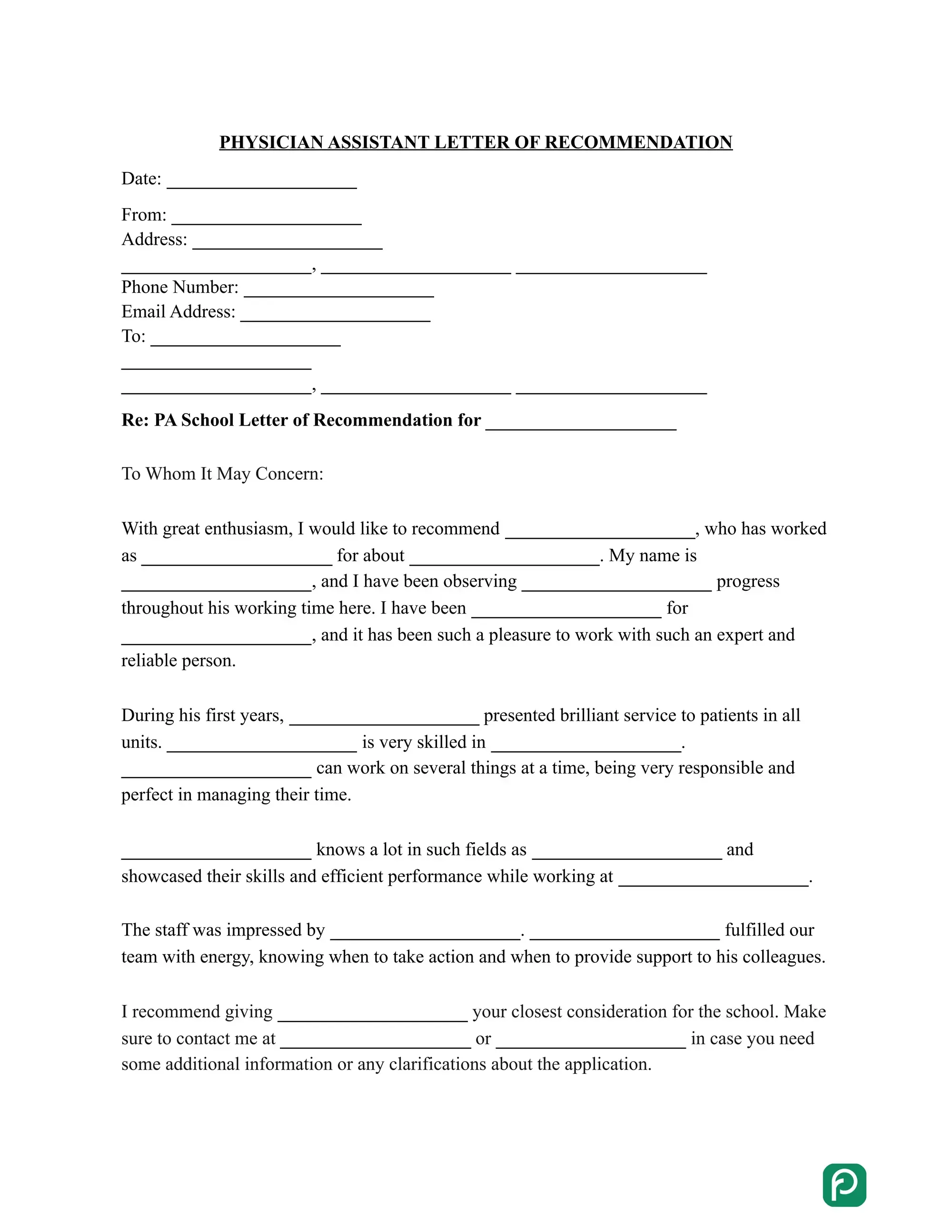
With great enthusiasm, I recommend ______ (the applicant's name). (He or She) has worked as ______ (the applicant's role) under my supervision for _____ (how long).
My name is _____ (the writer's name), and I have been a _______ (the writer's position) for _____ (how long). I have followed the progress of ______ (the applicant's name) throughout (his or her) time here, and it has been a pleasure to work with such a capable and reliable person.
From the start, ______ (the applicant's name) gave patients excellent care in every unit. (He or She) is skilled in ______ (the applicant's areas of skill and accomplishments) and knows a great deal about ____ (subjects the applicant has studied).
______ (the applicant's name) handles several tasks at once, takes responsibility and manages time well. The staff was impressed by (his or her) energy and by how (he or she) knew when to act and when to support colleagues.
I recommend giving ______ (the applicant's name) your closest consideration for _____ (the program). Please contact me at _____ (the writer's email address or phone number) if you need more information.
Sincerely,
_______ (the writer's signature)
_______ (the writer's full name and job title)
_______ (the writer's workplace)
Dear ______ (the recipient's name),
I am pleased to recommend ______ (the applicant's name) to you. My name is _____ (the writer's name). I supervised _______ (the applicant's name), who studied in my department for ____ (how long).
______ (the applicant's name) would be an excellent fit for a physician assistant program. (He or She) is hardworking, patient, kind, reliable and _____ (other traits).
During (his or her) studies in my department, the student gained ______ (the applicant's skills) and completed _____ (tasks and study projects). (His or Her) performance was outstanding, and I enjoyed supervising such a student.
I believe that _____ (the applicant's name) will be a great asset to your physician assistant program. If you have any further questions about the student, please contact me at _____ (the writer's email address or phone number).
Best regards,
_______ (the writer's signature)
_______ (the writer's full name and job title)
_______ (the writer's workplace)
The number of letters varies by program, so each program's admissions page is the place to check. Many applicants line up an extra writer in case a letter arrives late.
A letter from a PA is asked for by some programs and only preferred by others. Read each program's letter rules before you choose your writers.
Your writer signs the letter, so it should reflect their own view of you. You can share a draft as a starting point, and the writer can edit it before signing.
A letter sent through CASPA goes to every program on your list, so the writer cannot adjust it for one school. A school-specific version is possible only for a program that collects its letters outside CASPA.
The request goes out well before your first application deadline. Early requests give the writer time to write a specific letter and give you time to replace a writer who says no.
A few quick steps keep the letter ready for your application:
General information, not legal or tax advice.
