
Updated:
A letter of recommendation thank you note is a brief written thanks. The note thanks the author of your recommendation letter and shares the outcome of your application. Students, graduates and job seekers send one, especially after an offer or an admission.
This guide explains when to send the note, what goes in each part, how to write it step by step, and how to adapt the sample notes below to your own referee.
Key facts
Build Your Document
Answer a few simple questions to make your document in minutes
Save and Print
Save progress and finish on any device, download and print anytime
Sign and Use
Your valid, lawyer-approved document is ready
A thank you note for a recommendation letter is a short, formal message to the person who wrote your reference, sent to show that their time and effort mattered to your application. The person who writes the recommendation is called the referee, the recommender or the author.
The note differs from a general thank you card in one way: it reports back. The referee vouched for you to a school or an employer, so the note tells them where the letter went and what happened next.
A recommendation letter, also called a reference letter, is often used when applying for a job or for admission to an academic institution. It is sent along with the CV and application letters, and the person who writes it is called the referee or the author.
In the letter, the author describes the applicant's character, skills and abilities. The letter gives the school or employer a second voice on the applicant, and the reader can contact the author with questions.
A recommendation letter usually contains:
A thank you note for a letter of recommendation goes out soon after the referee submits the letter, and a second short message follows once you hear the result of your application. Many applicants send thanks at three points, each with a different message.
A first thank you, sent when the referee says yes, is short and practical. The message thanks the referee for agreeing, confirms the deadline and the address for the letter, and offers your resume or any notes that make the writing easier.
The main thank you note goes out once the school or employer confirms that the letter arrived. This note thanks the referee for the time the letter took and names the program or job it supports.
A final update tells the referee the outcome: an admission, an offer, a waitlist or a rejection. Referees like to know how the story ends, and the update keeps the door open if you ask for another letter later.
A thank you note for a recommendation letter keeps a good relationship with the referee after the favor is done, which matters if you need another letter for the next school, scholarship or job. A quick "thanks for the recommendation" email is polite, but a formal note says more.
A thank you note for a recommendation letter has a salutation, a thank you, the outcome, one specific detail and a closing, and the printed version adds a date and a signature. Each part has one job.
A thank you letter for a letter of recommendation follows the order of a formal letter: heading, date, greeting, body and closing. Each step below takes a minute or two, and the finished note works by email or on paper.
A thank you note for a recommendation letter works as an email, a handwritten card or a printed letter; the right choice depends on how often you see the referee and how formal your relationship is.
An email reaches a busy referee fast and suits a professor or manager you rarely see in person. The email keeps the same parts as a letter, with a clear subject line and no signature line.
A handwritten card feels more personal and suits a teacher, counselor or coach you see often. The card needs only a few sentences: the thanks, the outcome and your name. Hand it over in person if you can.
A printed letter is the most formal choice and follows the full structure above, with the date, a heading and your signature after the closing.
A thank you note for a job reference thanks a former manager, colleague or client who spoke or wrote for you to a hiring employer. The note follows the same parts, with a few differences in tone.
A thank you note for a recommendation letter goes wrong most often when it is late, generic or never sent. These are the mistakes referees notice.
The sample thank you notes below cover a professor after an admission, any referee, a job reference and a referee who has just agreed to write. Each sample is a starting point to change so it matches your own story.
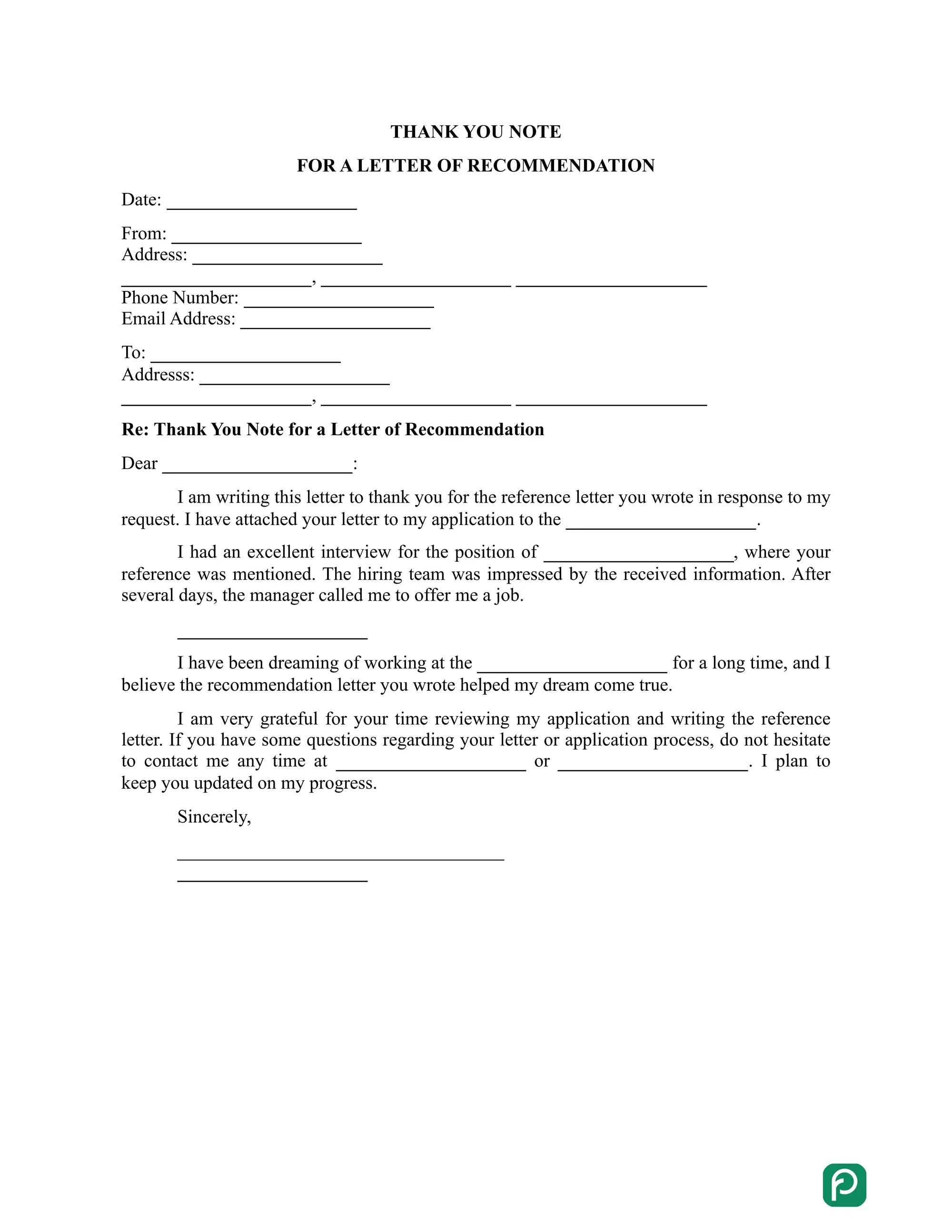
Thank You for a Recommendation Letter
___________________, 20___
(write the date here)
Dear ______________, (enter your professor's name here)
I am writing to thank you for the reference letter you wrote a couple of weeks ago. I attached your letter to my application to _______________ (insert the school where you sent the letter). I have since passed the exams and attended the interview, where your recommendation was mentioned, and I described the work we did together.
I believe that without your letter, the admission process would have been much harder. The school's representatives were glad to receive it. Thank you very much for the reference letter. If there is ever anything I can do for you in return, please do not hesitate to ask.
Best regards,
_____________ (type your name here)
_____________ (add your signature here if the letter will be printed out)
Thank You for a Reference Letter
___________________, 20___
(write the date here)
Dear ______________, (enter the referee's name here)
Thank you very much for the reference letter you wrote at my request. I am especially grateful that you found the time to write it on such short notice despite your busy schedule.
I sent your letter to _________________ (indicate where the letter was sent) as part of my application, and I believe it made a real difference. Your reference came up during the interview, and the hiring team said they were impressed by what you wrote.
I do not think I would have gotten the position without your help, because you highlighted exactly the qualities they were looking for. If you ever need anything from me, please reach out at any time, and I will do my best to help.
Sincerely,
_____________ (insert your name here)
_____________ (leave your signature here if you print out your letter)
Subject: Thank you for the reference
Dear ______________, (enter your former manager's name here)
Thank you for speaking with ______________ (insert the company name) about my work on your team. I am happy to tell you that they offered me the ______________ (insert the job title) position, and I start next month.
The hiring manager mentioned how clearly you described my work on ______________ (insert a project), and I know your words carried weight. I hope we stay in touch, and please let me know if I can ever return the favor.
Best regards,
_____________ (type your name here)
Subject: Thank you for agreeing to write my recommendation
Dear ______________, (enter the referee's name here)
Thank you for agreeing to write a letter of recommendation for my application to ______________ (insert the program or employer). The letter is due on ______________ (insert the deadline), and the submission link is ______________ (insert the link or address).
I have attached my resume and a short list of the projects we worked on together, in case they help. I will let you know as soon as I hear back.
With thanks,
_____________ (type your name here)
A short thank you message suits a text, a card or a quick email. Each line below can stand alone or open a longer note.
Send a short note that thanks them, names where the letter went and shares the outcome. One personal detail about how the letter helped makes the thanks feel sincere.
Send it soon after your referee writes the letter, or as soon as you hear back about your application, and if you have news such as an offer or an acceptance, include it in the note.
Yes, a thank you note is still right after a rejection. The referee did the work either way, and a short update tells them the letter arrived and that you value their help for the next application.
About half a page is enough. A few sentences that thank your referee, share the outcome of your application, and offer to return the favor are all you need.
It is a good idea to thank every referee. Write a separate note for each person and mention something specific about how that person supported your application.
A gift is optional, and the note alone is enough. A referee wrote the letter as a favor, not for a reward, so a sincere note with real news is the thanks that counts.
A brief reply that thanks them again and shares any next step is enough. The exchange keeps the relationship warm for the next time you need a reference.
General information, not legal or tax advice.
