
The artist release form (also known as artwork release form or art release form) is a legal document signed to protect copyrights. It could be a work of any type of art: music, visual arts, literature, graphic arts, performing arts, and decorative arts. Fill in the free template below online, then print, sign and keep a copy.
Last Updated: October 2026. This guide is reviewed and updated regularly to reflect current law. If you notice an error or outdated information, please contact us.

Build Your Document
Answer a few simple questions to make your document in minutes
Save and Print
Save progress and finish on any device, download and print anytime
Sign and Use
Your valid, lawyer-approved document is ready
Suppose a business entity, large enough to compensate for any artwork, gets interested in something you have created as an artist. In that case, they have to use the release of liability form to obtain legal proof that they can display your work for private or commercial purposes.
A person who has created a work of art (painting, film, song, dance) has a right to claim monetary compensation for their creation when they consent to a business’s use of the work for promotion or production. In this case, the form will indicate that the buyer has copyrights and that an artist has received some compensation for the piece.
If there is no artist release form, an artist can litigate a case and define the sum of money that a person who has used the piece illegally must pay as compensation. For example, if your soundtrack has been used in a film without your permission, you are encouraged to defend your rights and make a legal claim against the filmmaker for violating copyrights.
Two parties appear on the FormsPal template, and each has its own part to fill in.
There are many situations when an artist release form may help you protect your rights. The form is mostly used when famous labels and big companies want to use intellectual property legally. The list includes but is not limited to the following occasions:
There are many other situations in which an artist release form comes into play. It is always a great idea to obtain an artist’s permission if they are paid for a creative piece. It can help a company avoid legal cases in court and other confusing moments.
If you obtain the right to use another person’s intellectual property entirely for free, it is still recommended to complete the form to guarantee your copyrights’ protection. It is also worth mentioning that although after selling or giving away an artwork, the owner lets the buyer use it for established purposes, the creator still has a right to include it in their portfolio or use it for the promotion of their talent.
| Document Name | Artist Release Form |
| Other Names | Artwork Release, Graphic Design Release |
| Avg. Time to Fill Out | 5 minutes |
| # of Fillable Fields | 8 |
| Available Formats | Adobe PDF |
The FormsPal artwork release template fits on a single page and contains eight fillable fields. They fall into five distinct parts, and understanding what each part requests makes the individual blanks considerably quicker to complete.
You are welcome to use our form-building software to obtain the needed file. After you have completed the paper, print it, and keep the original document in a safe place. You can also open the downloaded PDF in the FormsPal PDF editor to type your answers. The template is one page long, so filling it out takes two steps.
The screenshots under each step show the FormsPal Artist Release template filled with sample entries in blue, so you can see where each answer goes. The names, addresses, dates and amounts are examples only.


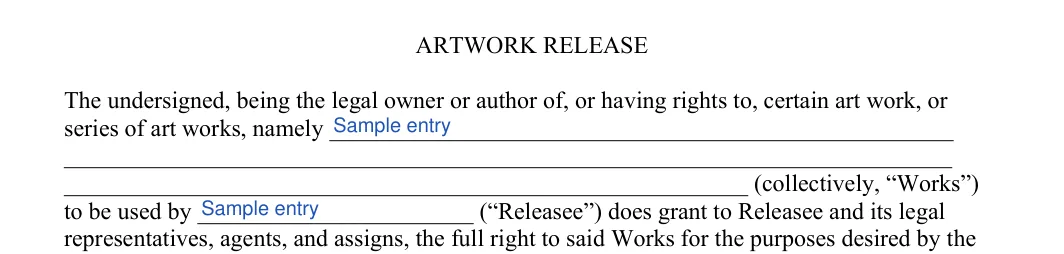
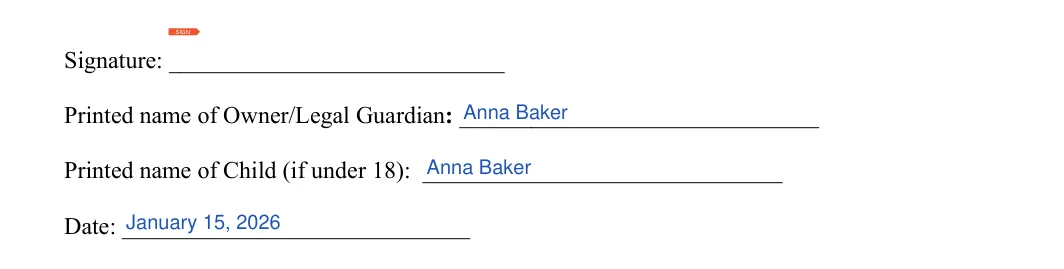
Talk the deal through with the other party before the paperwork is finished. These three steps cover the negotiation, the conditions you agree on and the signature, and they work alongside the blanks you filled in above.
The table below shows how a completed template could look. All of the entries are fictional, so replace them with your own information before you print the form or send it to the other party for review.
| Part of the form | Sample entry |
|---|---|
| Art works | Harbor Sunrise, oil on canvas, 2024 |
| Releasee | Blue Door Gallery |
| Signature | Signed by hand by Anna Baker |
| Printed name of owner or legal guardian | Anna Baker |
| Printed name of child | Empty, because the owner is an adult |
| Date | January 15, 2026 |
An artwork release appears in many everyday creative projects, from gallery exhibitions to commissioned illustrations. The three examples below demonstrate how different professionals use the same one-page template, and each of them begins with a clear description of the artwork.
Most complications with a release originate from small gaps in the paperwork, and a careful review of the finished form catches the majority of them, so read every line one more time while keeping the other party's perspective in mind.
Some projects need more than one release. FormsPal also offers a photo release form for projects that include photographs, a model release form for shoots with a model and a photography copyright release form for photographers. Each of these is a free template that you can complete online, print and store alongside your artwork documentation.
It is a one-page form that lets the owner of an artwork give another party the go-ahead to use that work. In the FormsPal template, that party is called the Releasee.
The two names describe the same kind of form. You may also see it called a graphic design release.
Yes. The template has three Art works lines for describing a single piece or a series of artwork. For a series, give the series name and a short description, such as Harbor Series, ten oil paintings from 2024.
The owner of the artwork adds a handwritten signature on the Signature line and prints their name below it. The template also has a line for a child's printed name, which you fill in only when the owner is under 18.
Keep a completed copy with your artwork records and give an identical copy to the other party. If you filled out the form online, print it first so that both copies are exactly the same.
Yes. Open the free template, type the artwork description and the Releasee into the fillable fields, and then print the completed page for signing.
Give the collection a title, then add the year or period and a short description of the medium, because a line such as Studio Prints 2022 to 2024, screen prints on paper keeps the identification of the whole collection clear.
General information, not legal or tax advice.
