
Updated:
A car accident release of liability is a signed claim settlement. The injured party accepts a payment and gives up further claims against the other driver for that accident. FormsPal offers a free template to fill out online or download as a PDF.
Build Your Document
Answer a few simple questions to make your document in minutes
Save and Print
Save progress and finish on any device, download and print anytime
Sign and Use
Your valid, lawyer-approved document is ready
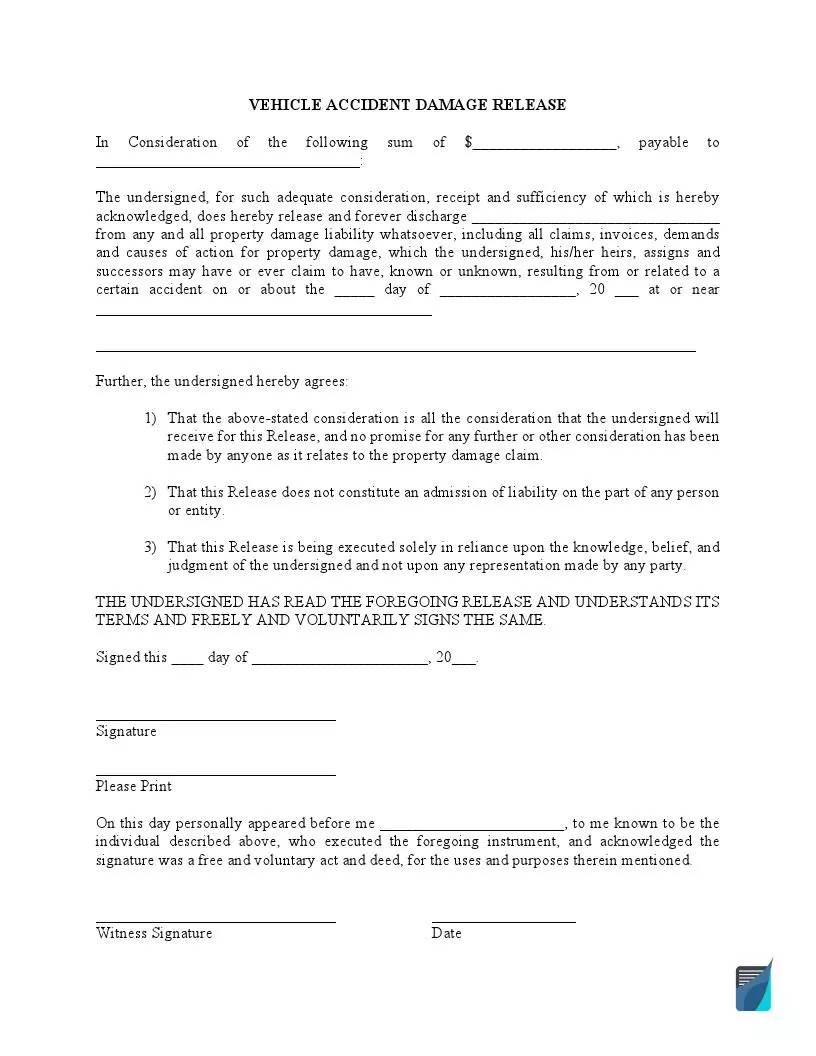
A car accident release of liability form is a short agreement in which one person accepts an agreed sum for crash damage and promises not to sue the other person over that accident. People also call it a car accident settlement agreement, a release of all claims or an accident waiver.
The person who gives up the claims is the releasor. The person who is let off the hook is the releasee, usually the driver who caused the damage or that driver's insurer. Once both sides sign, the release closes the dispute over that one accident.
Drivers, passengers and vehicle owners use it after a minor collision, often when the two sides prefer to settle a dented bumper or a small injury between themselves. Insurance companies use the same kind of document, often titled a release of all claims, before they pay a settlement. This page is one of the types on our release of liability form page.
A car accident release of liability form names both parties, describes the accident, sets the payment and says which claims end once it is signed. Read each of the parts below before you sign a release, whether you write it yourself or an insurer sends it to you.
| Document Name | Car Accident Release of Liability Form |
| Other Names | Car Accident Settlement Agreement, Release of Claims |
| Avg. Time to Fill Out | 7 minutes |
| # of Fillable Fields | 16 |
| Available Formats | Adobe PDF |
The release opens with the full name and mailing address of each party, with the city where each one lives. It then says that both parties sign knowingly and on purpose, to end the claims between them.

The scope clause says that the releasor frees the releasee from all claims for vehicle damage and injury caused by the accident, and it gives the date of the accident. Some releases also name claims from the same accident that the releasor does not yet know about when signing. That clause is the reason to wait until injuries and repair costs are clear.

This clause keeps the releasor's claims against anyone else who is not named in the release, such as another driver or a parts maker. Without it, a broad release could be read as ending those claims too.

The non-admission clause says that the releasee pays without admitting fault for the accident. It lets the at-fault side settle without signing an admission that could be used against it later.
The compensation clause gives the exact amount agreed by the parties or offered by the insurer, and the name of the person who receives it. Write the amount in words and in figures so the two can be checked against each other.

The closing clause usually says that the release binds each party's heirs, executors, administrators, legal representatives and assigns as well. Check whether anyone else with a claim from the accident, such as a spouse, needs to sign the release too. The signatures and the dates they were made come last.

Maryland limits when a release can be taken from an injured person in a hospital, according to Md. Code, Cts. & Jud. Proc. § 5-401.1. Our legal sources hold no rule of this kind for the rest of the country, so the table covers Maryland only.
| Rule | Condition | Source |
|---|---|---|
| No settlement talks and no general release from the patient for 15 days from the date of the occurrence that caused the injury (Md. Code, Cts. & Jud. Proc. § 5-401.1) | Only when the injured person is confined to a hospital or sanitarium as a patient and the other side's interest is or may become adverse | Md. Code, Cts. & Jud. Proc. § 5-401.1 |
| A settlement or general release taken against that rule may not be used in evidence or for any purpose in a legal action about the injury (Md. Code, Cts. & Jud. Proc. § 5-401.1) | Only when it was obtained from a patient confined to a hospital or sanitarium contrary to the section | Md. Code, Cts. & Jud. Proc. § 5-401.1 |
| A release signed by a person with personal injuries does not discharge a subsequent tortfeasor (Md. Code, Cts. & Jud. Proc. § 5-401.1) | Only when that person is not a party to the release and either was not known to be responsible at signing or is not specifically identified in the release | Md. Code, Cts. & Jud. Proc. § 5-401.1 |
The last row is why the release should name every person and company it frees. In Maryland, a personal injury release does not discharge a subsequent tortfeasor who is not a party to it and who either was not known to be responsible at signing or is not specifically identified in it (Md. Code, Cts. & Jud. Proc. § 5-401.1).
A car accident release settles claims after a crash has happened, while an activity liability waiver gives up claims before a risky activity starts. Searches for a "release of liability waiver" mix the two, but the documents do different jobs.
In California, a contract whose object is to exempt anyone from responsibility for their own fraud, willful injury to the person or property of another, or violation of law is against the policy of the law, under Cal. Civ. Code § 1668.
In Minnesota, an agreement for a consumer service, including a recreational activity, that releases one party from liability for conduct greater than ordinary negligence is void and unenforceable, under Minn. Stat. § 604.055.
In Wyoming, the recreation liability section grants no immunity to a person who causes damage by the negligent operation of a motor vehicle, according to Wyo. Stat. Ann. § 1-1-125.
If you need a waiver for an event, a sport or a rental rather than a crash settlement, pick another type on our release of liability form page.
A car accident settlement usually moves through these steps: gather the facts, agree on the amount, deal with the insurers, read the release, then keep a signed copy. The release is the last document in that chain, not the first.
Collect the other driver's name, contact details, insurer and policy number at the scene, along with photos of both vehicles and the road. If the police come, ask how to get a copy of their report. These details show who caused the crash and support the amount you agree on later.
The compensation covers what the accident cost the injured party: vehicle repairs, medical bills and time missed from work. Add up repair estimates and bills before you name a figure, because the release ends the claim at the amount written in it.
The insurer will usually send its own release of all claims with the settlement offer. Compare its wording with the parts listed above before anyone signs.
Use the insurer's form, or fill out the FormsPal template on this page when the two drivers settle between themselves. Read the scope clause closely: if its wording covers unknown claims, a later injury from the accident is usually not paid on top of the agreed sum. Check whether the form you sign has such a clause.
Each party keeps a signed copy, and the insurer keeps one when it pays. The signed release is the proof that the claims ended if either side tries to reopen the dispute later.
These steps follow the FormsPal template that you can download from this page, from the top of the form to the signature lines. Fill in every line with care, because a missing name, date or amount leaves room for a new claim against the releasee.
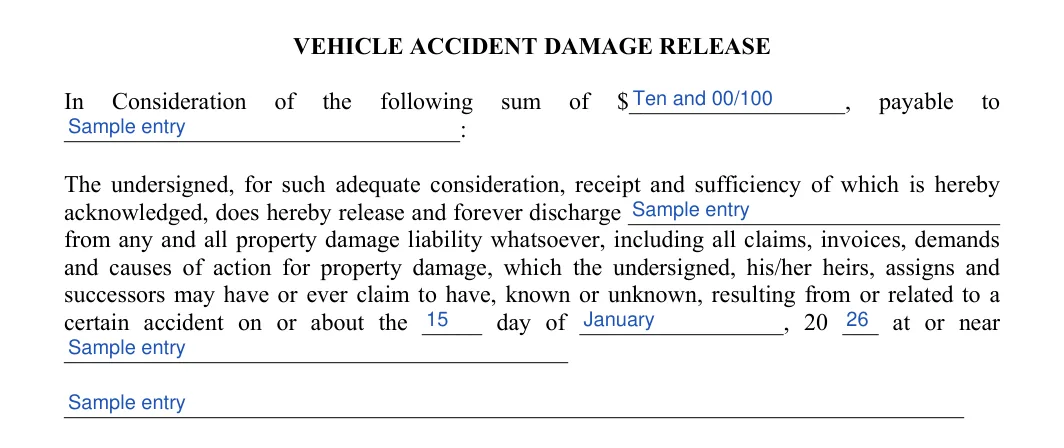
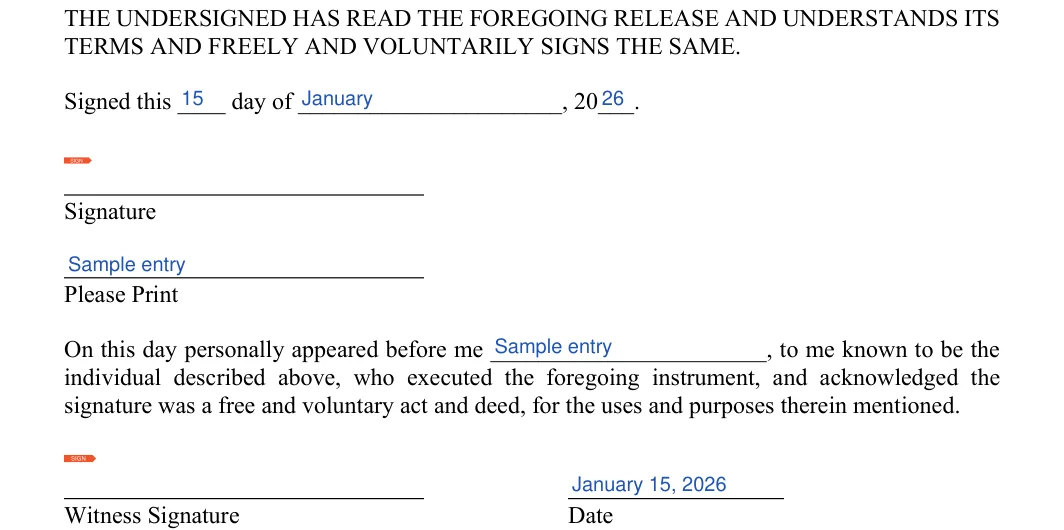
The screenshots under each step show the FormsPal Car Accident Release of Liability template filled with sample entries in blue, so you can see where each answer goes. The names, addresses, dates and amounts are examples only.
On page 1, fill in the first block of the form:
The three numbered agreements below the release paragraph are preprinted, so read them and move on.
Read the statement that begins "The undersigned has read the foregoing release", then complete the signing block:
Yes. Select Create My Document and answer a few questions, and FormsPal builds the document for you. You can also download the PDF and type into its fillable fields in the FormsPal PDF editor. Print the finished form afterward and sign it by hand.
The PDF has 16 fillable fields. They cover the amount, the person who receives it, the person released, the date and place of the accident, the signing date, the signer's name and the witness lines.
Write it in the first block of the form, after "In Consideration of the following sum of". Then write the name of the person who receives the money on the "payable to" line.
Wait until a doctor has checked the injuries and the repair costs are known before you sign.
Yes, the template is titled Vehicle Accident Damage Release and does not name a type of vehicle. Its lines ask for the parties, the amount, and the date and place of the accident, which fit a truck, van or motorcycle crash as well as a car.
An insurer's release of all claims does the same job as this form: it ends your claims over the accident in exchange for the settlement payment. Read the insurer's version for who it releases and which claims it covers, since its wording may be broader than a release written between two drivers.
Print one copy for each person and sign each copy. Keep your signed copy with your photos, repair estimates and insurance emails.
General information, not legal or tax advice.
