
Updated:
A partial release of lien waives lien rights for one progress payment. The contractor signs it once paid; its wording sets which unpaid amounts stay open. Contractors paid in stages use it; this page shows how to fill it out.

Build Your Document
Answer a few simple questions to make your document in minutes
Save and Print
Save progress and finish on any device, download and print anytime
Sign and Use
Your valid, lawyer-approved document is ready
Key facts
A partial release of lien is a signed waiver of lien rights tied to one progress payment, given by the party who did the work or supplied the materials. The document confirms that this payment arrived and that the signer gives up a lien claim for it. Many forms word that waiver as all work through a stated date, often except retention and disputed extras, not only the payment's dollar amount.
A mechanics lien is a claim against real property by someone who improved it and was not paid. The partial release trims that claim by what its wording covers. Work it excludes stays open to a lien, but only while the signer's claim stays timely.
The document goes by several names: partial lien waiver, partial lien release, partial waiver and release upon progress payment, and subcontractor partial lien waiver. Each name points to the same paper: one payment, one waiver.
| Document Name | Partial Release of Lien Form |
| Other Names | Partial Lien Waiver, Subcontractor Partial Lien Waiver |
| Avg. Time to Fill Out | 7 minutes |
| # of Fillable Fields | 14 |
| Available Formats | Adobe PDF |
A partial lien waiver fits any project paid in stages, where each progress payment closes out part of the contract price. The owner or general contractor asks for one before or in exchange for each payment, so the property stays clear of claims for work already paid.
The waiver covers subcontractors, material suppliers, equipment renters and the general contractor alike. A long remodel or a new build often produces a stack of them, one per payment and per payee.
Before preparing the form, gather these papers:
A final release, not a partial one, fits the last payment on a contract. See the mechanics lien release form for releases of a whole lien.
A conditional partial waiver takes effect only when the named payment actually reaches the signer, while an unconditional one takes effect as soon as it is signed. The difference decides who carries the risk of a check that does not clear.
The template on this page is a waiver for one progress payment. Read its release wording to see which kind it is before signing, and match it to what the contract asks for.
A partial release of lien is signed by the party who receives the payment: the contractor, subcontractor or supplier that holds the lien rights being waived. The owner or general contractor who pays does not sign it.
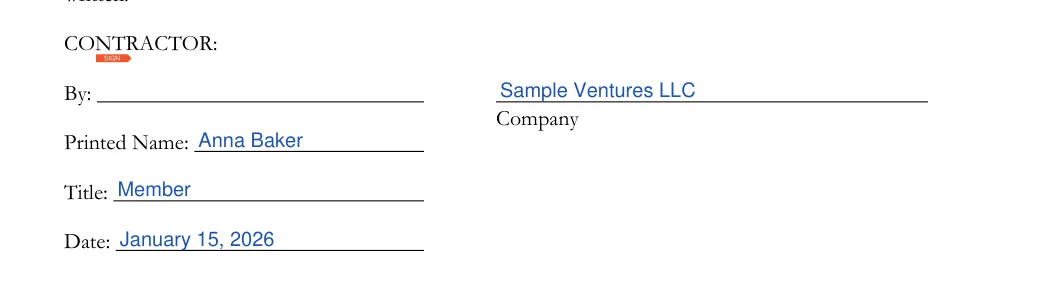
On this template, the signer completes the Contractor block: company name, signature on the By line, printed name, title and date. A company signs through an officer, member or manager who has authority to bind it.
The waiver names the parties, the project, the contract and the payment amount, so anyone reading it later knows exactly which money it released. Each entry on the form serves that purpose:
A partial release works best when the invoice and the payment line up before anyone fills in the form. A short sequence avoids disputes over which work the money covered:
Paying several subcontractors at once is simpler with one waiver from each payee. A joint check made out to the contractor and a supplier helps confirm that both were paid.
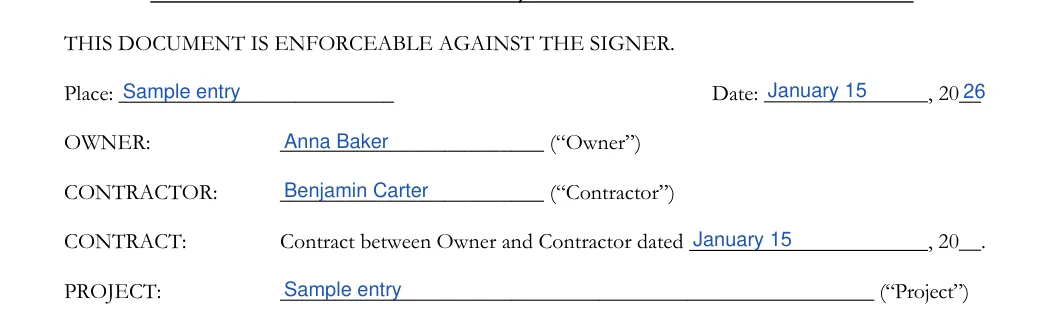
The form takes three groups of entries: the header with parties and project, the payment amount, and the signature block. The steps below follow the template on this page in the order the form asks for each entry.
The screenshots under each step show the FormsPal Partial Release of Lien template filled with sample entries in blue, so you can see where each answer goes. The names, addresses, dates and amounts are examples only.




For questions about the wording or about a payment dispute, ask a construction attorney before signing.
The signed release becomes useful to the payer once it is signed and in the payer's hands. The signer checks the amount, signs and hands over the original:

Related documents for the end of a project sit on the release of liability form page.
The waiver's wording and signing formalities vary from state to state, and some states publish their own waiver forms. The facts behind this page hold no state lien statute, so this page lists no state rule.
Before using the general template, compare it with any form your state or county publishes for lien waivers. A project in a state with its own wording often expects that wording on every waiver.
A Florida project may expect waiver wording drawn from Florida's construction lien statute, which this general template does not claim to track. Ask the owner, the lender or a Florida construction attorney which waiver wording the project uses before signing.
A partial release of lien differs from a final release and from a mortgage partial release in what it frees and who gives it. The three documents share a name but not a purpose.
A final release waives lien rights for the last payment and closes the signer's claim on the project. A partial release leaves the claim open for every payment still to come.
A mortgage partial release frees part of a mortgaged property, such as one lot, from the lender's lien while the loan stays in place. The lender gives that release, not a contractor, and it has nothing to do with payment for construction work.
The waiver is easiest to fix before it leaves the signer's hands. Read it once from top to bottom against this list:
The sample table shows one way to fill in each line with made-up entries. Replace every name, date and amount with the details of your own contract and project.
| Line on the form | Sample entry |
|---|---|
| Place | Springfield |
| Date | January 15, 2026 |
| Owner | Anna Baker |
| Contractor | Benjamin Carter |
| Contract dated | December 1, 2025 |
| Project | Kitchen remodel at 123 Main Street |
| Payment Amount | $2,500.00 |
| Company | Sample Ventures LLC |
| Printed Name | Benjamin Carter |
| Title | Member |
| Date (signature block) | January 15, 2026 |
The waiver needs a notary only where the state or the project's contract asks for one; this page holds no notarization rule for lien waivers. Ask the owner or general contractor before signing, and use a notary when the form carries a notary block.
A lien waiver and a lien release are often used as two names for the same document. A release of lien can also mean a paper that cancels a lien claim already recorded against the property.
The party who made the payment keeps the signed original, usually the owner or the general contractor. The signer keeps a copy with the invoice and proof of payment.
The waiver works the same way for a payment from the general contractor. On this template, the subcontractor enters its own company in the Contractor block.
A partial waiver covers what its own wording names: a payment amount, or all work through a stated date, often except retention and disputed extras. A waiver through a date can reach work billed in earlier payments, so the signer reads the through date and the exceptions before signing. A separate waiver for each progress payment keeps every amount easy to trace.
General information, not legal or tax advice.
