
Updated:
A mortgage lien release form is the lender's signed proof of payoff. The release, also called a satisfaction of mortgage, confirms the loan is paid and lifts the lien. Homeowners need it after the final payment, especially before selling or refinancing the property.
This page explains what the release includes, how to fill it out and sign it, how to ask the lender for it, and how to check that it reached the county land records. The release is one kind of release of liability form: it frees the property, not a person, from a claim.
Key facts
Build Your Document
Answer a few simple questions to make your document in minutes
Save and Print
Save progress and finish on any device, download and print anytime
Sign and Use
Your valid, lawyer-approved document is ready
A mortgage lien release form is the document a lender signs to say a mortgage loan is paid in full and its claim on the property has ended. The release turns a private payoff into a public fact once the county enters it in the land records.
A mortgage gives the lender a lien: a claim against the home that secures the loan. Paying off the loan ends the debt. The release is the signed paper that shows the lender gives up its claim on the home.
A mortgage release matters at the moment the property changes hands or serves as security again. A buyer's title company, a new lender or an insurer reads the land records, and an open mortgage there raises a question someone needs to answer.
A mortgage lien release is a release of the property from the lender's claim, not a waiver of injury claims like a sports or activity release. Searchers who type "mortgage release of liability" usually mean one of two documents.
A deed of reconveyance does the same job for a deed of trust that a satisfaction of mortgage does for a mortgage. Under a deed of trust, a trustee holds title for the lender, and the reconveyance returns that title to the owner after payoff. The loan papers name which of the two instruments secures the loan, and that tells you which release to ask for.
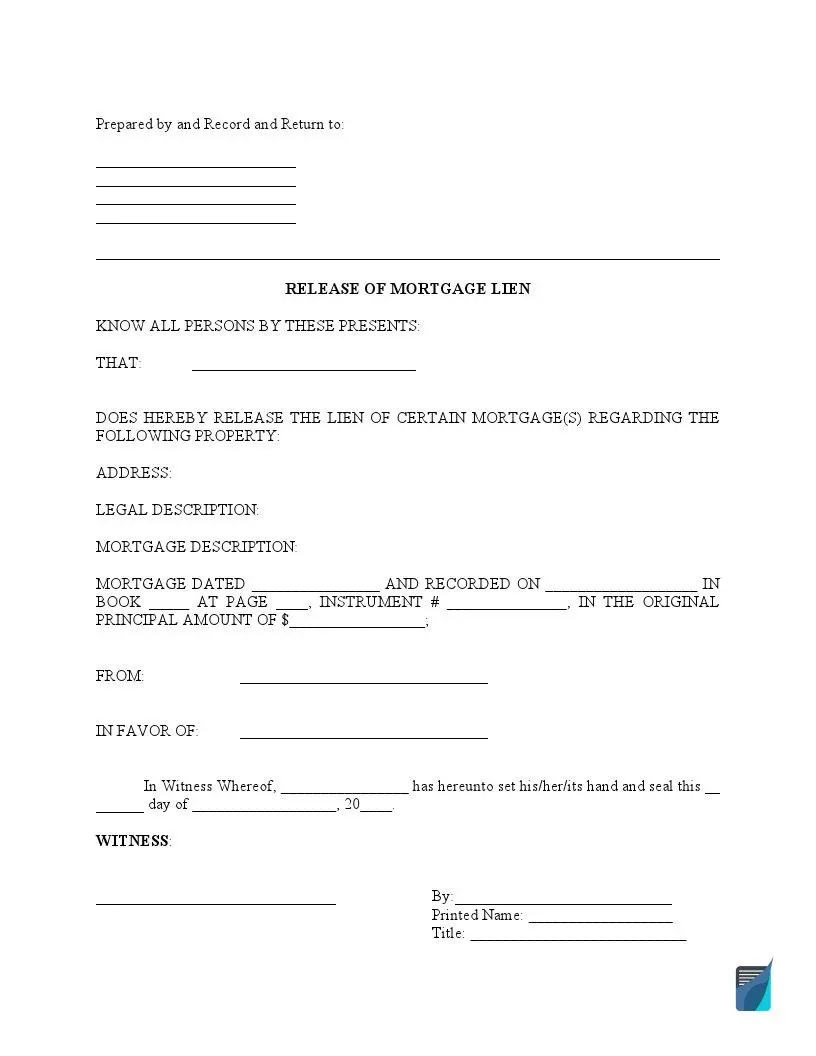
A mortgage release form includes the parties, the loan, the payoff and the property, so that the lender, the notary and the recording office all work from the same facts. The form is short, and each line ties the release to one loan and one parcel.
The legal description and the recording reference link the release to the right mortgage in the land records. A street address alone can match more than one parcel, and a county clerk indexes the release against the original mortgage, not against the house.
Copy the legal description word for word from the recorded mortgage or the deed. Take the book and page, or the instrument number, from the stamp on the first page of the recorded mortgage.
| Document Name | Mortgage Lien Release Form |
| Other Names | Satisfaction of Mortgage, Property Lien Release |
| Avg. Time to Fill Out | 11 minutes |
| # of Fillable Fields | 31 |
| Available Formats | Adobe PDF |
A mortgage lien release moves from the lender to the county in five steps after the final loan payment. The order matters: a release checked before signing saves a second round with the lender.
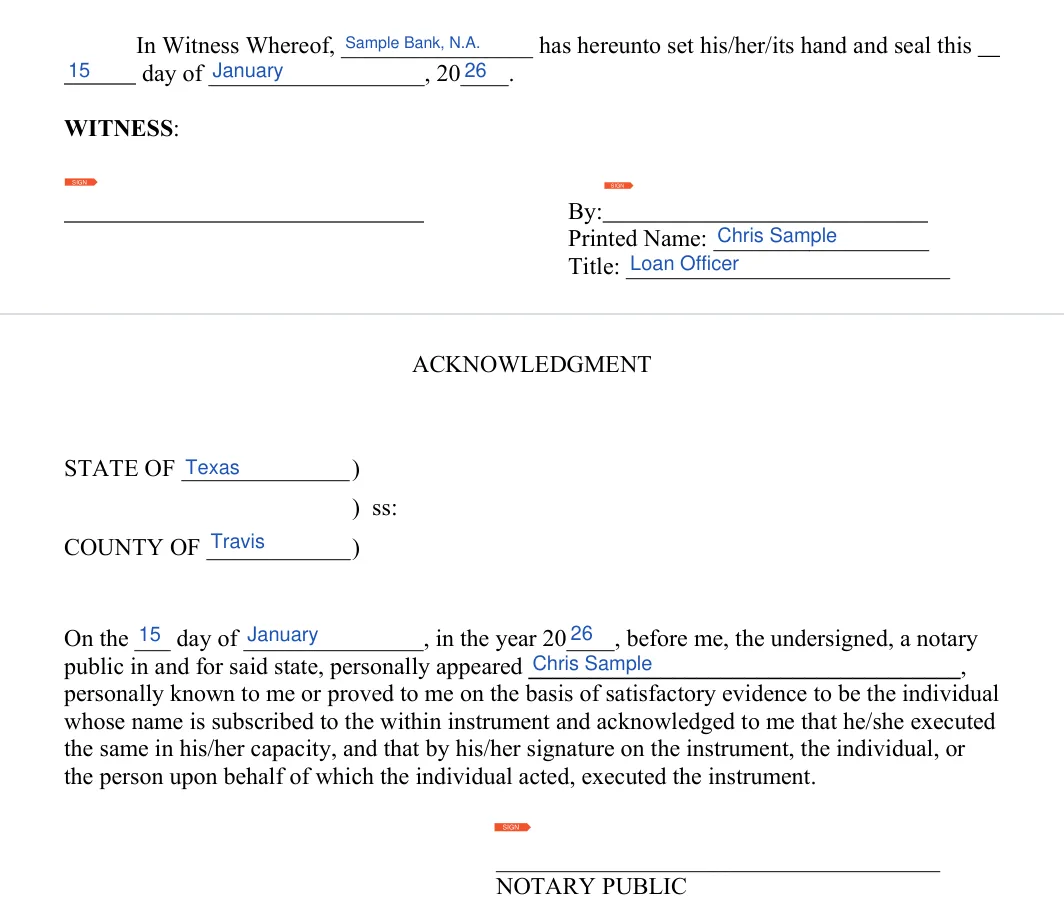
The screenshots under each step show the mortgage lien release filled with sample entries in blue, so you can see where each answer goes. The names, addresses, dates and other entries are examples only.
The release names two parties: the mortgagor and the mortgagee. The mortgagor borrowed the money and gave the home as security for the loan. The mortgagee is the bank or other lender that made the loan, or the company that now holds it.
The names on the release match the names on the original mortgage. A borrower who has since married or changed a name keeps the old name on the release and can add the new one after it.

The release carries the lender's signature, given by an officer of the bank or servicer, followed by a notary's acknowledgment of that signature. The borrower does not sign it; the borrower receives it.
The form on this page includes an acknowledgment block, because county recorders generally take a release with one. This page sets out no state's signing rules; the county recorder where the property sits can say whether its office accepts a release in another form.
A signed release takes effect in the public record once the county recording office enters it. Depending on the state, it may be called the County Clerk’s Office, County Recorder’s Office, Register of Deeds, or Land Registry Office.
The "record and return to" box at the top of the form names the person who gets the stamped original back. Put the homeowner's name and address there, so the recorded copy comes home.

The mortgage release form fills out in three parts: the loan details, the release with the lender's signature, and the notary acknowledgment. Have the loan number, the date of the final payment, both parties' full names and the property's legal description at hand before you start.


The acknowledgment section holds the notary's part of the form: the state and county, the names of the people who appeared, the document they signed, the date, the notary's signature and the date the notary's commission expires.

A written request gets the release moving when the lender has not sent it on its own after the final payment. The request lets the lender match the release to your loan file right away, and your copy shows when you asked.
A lien release request rests on three papers: the payoff proof, the loan papers and the recording details. The lender uses them to confirm the payoff and to fill in the release.
A mortgage release letter asks the lender, in a few lines, to send or file the signed release. Replace the bracketed items with your own details, and keep a signed copy of the letter with your property records.
Dear [Lender name],
I paid my mortgage loan in full on [day of the final payment]. The loan number is [loan number], and the property is at [property address]. Please send me the signed mortgage lien release, or tell me when the release was filed with the county recorder.
Please include the legal description of the property and where the original mortgage was recorded in your reply. If you need anything more from me, such as a copy of the final payment or a photo ID, let me know.
Thank you,
[Your name]
Send the letter by tracked mail, or paste it into your lender’s secure message portal. Then write the day you sent it on your copy, so you can follow up later.
The time a lender gets to release a mortgage lien depends on where the property is located. The period and the penalty for a late release come from the law of that state, and this page lists no state's figures.
A dated paper trail lets you hold the lender to whatever period applies. The county recorder or a real estate attorney where the property sits can tell you the period, and the deadline calculator counts the days from a start date.
Mortgage lien release requirements differ by state, and often by county, in the wording of the release, the signing formalities and the recording office's page and format rules. This page states no state's rules; check the release with your lender and the county recorder before it is signed.
Some states and counties publish their own release form. The county recorder's website is the first place to look, and the lender's release department often uses that form already.
An unrecorded release leaves the paid mortgage showing as open in the county land records. The debt is gone, but anyone who searches the records sees a lien that nothing has cleared.
The gap usually surfaces at a bad time: a buyer's title search before closing, or a new lender's review before a refinance. A recorded release, or the lender's signed release that you can record yourself, closes the gap. A homeowner who finds an open mortgage years later starts with a written request to the lender, or to the company that now holds the loan.
A copy of the recorded release comes from the county recording office where the property sits, or from the lender that filed it. Some counties offer an online search of their records; others answer by phone or at the counter.
The details on the release should match the details in your loan papers. If the release is missing, send a new request to the lender and ask for a written reply.
The recorded release belongs with your deed and your final payoff statement for as long as you own the property. A few follow-up steps finish the job.
Each paper in the payoff trail sits with a different person or office. Use the table as a checklist when you ask the lender for the release.
| Item | Who has it | Why keep it |
|---|---|---|
| Final payoff statement | Your lender | Shows the final payment and that the loan was paid in full |
| Signed release | Your lender, then the county recorder | Shows that the lender released the lien |
| Recorded copy | The county recorder | Lets you check the public record |
| Original mortgage papers | You and the county recorder | Help you match names and the legal description |
| Insurance policy | You and your insurer | Lists the lender until you ask to remove it |
Keep copies of all five items in one folder. If you sell the property later, a buyer, a real estate agent, or a title company may ask to see them, and having them ready saves days of waiting.
Most delays on a mortgage release come from details that do not match the original mortgage. Check each line against the recorded mortgage before the lender signs.
The mortgage release uses a handful of terms of art, defined here in plain words.
The mortgage release form on this page includes a notary acknowledgment, and lenders usually sign releases before a notary. This page sets out no state's rule on it; the county recorder where the property sits can say what its office takes.
The lender often sends the signed release to the county itself; in other cases it mails the release to the homeowner to take in. Ask the lender which it does, and get the answer in writing.
A partial release frees one part of the mortgaged land, such as a lot that is sold off, while the mortgage stays on the rest. It describes only the part released, by its own legal description.
Check your last statement for the name of the company that serviced the loan. Then look at the original mortgage in the land records to find the lender named there. A title company or a real estate attorney can help you trace the current holder of the loan.
Keep the recorded release with your deed for as long as you own the property. Keep a copy of it after a sale too, because it is part of the record of your property.
Yes, the two names describe the same document in most places: the lender's statement that the mortgage is paid and its lien is released. Counties and lenders pick one name or the other in their own forms.
General information, not legal or tax advice.
