
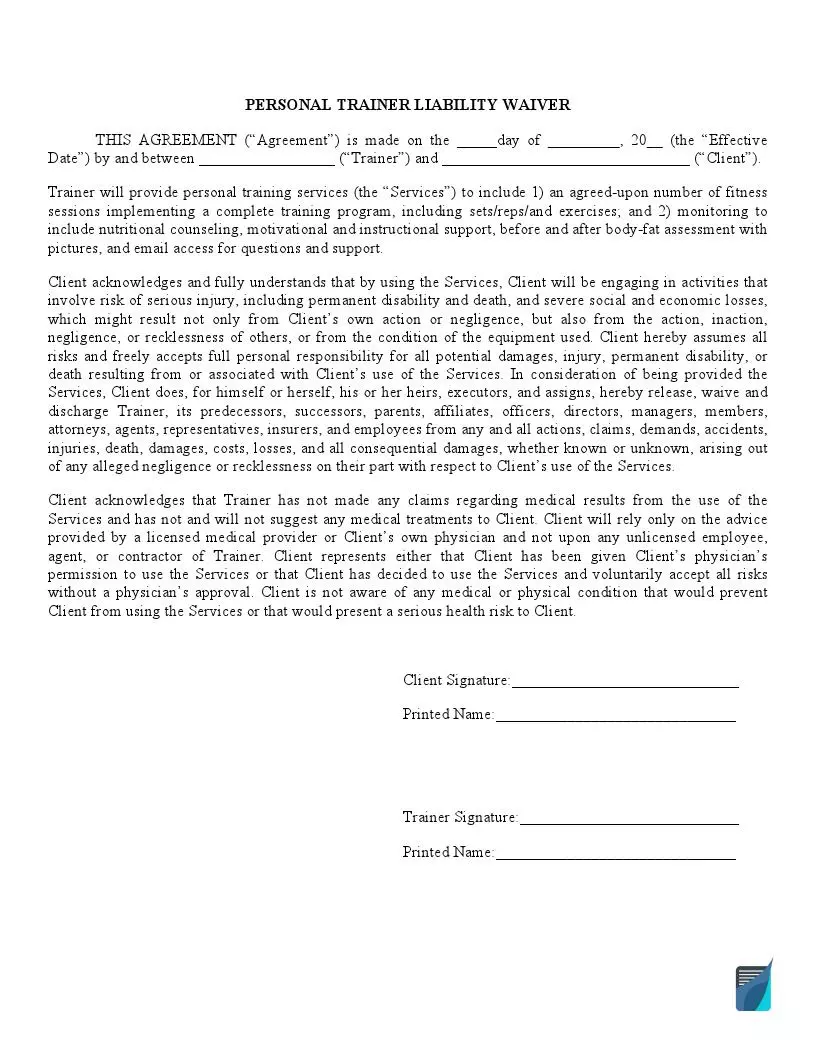
A personal trainer waiver and liability release form, or personal trainer liability waiver, is a signed record that a client accepts the risks of exercise. Having a personal trainer waiver means that a client realizes possible risks and gives consent not to pursue the trainer or a fitness provider in court should any misfortune occur. Have the client read and sign this release of liability form before the first session.
Last Updated: October 2026. This guide is reviewed and updated regularly to reflect current law. If you notice an error or outdated information, please contact us.
Build Your Document
Answer a few simple questions to make your document in minutes
Save and Print
Save progress and finish on any device, download and print anytime
Sign and Use
Your valid, lawyer-approved document is ready
Trainers work with clients of different ages and fitness levels, so each person brings a specific set of physical conditions and goals. A signed liability waiver helps you and your client agree on who is responsible for what before the first fitness session. Trouble tends to start in one of the areas below, so it pays to think about each one before you take on a new client:
Regardless of all precautionary measures, accidents may still happen due to misuse of equipment, violation of instructions, or misunderstanding. Unfortunately, it is tough to prove that the client failed to stick to their trainer’s directions. Therefore, it is crucial to supervise any consumer’s actions during the session.
Most disputes between trainers and clients start in one of the areas below. Each one is a risk worth thinking about early, for everyone involved.
Some clients can prosecute their trainers for injuries like sprains and twists. Being a coach, make sure you give clear instructions and lead your client throughout the session carefully. Injuries might result from wrong directions, a trainer’s inexperience, or a client’s disregard of instructions.
Being a trainer, make sure you have enough qualifications, experience, and education to build a nutrition program. Do not advise on nutrition if you possess no relevant qualifications. Eating disorders, health problems, and psychological traumas caused by improper nutrition plans are serious violations that can lead to severe health damage.
If you manage a gym, ensure regular inspections of your equipment. Any occurrences will provide an extra point against your professional competence. Though general equipment malfunctions will be covered by insurance (if you have one), playing safe is never too much.
Education and relevant certificates that prove one’s qualifications build an essential basis of legal, administrative, and professional knowledge. Make sure you possess legal powers to conduct private training.
Some clients may have issues with how trainers behave during the sessions. Make sure you don’t misuse your powers and treat your client with respect. Avoid engaging the client in intimate relationships and preserve business honor.
Lack of information is the most common reason for confusing and injuring situations during sessions. Some clients don’t mention their medical history and injuries, which results in unexpected consequences. Being a professional, you should claim the clients’ copy of the medical release form to understand possible dangers.
| Document Name | Personal Trainer Waiver and Liability Release Form |
| Other Name | Personal Training Waiver |
| Avg. Time to Fill Out | 5 minutes |
| # of Fillable Fields | 9 |
| Available Formats | Adobe PDF |
These documents focus on different matters and do not substitute each other. On the contrary, it is a great idea to have both forms. Insurance is responsible for protecting you from unexpected cases that do not cover the training directly. For example, if you damage your client’s property during the session.
Training liability release helps prevent any accusations if your client sustains an injury due to the coach’s instructions and fitness plan. It makes the trainer waiver indispensable because by signing the form, the client realizes possible risks.
A liability waiver is not a cure-all, but it adds a layer of protection against many of the risks listed above.
Keeping the right paperwork, such as a signed waiver, helps protect your business and your brand. A few simple routines go a long way when you take on a new client or start a new training program. Start with these three:
Store each signed waiver with the client’s file, so you can find it quickly when a question comes up.
The steps below follow the FormsPal template you can download on this page. Type your answers in the PDF editor or print the form and write by hand. The form is one page long with nine fillable fields, so most people finish in about 5 minutes. Work through the steps in order, from the top of the page down to the signature lines.
The screenshots under each step show the FormsPal Personal Trainer Waiver and Liability Release template filled with sample entries in blue, so you can see where each answer goes. The names, addresses, dates and amounts are examples only.



Once the blanks are filled in, read the whole waiver again with the client. Take a few minutes for this part, because a waiver can only protect both sides when everyone understands it. Answer any question before anyone signs. Then follow the steps below to sign the form and keep a record of it.


Personal trainer waivers often include the sections below. Each one covers a different part of the legal agreement between the trainer and the client. Read through them before you choose or write a waiver for your own training business.
The client learns about possible risks that may occur during training practices. By authorizing the section, the client recognizes their responsibility.
The section approves not to pursue the trainer or the fitness provider for any injury or damage of belongings.
This section ensures the client’s consent to release the trainer and the fitness provider from liability and save harmless.
The paragraph proves the client is an adult of at least 18 years old and physically and mentally healthy to participate in training activities.
Provide the client’s initials to ensure their consent to follow the laws of the territory. This section requires that one enters the state as well.
Here are quick answers to common questions about the liability waiver and the FormsPal template. Each answer is short, so you can scan the list before your next session with a new client.
It is a signed waiver form in which a client accepts the risks of physical activity before training begins. It adds legal protection for the trainer and the fitness provider, and the trainer keeps the signed copy on file.
The one-page FormsPal template has nine fillable fields. They sit in these parts of the page:
The FormsPal template takes about 5 minutes to fill out. Plan a few extra minutes to read it together with the client.
A waiver records the risks a client accepts, while insurance is a separate layer of protection for the trainer, so many trainers keep both.
A copy for the client is a good habit. Keep the original with your own records and give the client a scan or a printout.
General information, not legal or tax advice.
