
A college roommate agreement is a written plan that roommates make together about quiet hours, chores, shared costs and guests. Setting it out at move-in keeps shared living fair and friendly. Use the free college roommate agreement template below next to your rental agreement. If your school did not give you a good room rental agreement template, this page shows what to cover.
Last Updated: October 2026. This guide is reviewed and updated regularly to reflect current law. If you notice an error or outdated information, please contact us.
Build Your Document
Answer a few simple questions to make your document in minutes
Save and Print
Save progress and finish on any device, download and print anytime
Sign and Use
Your valid, lawyer-approved document is ready
Living together is a lot different than hanging out or staying over from time to time. Since you are probably all figuring out how to live on your own, a good roommate agreement matters even more than usual. It puts every roommate's expectations in writing, so small annoyances do not turn into big arguments.
Having a roommate agreement helps roommates work out how to live together, settle disputes, and still stay friends.
If you are moving in with people you do not know as well, a solid roommate agreement is even more useful. You will know exactly what to expect from each other and can avoid major problems or fighting.
Every agreement is different. The short answer is to include any details about how the home is kept, plus anything else that helps you stay focused on your studies. Common topics include:
Of course, not every roommate agreement needs all of those details. Some will need more sections to cover things a little more thoroughly. Talk with your future roommates and see what matters most to each of you. Then come up with a list of important decisions and compromises.
If you rent an apartment or house with roommates instead of living in a dorm, add the money details to your roommate agreement. If you and your roommates are all tenants on the same lease, agree on how to share the rent. Talk about:
Your lease is the paperwork you sign with a landlord or the campus housing office. A roommate agreement is a separate plan that roommates make with each other about daily life. Keep a copy of each where every roommate can find it.
Your first dorm roommate agreement might not be your last one. College is when people figure out living on their own and build new habits. You may need to update your agreement from time to time to keep everything working well.
It’s important in the beginning to set up a process for changing, or at least considering changes to, your original agreement. That might look like monthly roommate meetings to talk about how things are going and discuss changes. It might also be a way to ask for changes in person or in a group chat.
It’s important not to change the agreement too often. You will have no way to know if your new arrangement is working if you don’t give it a chance. But you also shouldn’t feel locked into an agreement that is permanent and unchangeable.
| Document Name | College Roommate Agreement Form |
| Other Name | Dorm Roommate Agreement |
| Avg. Time to Fill Out | 15 minutes |
| # of Fillable Fields | 99 |
| Available Formats | Adobe PDF |
| College Roommate Guide | |

The steps below follow the free FormsPal template on this page. It is a good place to start, but customize it as you go. Do not be afraid to change sections while you fill it in, and include a way to change the agreement in the future. If you download the PDF, you can fill it in with the FormsPal PDF editor.
The screenshots under each step show the FormsPal College Roommate Agreement template filled with sample entries in blue, so you can see where each answer goes. The names, addresses, dates and amounts are examples only.
Before you start, gather these details:
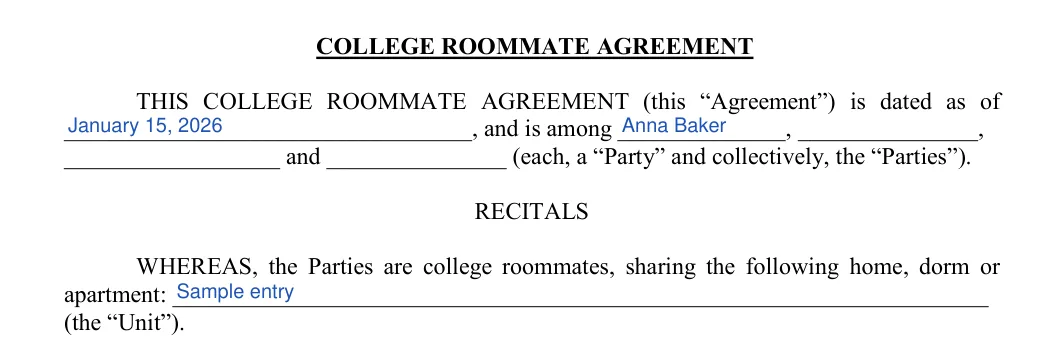
Step 1: Agreement Date, Roommates and the Unit
On page one, enter the date and write each roommate’s name in the blanks, up to four names. Then describe the dorm room, suite or apartment you share. The form calls it the Unit.
Step 2: Contact Information for the First Roommate
Under Contact Information, enter the first roommate’s name, cell number and email address, plus two emergency contacts. Use a name your roommates will recognize and contact details you are happy for them to have.


Step 3: Contact Information for the Second Roommate
Fill in the second block the same way: name, cell number, email address and two emergency contacts. Since you all live together, everyone needs to know who to call in an emergency.

Step 4: Contact Information for the Third Roommate
Complete the third block with the third roommate’s details. Leave any block you do not need blank.

Step 5: Contact Information for the Fourth Roommate
Use the fourth block at the bottom of page one if a fourth roommate is joining. Phone numbers and emails change, so tell each other when yours does.

Step 6: Quiet Hours, Monday to Thursday
On page two, write the quiet hours for Monday through Thursday in the blanks. Pick times that leave room to study and sleep, even when friends are over or someone is on the phone late.


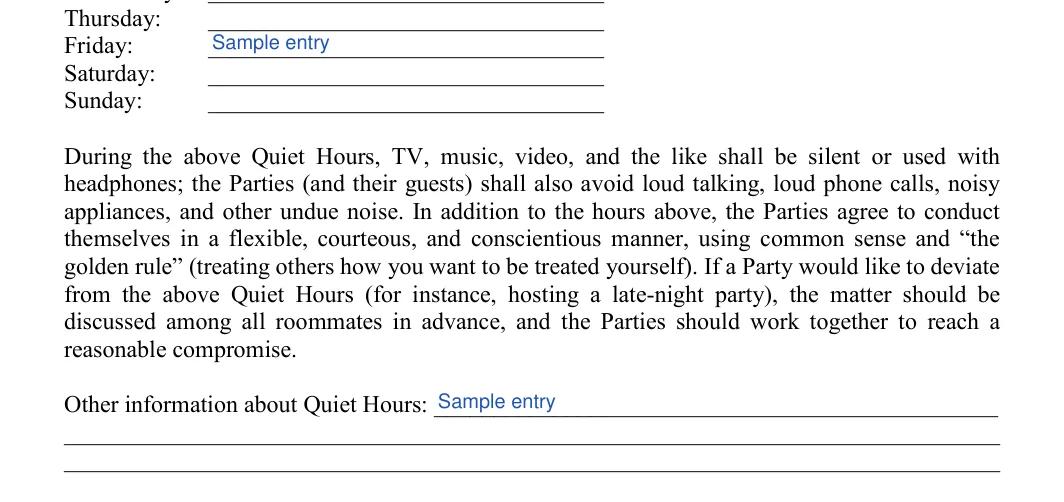
Step 7: Quiet Hours, Friday to Sunday and Other Information
Enter the hours for Friday, Saturday and Sunday. Then use the Other Information lines for anything else about quiet hours, such as late parties or which sounds are fine. For instance, it might be okay to run the dishwasher during quiet hours, but not the TV.
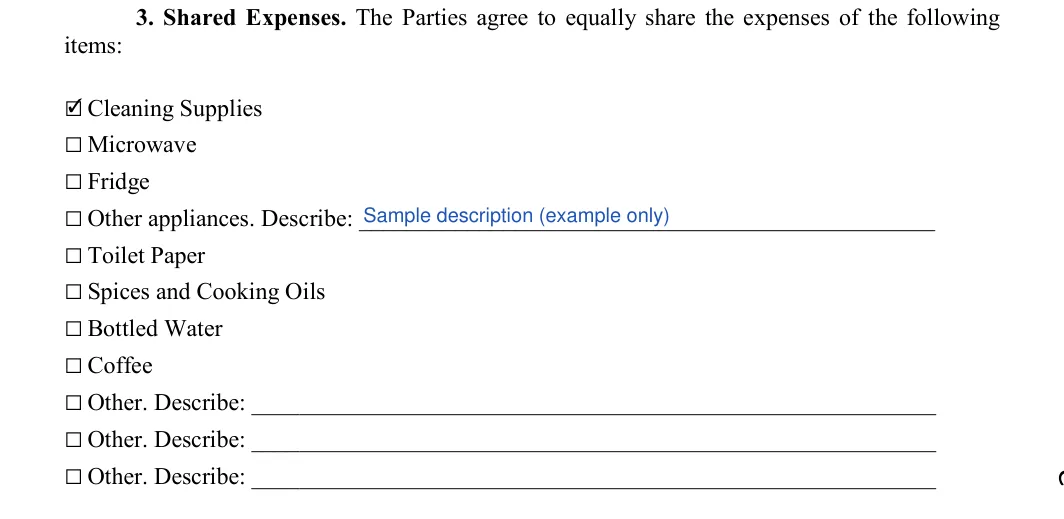
Step 8: Shared Expenses
Check each item the roommates will split equally, such as cleaning supplies, a microwave, a fridge or toilet paper. Describe any other item you split on the Other lines. That way, nobody ends up paying for things they never wanted or needed.

Step 9: Shared Expenses Notes and Food
On page three, write what happens to a jointly owned item when you move out or part ways, and add any other notes about shared costs. Then check one Food option: separate food or shared food. Whichever you choose, agree on where food is stored.
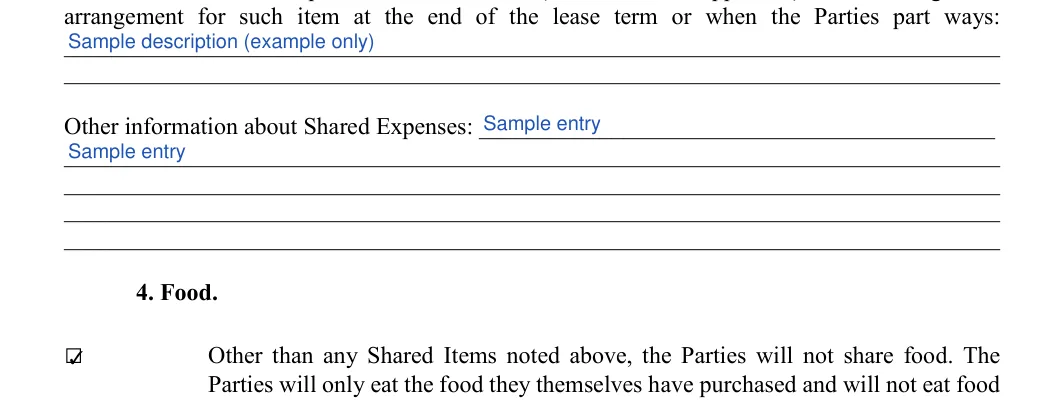
Step 10: Personal Items
List the personal items that will not be shared and the ones that may be shared. The form suggests items such as a bicycle, TV, computer or hairdryer. The owner of each item decides whether it is shared, and can change their mind later on.

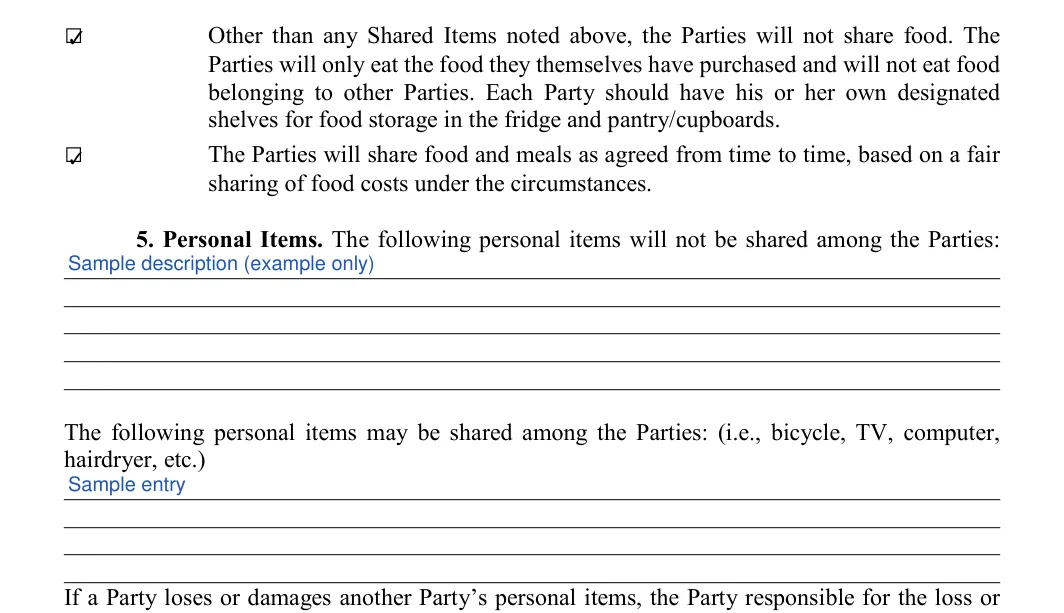
Step 11: Guests: Overnight Visitors
At the bottom of page three, under Overnight guests, check Prohibited if overnight guests are not allowed. Guests are a big part of college life, so talk it through with your roommates first.


Step 12: Guests: Permitted, Case by Case and Other Information
At the top of page four, check Permitted or the case-by-case option instead if that matches your plan. Add any other guest rules on the lines, such as how much notice to give roommates before someone comes over.
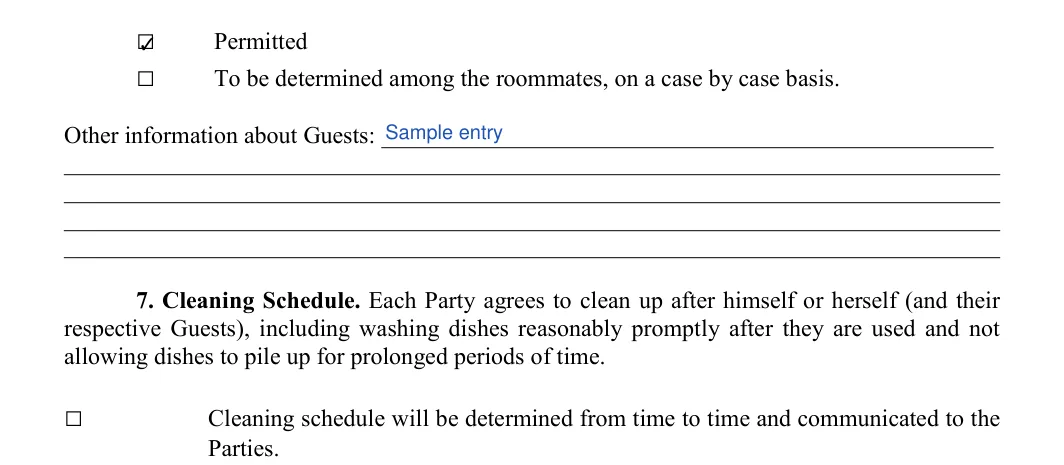
Step 13: Cleaning Schedule
Check whether the schedule will be set from time to time or fixed. If it is fixed, write it on the Set cleaning schedule lines. Cleaning can be a challenge for college roommates. A rotation or a list of separate chores keeps everyone on task and helps your home feel like a home.

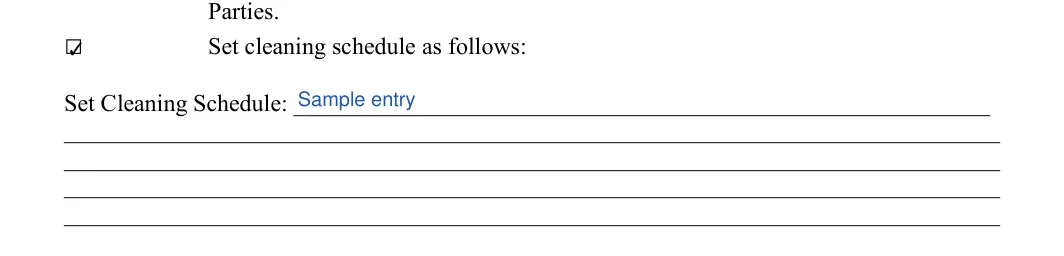
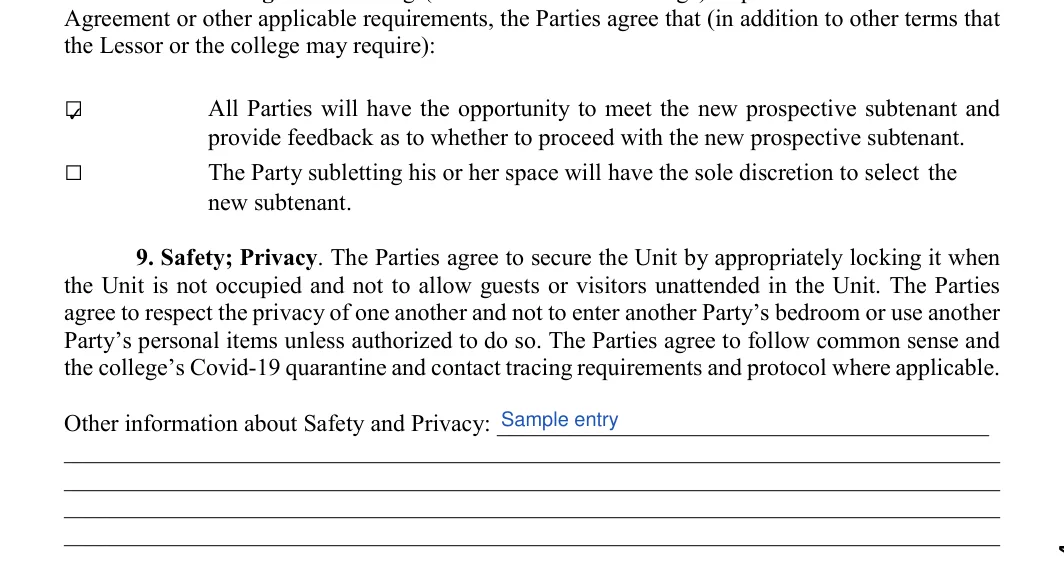
Step 14: Subleasing, Safety and Privacy
Check the subleasing option that fits your plan: everyone meets the new subtenant, or the subletting roommate chooses. Not all leases allow subletting, but it’s common for college students to need to find someone to take over all or part of their lease. You should have some rules, like everyone getting to meet and approve a new sublet, to make sure subleasing doesn’t cause problems in the future.
Then add any safety or privacy notes on the lines. For instance, if one roommate has a severe nut allergy, they may ask that nut products stay out of the home or be labeled and stored separately. Let everyone add their own needs, whether they relate to physical or mental health.


Step 15: Signatures
On page five, each roommate signs and prints their name on one of the four lines. The College Rules and Disagreements sections on this page are text only, so there is nothing to fill in.


Once the template is filled in, a few simple habits turn it into something the whole household actually uses. Go through these steps together as roommates, ideally before classes get busy.
These quick answers cover what college roommates ask most often. They range from what to include and how to update the roommate agreement to what to do when roommates disagree or move out.
Most roommates cover quiet hours, cleaning, shared expenses, food, personal items, guests, subleasing and safety. Add anything else that matters to your household, then have every roommate sign the roommate agreement.
The template works for a dorm room, a suite or an apartment you share. If you also have a lease, read it first so your roommate agreement fits with it.
A roommate agreement is a plan between you and your roommates about daily life, such as chores, guests and shared costs. A lease is the agreement with your school or landlord about the space itself. Keep both handy.
Many roommates review the agreement at a regular meeting and update it together. Make the change in writing and have everyone sign again.
Start with a roommate meeting. Each person explains what is not working, and the group looks for a compromise. If you cannot agree, ask your resident advisor or housing office for help.
Everyone who lives in the home should sign, so each person shows they have read and agreed. The template has four signature lines.
General information, not legal or tax advice.
