Job Application Template
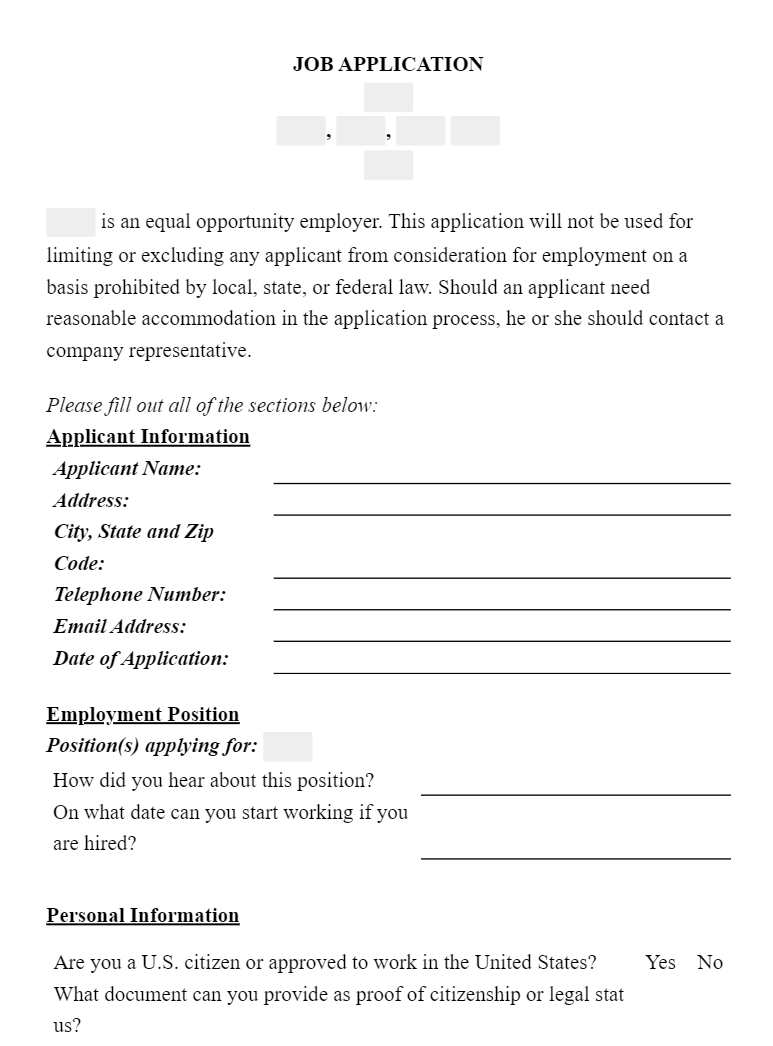
A job application template, also known as an employment application form, is a ready-made form that collects an applicant’s contact details, education, work history, and references in one standard layout. It lets the employer compare candidates side by side and choose the most suitable one. An employment application is not always a necessary part of the application process, but it brings many advantages for both employers and employees. Download our free template, fill in the blanks, and edit any question you do not need.
Last Updated: October 2026. This guide is reviewed and updated regularly to reflect current law. If you notice an error or outdated information, please contact us.
Build Your Document
Answer a few simple questions to make your document in minutes
Save and Print
Save progress and finish on any device, download and print anytime
Sign and Use
Your valid, lawyer-approved document is ready
It’s hard to underestimate the advantages of a job application template. It helps a company to standardize the application process and easily compare the job applicants. It’s especially relevant for companies with a large-scale hiring. Job application forms also help candidates prepare for the hiring process, so they do not forget any crucial personal or experience details.
Benefits for Employers
A job application template has a specific format that helps the employer organize the information consistently. With the same pattern for every applicant, the hiring process stays standard and candidates are easy to compare. A resume or CV can contain some praise of the applicant, while a job application consists only of facts.
- A signature: the applicant signs the form to confirm that all the information is true.
- Contact references: the hiring manager can reach a candidate’s former or current employer to verify employment experience or ask for recommendations.
Get the applicant’s approval before contacting a current employer, since that employer may not know about the job search.
Benefits for Applicants
This template is useful for applicants too. It gives them one clear format, so they do not spend time looking for the right layout.
- It keeps your information organized.
- It helps you prepare for job applications and not miss any important detail.
- Some forms ask for consent to a drug test, so you have time to think about it in advance.
Even with all these advantages, send the employer a cover letter as well. It helps you stand out from other applicants and shows your motivation to work for this particular company.
A job application template can vary depending on the circumstances and the hiring company. However, a standard template usually includes the sections below. Start with the basics and add or remove questions to match the job.
- Personal information of the applicant. This section provides applicants’ information such as full name, phone number(s), email(s), mailing address. Often, a company requests to add a social security number. Here, you can also include your LinkedIn profile (if relevant).
- Education details. You are expected to describe your education information, including names of schools, colleges, business schools, or universities you studied at. You should also name the subjects of study.
- Work experience details. This section describes your current employment status and previous jobs, including names of companies, their address, employment dates, responsibilities and duties, skills that you used or learned, and promotions (if any) while working at the company. You should name every job title and indicate whether you worked as a freelancer. It’s possible to include each supervisor’s name and email for references. However, this information is usually stated separately.
- Contact information for references. Candidates with recommendations stand out. Therefore, add the contact information of your current or former employer, such as an email address or phone number. Make sure that they are ready to give positive references.
- Military service. A job application usually includes the question about membership in the Armed Forces or the National Guard.
Sometimes, job application forms include additional questions about:
- Desired days or hours available for work
- Desired pay range
- Consent to taking a drug test (if relevant)
- Consent to the background check (to check the criminal history or a withheld judgment to a felony)
- The driver’s license, any accidents, or moving violations during the past years
Download our job application template, which includes general information and is fully customizable. If your potential employer gives you specific questions, answer them in the template. Sometimes, hiring managers ask applicants to fill in the company’s own form. In every case, these six steps help you prepare a complete application.
- Define personal information. As with CVs or resumes, the first thing you should do is to provide your potential employer with your contact information. Here, you are required to include your full name, phone number, email address, and mailing address. Sometimes, it’s necessary to indicate your age and social security number.
- Indicate the application details. In this section of applications, you are expected to indicate what job position you are applying for, your available start date, desired days or hours for work, and desired salary. If the position is connected with transportation, you may need to answer about the driver’s license and any moving violations during the past years. Here, it’s also relevant to indicate your goals related to the position.
- Describe educational credentials. You should indicate the school and university you studied at and what degrees you earned. It will help the employer understand your background and how your expertise is relevant to the position. Sometimes, it’s possible to include training, qualification courses, or even volunteering work.
- Provide the employment history. Next, describe your work experience, including all the relevant experience in your field. For each job, list the company name, address, and dates of employment. Add the supervisor’s name, your job title, your duties, the skills you learned, and any promotions. Write a clear job description. You can also include your salary and your reason for leaving. Be specific about employment details and include only information relevant to the industry.
- Identify the reference options. List the references your potential employer can contact for recommendations. This information can be included in the previous section or stated separately. Anyway, make sure that you allow your potential employer to contact your former or current employer for references. Sometimes, job hunting can lead to dismissal.
- Verify the information. All job application forms require verification with the applicant’s signature. Signing the form, a job candidate confirms that all information in the document is true. In certain cases, you may also be requested to verify the consent to taking a drug test (if relevant) or background check. If you want to refuse these options, you should warn your potential employer and explain the reason. In some cases, you will have to write a waiver.
Tip: Use a professional email address and check your inbox and spam folder for replies. Keep a copy of every application you send, so it is easier to answer follow-up questions and to reuse your details for the next job.
Frequently Asked Questions
Are Job Applicants Required to Take a Drug Test?
State laws allow employers to test applicants for drugs. As a rule, an employer is allowed to take a drug test if the applicant is warned about such a possibility with advanced notice or it’s stated in the job application as a part of the screening process. All tests are required to be administered by a state-certified laboratory. Additionally, all applicants to the position must be tested similarly; no discrimination is permitted.
Drug testing is usually required for safety-sensitive industries like transportation, safety, defense, and aviation. While private employees are not obligated to take a drug test, many federal employees are, including national security, law enforcement officers, employees with duties to protect property, life, and health.
What Desired Salary Should I Indicate on the Employment Application?
Put a realistic pay range or write “negotiable”. A very high number may be tempting, but it is better to judge your skills and experience honestly. Research your field to find the average pay for the role, then choose one of these options:
- A pay range that fits your experience and the average for your field.
- The word “negotiable”, so you do not seem fixed on one amount.
- A single figure, only when the employer asks for one.
May I Put Some Additional Information in the Application Form, Such as Awards?
Usually not. Use a resume or cover letter for awards, hobbies, and extracurricular activities. A job application form is designed to standardize the application process. It gathers the same information from every applicant so that it is easy to compare them.
Do I Still Need a Resume If I Fill Out a Job Application Form?
Yes, send both when the employer accepts them. The template collects the same set of facts from every candidate. Your resume tells your career story in your own format. Add a short cover letter that explains why you want to work for this company.
General information, not legal or tax advice.
With over 25 years of experience as a business and transactional attorney, Jennifer has mastered the craft of closing highly successful deals for her clients. Through her wide-ranging expertise in commercial contracts, real estate transactions, M&A and corporate law, Jennifer secures results that are second-to-none.
Published: Jul 20, 2022