
A Maine last will is a written legal document that lets a testator name an executor and direct how their property should be distributed after death. A will that does not meet Maine's signing and witness rules can be challenged in probate court, so it is worth reviewing those rules before you sign.
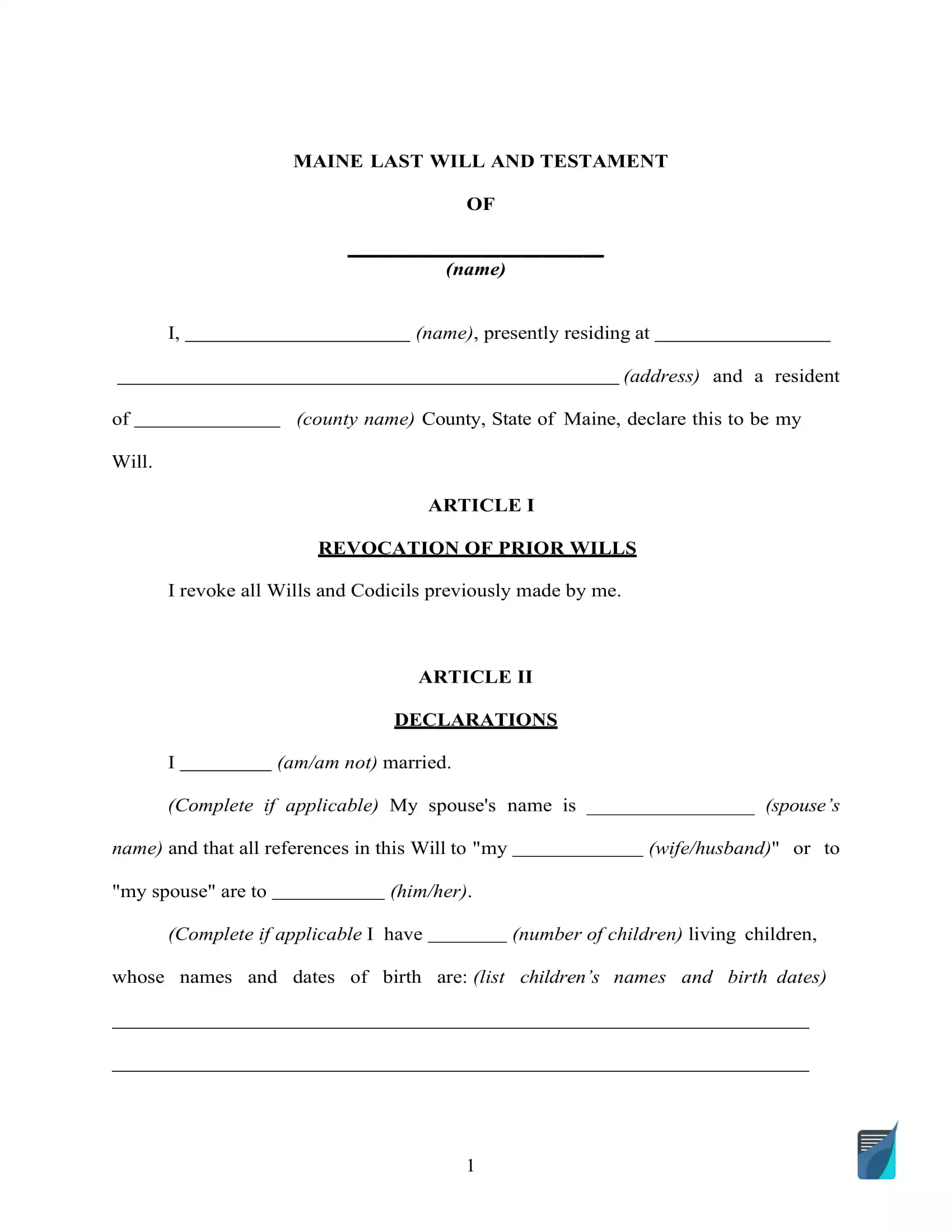
Download a fillable and printable Maine last will and testament template to fill out yourself, or use our step-by-step document builder that walks through each section of the form.
Build Your Document
Answer a few simple questions to make your document in minutes
Save and Print
Save progress and finish on any device, download and print anytime
Sign and Use
Your valid, lawyer-approved document is ready
Last Updated: September 2026. This guide is reviewed and updated regularly to reflect current Maine law. If you notice an error or outdated information, please contact us.
Maine last wills must follow the signing and witness rules set out in the state's Probate Code, Me. Rev. Stat. tit. 18-C. The table below summarizes who may make a will, how many witnesses must sign it, whether self-proving affidavits and handwritten wills are recognized, and which statute section states each rule.
| Requirements | State laws | |
| Statutes | Title 18-C, Article 2 – Intestacy, Wills and Donative Transfers; Part 5 – Wills | |
| Signing requirement | Two witnesses | §2-502. Execution; holographic wills |
| Age of testator | 18 or older | §2-501. Who may make a will |
| Age of witnesses | No minimum age set; must be generally competent to serve as a witness | §2-504. Who may witness a will |
| Self-proving wills | Allowed | §2-503. Self-proved will |
| Handwritten wills | Recognized if meeting certain conditions | §2-502. Execution; holographic wills |
| Oral wills | Not recognized | |
| Holographic wills | Recognized if meeting certain conditions | |
A "last will" and a "last will and testament" are the same document. Maine's Probate Code refers to it simply as a "will" throughout Title 18-C.
Maine does not require you to use a specific will form, but the document must meet the state's signing and witness rules to be valid. Review the requirements above and the state's probate statute before you begin, then follow these steps to complete your will.

Also, as an assurance, you can select a substitute executor of the will. That way, you’ll be able to make sure that, even if the initially chosen executor can’t perform their duties, there’s another dependable person you can count on.


If you have a revocable trust, you can create a pour-over will and name that trust as a beneficiary. A pour-over will transfers to the trust any property that was not already placed in it before your death.
These assets can include money for unpaid arrears, realty, shares, business control, cash, and any tangible things of monetary value that count among your possessions. You can also indicate who will get to take care of your pets after you’re gone.

At this point, you (and your two witnesses) have to sign the paper after writing your full legal addresses and names. After that, make sure you look over each section thoroughly prior to finalizing the matter to check if everything’s in order.


Maine requires at least two witnesses to attest to a last will. Under Me. Rev. Stat. tit. 18-C, 2-502, a will must be signed by at least two individuals who each witnessed the testator's signing (or the testator's acknowledgment of it) within a reasonable time.[1] Maine's optional statutory will form under section 2-517 states the same two-witness rule in its own text.[2] Our Maine last will and testament template already includes this two-witness attestation section for you to complete.
Yes. Any will may be made self-proved at execution through affidavits signed by the testator and witnesses before an officer authorized to administer oaths.[4] A self-proving affidavit means the witnesses will not need to testify in court later, which can speed up probate. If you use Maine's optional statutory will form, acknowledging the signatures before a notary is optional but recommended.[2] Our Maine last will and testament template already includes this optional self-proving affidavit section.
Yes. Any will may be made self-proved at execution through affidavits signed by the testator and witnesses before an officer authorized to administer oaths.[4] A self-proving affidavit means the witnesses will not need to testify in court later, which can speed up probate. If you use Maine's optional statutory will form, acknowledging the signatures before a notary is optional but recommended.[2]
Notarization is not required to make a Maine will valid. Completing the self-proving affidavit section of Maine's statutory will form and having the signatures acknowledged by a notary is optional, but doing so will simplify submitting the will to the probate court after your death.[2] Making your will self-proved can speed up probate and adds a layer of security if the will's validity is questioned.
Testamentary capacity describes a testator's legal and mental capability, or sound mind, to write and alter a last will.
You might be regarded as lacking testamentary capacity if you are underage or have dementia, senility, insanity, or a similar mental illness. That kind of condition can keep you from understanding your assets' value, who your heirs are, or what a will does. In Maine, an emancipated minor may make a will even though still under 18.[3]
In Maine, you cannot fully disinherit your spouse. Even if your will states so explicitly, a surviving spouse can still take an elective share equal to 50% of the marital-property portion of the augmented estate.[6]
You can name your currently living children and choose not to leave them anything. Maine law protects a different situation: a child born or adopted after you signed your will. Unless your will shows you meant to exclude any future children, that child can still receive a share of your estate.[7]
Yes. Maine law allows you to revoke a will and to amend it by codicil.[2] Common reasons to update a will include:
If you need to change a lot of provisions, it is usually simpler to revoke the will and create a new one rather than add several codicils.
Yes. A will that does not meet the standard witnessing rules is still valid in Maine as a holographic will, witnessed or not, as long as the signature and the material portions of the document are in the testator's own handwriting.[1]
| Related documents | Times when you could want to have one |
| Codicil | You would like to make a single or a few slight changes to your will. |
| Self-proving affidavit | You would like to save time and money for your witnesses. |
| Living will | You would like to declare your wishes regarding the end-of-life medical treatment and life-prolonging procedures. |
| Living trust | You want to skip probate by having your property in a trust. |
This page is general information about the Maine last will and testament template, not legal advice. For advice on your situation, talk to a Maine attorney.
