
A West Virginia last will and testament is a legally binding document that expresses the testator’s final wish in the form approved by law and determines the legal distribution of the will creator’s assets subsequently after their passing.
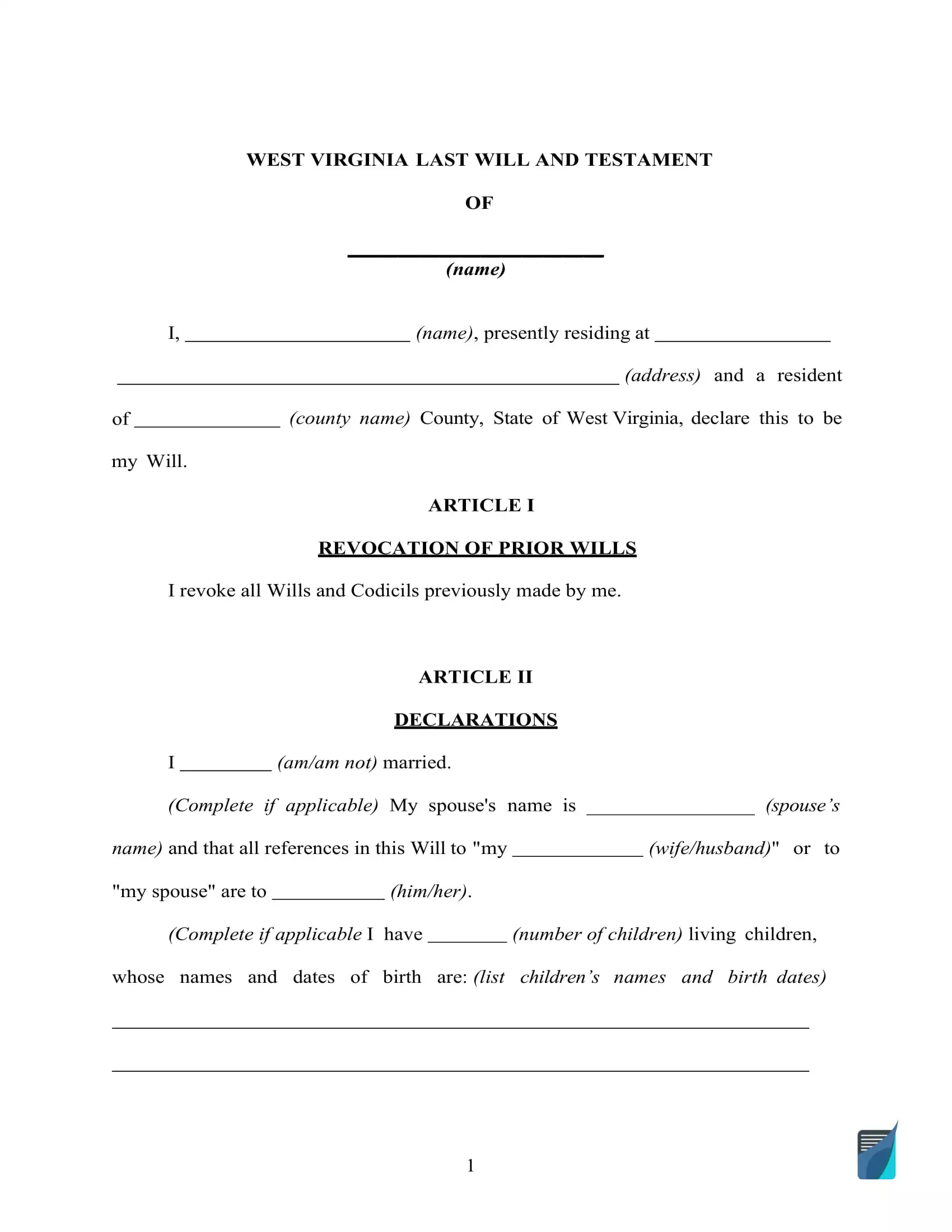
In this article, we provide you with a free downloadable West Virginia last will and testament template and the answers to a number of questions you may have relating to this specific document.
Build Your Document
Answer a few simple questions to make your document in minutes
Save and Print
Save progress and finish on any device, download and print anytime
Sign and Use
Your valid, lawyer-approved document is ready
West Virginia last will laws set out who may sign, how many witnesses are required, and which handwritten wills the probate court will accept. A valid West Virginia will must be in writing and signed by the testator, who must be at least 18 years old. At least two competent witnesses must watch the signing, then sign the will themselves in the testator’s presence and in each other’s presence.[1] The table below summarizes these state law requirements.
Last Updated: September 2026. This page’s content is reviewed and updated regularly to reflect current West Virginia law. If you notice an error or outdated information, please contact us.
| Requirements | State laws | |
| Statutes | Chapter 41 – Wills | |
| Signing requirement | Two witnesses | §41-1-3. Must be in writing; witnesses |
| Age of testator | 18 or older | General age-of-majority requirement |
| Age of witnesses | 18 or older | §41-1-3. Must be in writing; witnesses |
| Self-proving wills | Allowed | General provision, not covered by the sections cited above |
| Handwritten wills | Recognized if meeting certain conditions | §41-1-3. Must be in writing; witnesses |
| Oral wills | Not recognized | §41-1-3. Must be in writing, with witnesses |
| Holographic wills | Recognized if meeting certain conditions | |
And moreover, unless it be wholly in the handwriting of the testator, the signature shall be made or the will acknowledged by him in the presence of at least two competent witnesses, present at the same time.
A handwritten (holographic) will is allowed in West Virginia when it is wholly in the testator’s own handwriting and signed by him.[1]
Tip: A West Virginia last will and testament template from FormsPal can be saved as a PDF or Word file. This lets the testator start on a computer and finish the last steps, reviewing and signing with witnesses present, on paper.
1. Consider your possible choices. Before getting started, you might want to decide if you want to use the expertise of a lawyer or do the whole thing yourself. In the event that you wish to create the last will and testament by yourself, pick the type the testator will go for: a handwritten will or a free West Virginia will form.
2. Indicate your details. Add your full name and address (the city, county, and state of residence) to ascertain the testator of the last will. Go through the details you entered along with the rest of the passage, including “Expenses and Taxes.”

3. Specify the executor (or executrix). Choose the executor of your property and specify their particulars: full legal name and place of residence, which will usually be in the same state the testator lives because the majority of states impose special regulations on out-of-state executors. As a precaution, you may name an additional, substitute executor for the will. This way, you will be able to be certain that even when the originally appointed executor can’t perform their obligations, there’s a second dependable person available once the will is signed.

4. Indicate the guardian (optional). If you have underage or dependent children, you may not want the court to decide who raises them after you die. In that case, you can name someone you trust as their guardian.

5. Establish your beneficiaries. At this stage, the testator specifies the people who are going to inherit the estate. Enter their full names, places of residence, and your relationship to them (spouse, child, friend).
6. Distribute property. If you have a property allocation on your mind that’s not proportional, you’ll be able to describe it in this part. Property may include cash, stocks, real estate, company ownership, money owed to you, and any other things of monetary value you own. But, joint and living will property and assets, as well as your life insurance, cannot be put into your last will and testament.

7. Ask witnesses to sign the document. West Virginia law requires a will to be signed by two witnesses. You can appoint someone as a witness as long as they are older than 18 years and are not a beneficiary named in your will.
Consider choosing witnesses who are younger than you, so they are more likely to be available if the will is ever contested in court. After you review each section of your last will template, you and your two witnesses fill out your full names and addresses and sign the document.


Other West Virginia Forms
West Virginia law requires at least two competent witnesses for a valid will, and those witnesses must follow specific steps.[1] To properly witness a West Virginia last will and testament template, your witnesses must:
If you wish to disinherit your marriage partner, you will be able to do so. West Virginia is not a community property state. Sometimes called marital property, it is a kind of ownership of the assets presented by the laws that implies that 50 % of all assets (including arrears) of one spouse belongs to another and remains such upon divorce. In West Virginia, a surviving spouse may have the option of taking an elective share of the estate regardless of what the last will says.
As for the others, it is legal in West Virginia to disinherit members of your family in your last will. Your adult children or any other relatives can be legally disinherited totally in your last will. In order to do that, add certain provisions to the last will.
If the will is lost or destroyed, according to West Virginia law, the court will recognize it. But, only the original of the will can be accepted by the probate court. In line with West Virginia law, the absence of the will is assumed as its cancellation. This suggests that the executor must provide proof of the will’s legality, which might be very troublesome.
For holographic wills, the process can be far more problematic because sworn witnesses and testimony are required. The reason for not providing the last will and its contents has to be confirmed as well.
Only per your instruction and in your presence is someone allowed to sign your last will and testament.[1] It’s possible to give a corresponding instruction via several methods, including verbal communication, a positive answer to a query, or body gestures.
It is possible to get a notary to sign the name of a testator who is physically incapable of doing it if the latter instructs the notary public in the presence of a witness. It is worth noting that such witnesses can’t have an interest (equitable or legal) in any assets that are the issue matter or might be influenced by such a document (the will).
| Related documents | When to create one |
| Codicil | You would like to slightly change your last will without creating a new document from scratch. |
| Self-proving affidavit | You want to keep from possible issues during the probate. |
| Living will | You would like to declare your wishes about the end-of-life medical treatment and life-prolonging measures. |
| Living trust | You would like to deal with your end-of-life matters without probate. |
This page is general information about West Virginia last wills, not legal advice. For advice on your situation, talk to a West Virginia attorney.
