
A promissory note is a written promise in which a borrower agrees to repay money to a lender, usually with interest. Both sides may agree on any rate of interest.[1.1] They must specify the agreed rate in writing.[1.3] You can fill out the free template below online or download it as a PDF.
Last Updated: October 2026. This guide is reviewed and updated regularly to reflect current Nevada law. If you notice an error or outdated information, please contact us.
Build Your Document
Answer a few simple questions to make your document in minutes
Save and Print
Save progress and finish on any device, download and print anytime
Sign and Use
Your valid, lawyer-approved document is ready
The law on interest for a promissory note is in Nev. Rev. Stat. §§ 99.040 to 99.055. The statute lets the parties choose their own terms.[1.1] It also sets a default for the cases it lists.[1.2]
Section 99.040 covers a loan with no express written contract fixing a different rate. Its words are:
When there is no express contract in writing fixing a different rate of interest, interest must be allowed at a rate equal to the prime rate at the largest bank in Nevada, as ascertained by the Commissioner of Financial Institutions, on January 1 or July 1, as the case may be, immediately preceding the date of the transaction, plus 2 percent, upon all money from the time it becomes due
In plain words, the default is the prime rate at the largest Nevada bank, plus 2 percent. The Commissioner of Financial Institutions ascertains that prime rate on January 1 or July 1, whichever date comes right before the transaction.[1.2]
The statute applies this default only in the cases it lists. A note that states its own rate in writing does not depend on the default.
The parties may agree on the rate, on compounding, and on any other charges or fees.[1.1] The statute says the parties must specify in writing:
Keep these terms in the note itself, so the written record matches the deal.[1.3]
Put every agreed term and fee in the written note. The statute states that any contract or agreement in violation of the subsection is void and unenforceable, which means it cannot be enforced.[1.3]
When any loan is prepaid, the amount of interest earned must be computed by applying the agreed rate to the unpaid balance for each period.[1.5] In plain words, interest is figured on the balance still unpaid in each period, at the rate the note states.
| Document Name | Nevada Promissory Note Form |
| Other Name | NV Promissory Note |
| Max. Rate | By written agreement: any rate the parties agree on[1.4] Without agreement: the prime rate of the largest Nevada bank plus 2 percent[1.2] |
| Relevant Laws | Nevada Revised Statutes, Section 99.040 |
| Avg. Time to Fill Out | 10 minutes |
| # of Fillable Fields | 28 |
| Available Formats | Adobe PDF |
Popular Local Promissory Note Forms
If you want to lend or borrow money, think about creating a promissory note form. It is a useful binding document largely used by companies and individuals in many states. The following are the state-level promissory note forms our users read about most often.
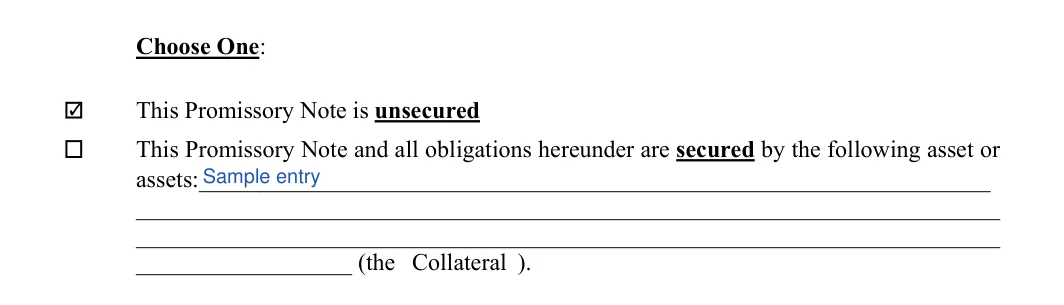
A promissory note is either unsecured or secured. An unsecured note rests on a promise to pay alone. A secured note also names collateral, which is property that backs the loan. The template lets you mark one of the two on page 2.
Unsecured notes are common between people who trust each other, such as family members and friends, because no property is pledged. An unsecured note usually covers these points:
Some people have the signatures notarized for extra assurance. The template itself has no notary lines. In practice, a lender who is not repaid may have to go to court to collect.
A secured note lists the collateral, meaning the assets put up to back the loan. A secured note usually contains:
On the template, you initial the secured box and list the assets on the lines provided.
The right type of note depends on the loan and on the people involved. Ask yourself these questions before you pick a box on the form:
A small, short loan between people who trust each other often works as an unsecured note. A larger or longer loan is easier to protect with a secured note that lists the collateral. If the loan is secured, name each secured asset clearly on page 2 of the form. A secured note of this type ties the loan to named property.
A promissory note and a loan agreement both record a loan, but they differ in length and focus. A promissory note is a short form built around the promise to repay. A loan agreement is usually longer and spells out more terms for both sides. Pick the form that matches the size and the risk of your loan.
FormsPal offers a family loan agreement, a payment agreement, and an IOU template for those cases.
A promissory note is a loan agreement in writing. It names both people, states how much was lent, and explains how and when the money comes back. A clear note leaves little room for argument later, so check each item in the list below before you sign the form.
These items match the fields on the FormsPal template, so you can fill them in one by one.
People use a promissory note whenever one person lends money to another and wants the terms on paper. Typical examples are a loan between family members, a loan between friends, a personal loan to cover a large purchase, and a loan to a small business. In each case the written agreement gives both sides the same record of what was promised.
The template offers two types of payment plan. With a fixed payment amount, the same dollar figure is paid on each due date. With amortization, the loan is paid back over a number of years, and the note points to an attached schedule of payments. Pick the type that fits your loan agreement and mark it on the form.
Say Anna lends Ben a principal amount of 6,000 dollars as an unsecured type of note. They choose a fixed payment amount of 500 dollars, due on the 15th of each month. Twelve payments repay the principal, so the maturity date falls twelve months after the first due day. This example ignores interest. If the note carries interest, the payment amount must be set to cover it.
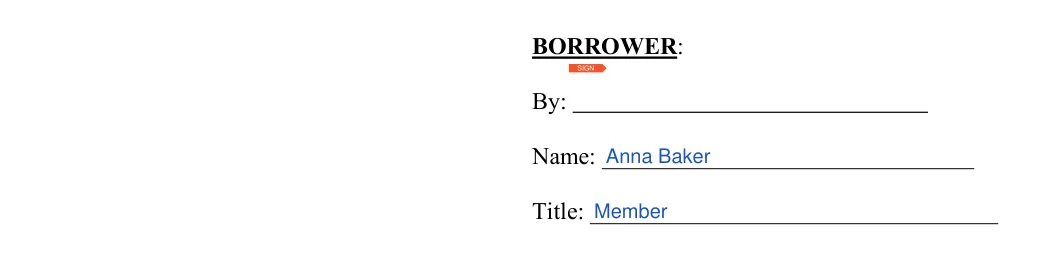
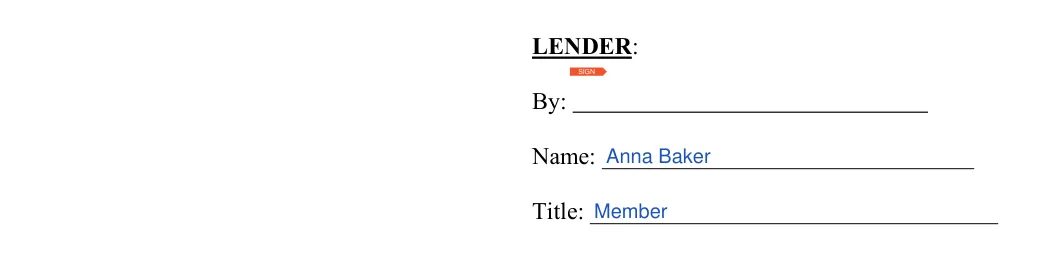
The Nevada promissory note PDF has 28 fillable fields over three pages. Work through it in order, from the date and principal amount to the two signatures. The six steps below follow the form, and each step shows that part of the form filled in with sample entries.
The screenshots under each step show the FormsPal Nevada promissory note template filled with sample entries in blue, so you can see where each answer goes. The names, addresses, dates and amounts are examples only.
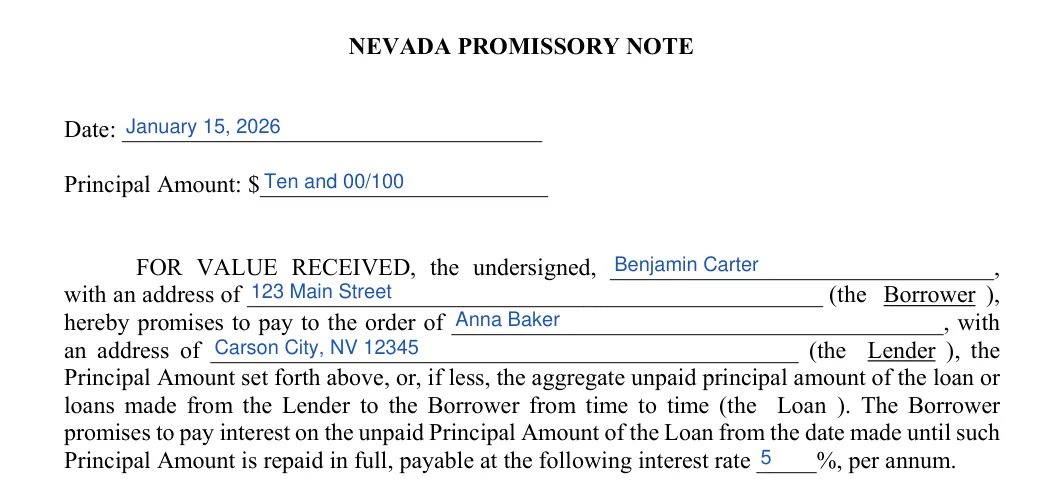
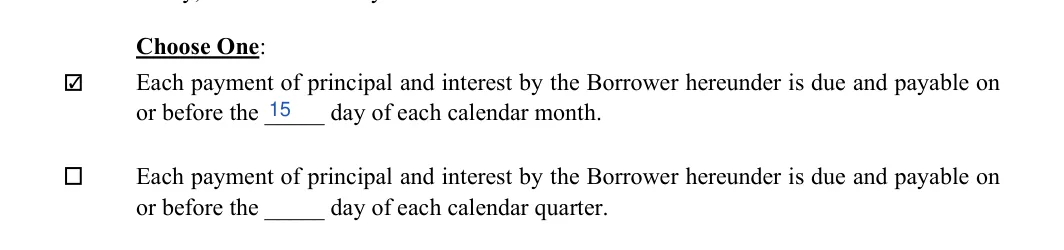
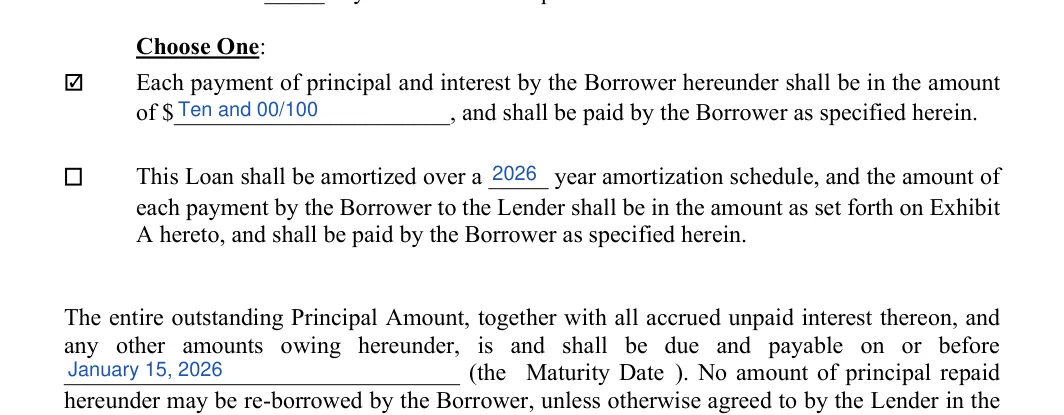
You can fill in the downloaded PDF with our online PDF editor. For a general overview of the topic and a template for every state, see our sample promissory note template.
A few minutes of checking can save both people a dispute later. Read the finished form from top to bottom, then confirm each item in the list below. Do this together, so both people see the same final text.
Print two copies, so each person keeps a signed original. This is common practice, not a legal requirement.
Signing the form is not the last step. Both people should keep a signed copy of the note for as long as the loan is open. A simple record of each installment helps both sides see how much of the loan is still unpaid.
These steps are common practice, not a legal requirement.
These two questions cover how Nevada sets interest on a promissory note and what happens when the note names no rate. Both answers come from Nev. Rev. Stat. §§ 99.040 to 99.055, which are listed under Sources below.
The rules are in Nev. Rev. Stat. §§ 99.040 to 99.055. The parties must specify in writing the rate they agree on, that it compounds if they so agree, and any other charges or fees.
Any contract or agreement in violation of the subsection is void and unenforceable.[1.3] When a loan is prepaid, the amount of interest earned must be computed by applying the agreed rate to the unpaid balance for each period.[1.5]
If no express written contract fixes a different rate, the statute sets one for the cases it lists. That rate is the prime rate of the largest bank in Nevada plus 2 percent, as ascertained by the Commissioner of Financial Institutions on January 1 or July 1 before the date of the transaction.[1.2]

General information, not legal or tax advice.
