Oregon Small Estate Affidavit Form

An Oregon small estate affidavit is a sworn statement that lists the decedent, the estate, the heirs, the devisees and the creditors. The statute calls it a simple estate affidavit. It fits an estate within $75,000 of personal property and $200,000 of real property and manufactured homes combined.[1.2] Filing must wait until 30 days after the death.[1.3]

Last Updated: October 2026. This guide is reviewed and updated regularly to reflect current Oregon law. If you notice an error or outdated information, please contact us.

Oregon small estate affidavit form preview

Create a free high quality Oregon Small Estate Affidavit online now!

Build Your Document

Answer a few simple questions to make your document in minutes

Save and Print

Save progress and finish on any device, download and print anytime

Sign and Use

Your valid, lawyer-approved document is ready

... or download your Oregon Small Estate Affidavit Form as a  PDF file

Oregon Small Estate Affidavit Laws and Requirements

Section 114.510 of the Oregon Revised Statutes sets two value limits for a simple estate affidavit.[1.2] The FormsPal template is titled Affidavit of Claiming Successor (Small Estate Affidavit). The person who signs the affidavit is called the affiant. On the form, the affiant is the heir, devisee, named personal representative or creditor who checks an authority box.

Value limits

The estate has to meet both limits. For general background on settling estates, see our guide to what probate is.

  • No more than $75,000 of the fair market value of the estate can be personal property other than manufactured homes.
  • No more than $200,000 of the fair market value can be the combined value of real property and manufactured homes.

Fair market value is set as of the date of death. If the death was more than one year before the affidavit is filed, it is set as of a date within 45 days before the filing.[1.2]

Liens and other debts do not lower the value of the estate. Use the full value of each asset when you compare the estate with the two limits.[1.2]

Oregon Small Estate Affidavit Laws Details

Estate value limit $75,000 of personal property other than manufactured homes and $200,000 of real property and manufactured homes combined[1.2]
Min. time after death 30 days[1.3]
Filing fee The fee set under ORS 21.145, with no fee for an amended affidavit[1.3]
Time to present claims Four months after the affidavit is filed[1.8]
State Laws Oregon Revised Statutes, Sections 114.505 to 114.550

Who Can File and What to Attach

Not everyone can file a simple estate affidavit, and the filer has to attach certain papers. This section covers who is barred from filing, the waiting period, the papers to file with the affidavit and the rule for safe deposit boxes.

A person may not file a simple estate affidavit in two cases.[1.3]

  • The person would be disqualified from acting as a personal representative under ORS 113.095.
  • The person has been convicted of a felony in Oregon or in another jurisdiction.

The 30 days count from the date of death. A simple estate affidavit may not be filed before they have passed.[1.3] You can count the days with our deadline calculator.

Papers filed with the affidavit

The affiant files these papers together with the affidavit.[1.5]

  • A certified copy of the death record of the decedent, filed as a confidential document.
  • If the decedent left a will, the original will, along with proof of the will. A certified copy can stand in only when the original will is filed in an estate proceeding in another jurisdiction. Our Oregon will template shows how a will is set up.
  • If the affidavit is filed under ORS 114.510 (1)(b), a copy of the trust instrument or a certification of the trust under ORS 130.860.

Safe deposit boxes

Check for a safe deposit box before you file. Say the decedent was the sole or last surviving lessee of a box, or owned its contents. If you know that, you may not file until you request an inventory of the box.[1.7] The affidavit then has to state the value of the contents of the box.

Creditors, Claims and Deadlines After Filing

Several deadlines start once the affidavit is on file. They matter to the affiant and to every creditor of the estate. This section covers when a creditor can file, how claims are presented and decided, and what the affiant must do after filing.

Creditors as filers

A creditor can become a claiming successor only if the creditor has not been paid in full within 60 days after the date of death.[1.1] If a decedent dies intestate and without heirs, that creditor may not file unless the State Treasurer has given written authorization.[1.4]

The creditor can notify the State Treasurer that the creditor plans to file. Within 30 days after that notice, the State Treasurer either gives the written authorization or says the Treasurer will file as claiming successor. The clerk of the probate court may not accept the creditor's affidavit without the authorization attached.[1.4]

Claims against the estate

A creditor can present a claim to the affiant within four months after the affidavit was filed, at the address stated in the affidavit for claims. If an amended affidavit is filed, claims can be presented within four months after that filing.[1.8]

A claim that was not listed in the affidavit counts as allowed unless the affiant mails or delivers a notice of disallowance within 60 days after the claim is presented.[1.8] The creditor then has 30 days to ask the probate court for a summary determination. A creditor whose claim is listed as disputed has four months after the filing to ask for one.[1.9]

The court hears the petition without a jury. Its order cannot be appealed and is enforced only through a petition for summary review under ORS 114.550.[1.9]

Duties of the affiant

The affiant has a few duties after filing.[1.10]

  • Do not mix estate property with property of the affiant or anyone else.
  • Within 30 days after filing, mail or deliver each instrument the affidavit says will be mailed or delivered.
  • Keep the records of the estate at least until the later of two years or the end of any summary review proceeding under ORS 114.550.

If a person who receives a certified copy of the affidavit refuses to pay a debt or hand over property, the affiant may send a written demand by certified mail.[1.6]

To title a vehicle listed in the affidavit, the affiant signs Oregon DMV form 735-6797, Simple Estate Certification, after the simple estate affidavit has been filed.[2.1]

Key Deadlines at a Glance

The table below pulls the deadlines from the sections above into one place. Each row names the event, the time limit and the statute section it comes from. Count from the date in the first column, and ask the probate court clerk if you are unsure which date starts a period.

EventTime limitSource
Filing the affidavitNot until 30 days after the deathORS 114.515[1.3]
Creditor becomes a claiming successorUnpaid in full 60 days after the deathORS 114.505[1.1]
State Treasurer answers a creditor's noticeWithin 30 days after the noticeORS 114.520[1.4]
Mail or deliver the listed instrumentsWithin 30 days after filingORS 114.545[1.10]
Present a claim to the affiantWithin four months after the affidavit or amended affidavit is filedORS 114.540[1.8]
Disallow an unlisted claimWithin 60 days after the claim is presentedORS 114.540[1.8]
Petition after a disallowanceWithin 30 days after the notice is mailed or deliveredORS 114.542[1.9]
Petition on a disputed claimWithin four months after the filing that lists itORS 114.542[1.9]
Keep estate recordsUntil the later of two years or the end of summary reviewORS 114.545[1.10]

Checklist Before You File

Use this list to check that the affidavit is ready to file. It follows the rules in the sections above, so you can tick off each point before you take the signed form to the notary and then to the probate court.

  • The estate is within both value limits, counted at full fair market value.
  • At least 30 days have passed since the death.
  • You are not barred from filing by a felony conviction or by disqualification under ORS 113.095.
  • You asked for an inventory of any safe deposit box and the affidavit states the value of its contents.
  • You have a certified copy of the death record to file as a confidential document.
  • If there is a will, you have the original will and proof of the will.
  • If you file under ORS 114.510 (1)(b), you have the trust instrument or a certification of the trust.
  • If you are a creditor, you checked whether the State Treasurer's written authorization is needed.
  • You wrote the address, email address or fax number for presenting claims in the affidavit.

Planning ahead for your own estate? Our Oregon power of attorney forms and Oregon living will form cover two other core documents. Our guide to what an executor does explains the role of the person who settles an estate. You can also browse all Oregon forms.

seal of oregon state
Other Oregon Forms
Various other popular Oregon forms readily available for download and that can be personalized in our simple document constructor.

Template Preview
Create a free high quality Oregon Small Estate Affidavit online now!

How to Fill Out the Oregon Small Estate Affidavit Form

The form runs five pages, and the fourteen steps below follow its order. Fill in the downloaded PDF with our online PDF editor, or print it and write the answers by hand. Each step names the part of the form it covers.

The screenshots under each step show the FormsPal Oregon small estate affidavit template filled with sample entries in blue, so you can see where each answer goes. The names, addresses, dates and amounts are examples only.


  1. Caption: In the Matter of the Estate of. At the top of page 1, fill in the Case No. line in the court caption.
    Oregon small estate affidavit: In the Matter of the Estate of, filled with sample entries
    Step 1: sample entries, not a real document.
  2. Print the deceased's name under the title. Print the deceased person's name on the line under "In the Matter of the Estate of", above the title Affidavit of Claiming Successor (Small Estate Affidavit).
    Oregon small estate affidavit: SUCCESSOR, filled with sample entries
    Step 2: sample entries, not a real document.
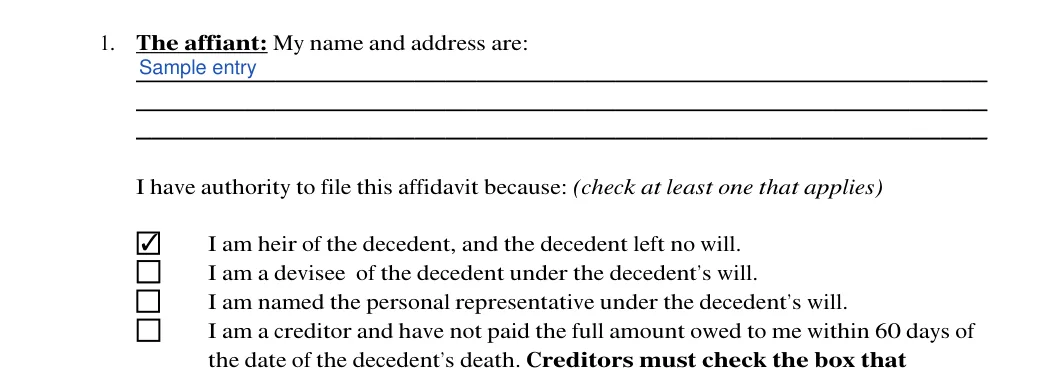
  3. Item 1: The affiant, name and address. Enter your name and address on the three lines. Then check at least one box under "I have authority to file this affidavit because". The choices are heir with no will, devisee, named personal representative or creditor. Affiant data section of Oregon small estate affidavit form
    Oregon small estate affidavit: The affiant: My name and address are, filled with sample entries
    Step 3: sample entries, not a real document.
  4. Item 1: Creditor boxes. Only a creditor fills this in. Check the box that applies, either written authorization attached or authorization not required because the decedent died testate or left heirs. Other filers skip this step. The form names the Department of State Lands, while the statute names the State Treasurer[1.4], so ask the probate court clerk which authorization to attach.
    Oregon small estate affidavit: applies, filled with sample entries
    Step 4: sample entries, not a real document.
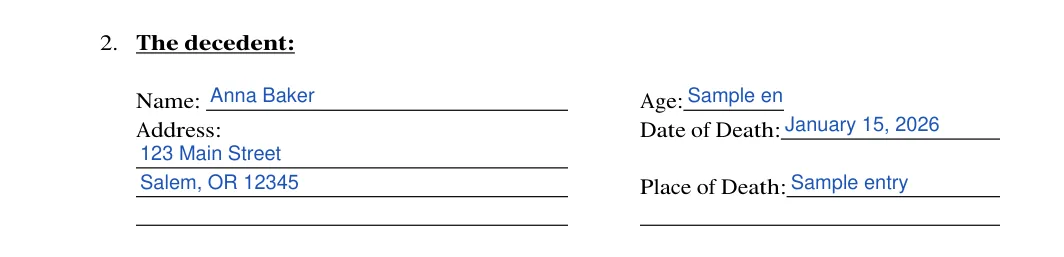
  5. Item 2: The decedent. Fill in the decedent's name, age, address, date of death and place of death. The form says a certified copy of the death record is attached, and Oregon law has the affiant file it as a confidential document.[1.5] Decedent data section of a small estate affidavit document for Oregon
    Oregon small estate affidavit: The decedent, filled with sample entries
    Step 5: sample entries, not a real document.
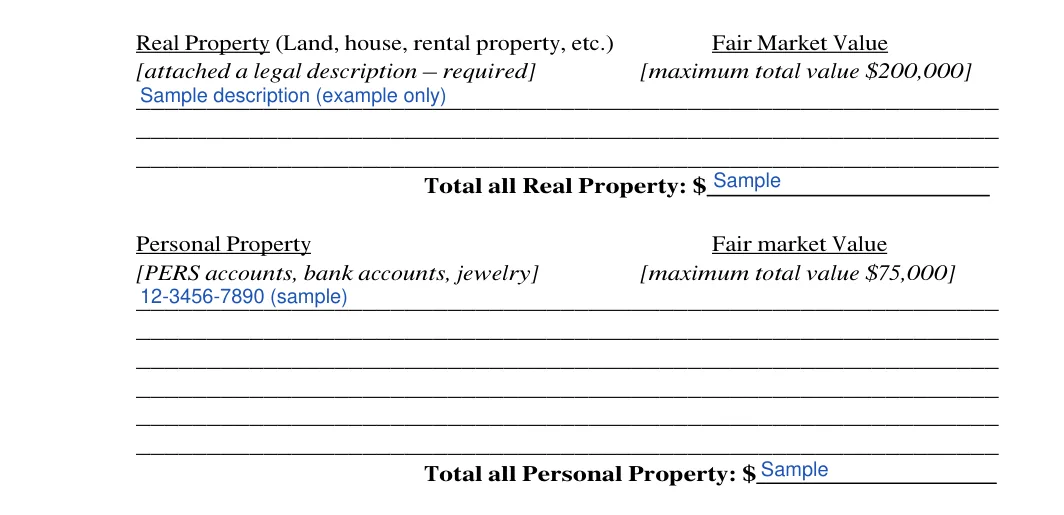
  6. Item 3: The decedent's estate. List the real property, with its fair market value and the real property total. The form asks for a legal description to be attached. Then list the personal property, with its value and the personal property total. The form prints maximum totals of $200,000 and $75,000 beside the two headings.[1.2] Decedent's estate description section of Oregon sea template
    Oregon small estate affidavit: Attached a legal description  required, Total all real property and more, filled with sample entries
    Step 6: sample entries, not a real document.
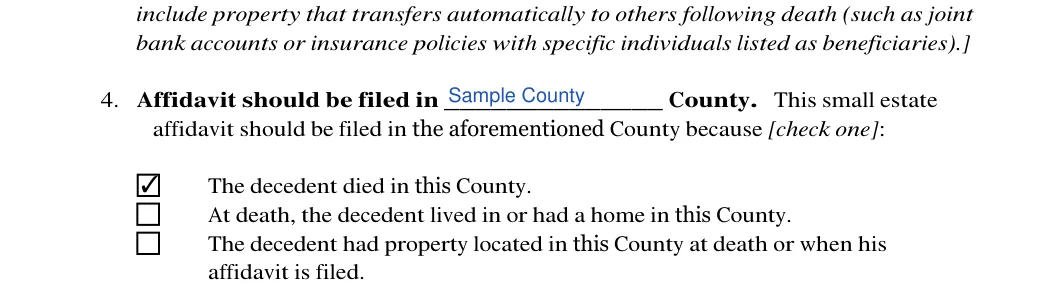
  7. Item 4: County where the affidavit is filed. Write the county in the blank, then check the one reason under "check one" that explains why that county is the right one. File the affidavit with the clerk of the probate court in a county where the decedent lived, died or had property (ORS 114.515(1) and ORS 113.015).[3.1] County choosing part of Oregon form of small estate affidavit
    Oregon small estate affidavit: County, Check, filled with sample entries
    Step 7: sample entries, not a real document.
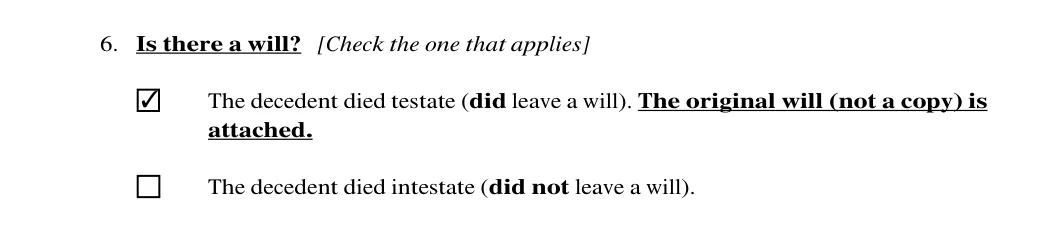
  8. Item 6: Is there a will?. Check the one box that applies, died testate or died intestate. For a testate decedent the form says the original will, not a copy, is attached.[1.5] Part for information about will of a small estate affidavit for Oregon
    Oregon small estate affidavit: 6. Is there a will? [Check the one that applies], filled with sample entries
    Step 8: sample entries, not a real document.
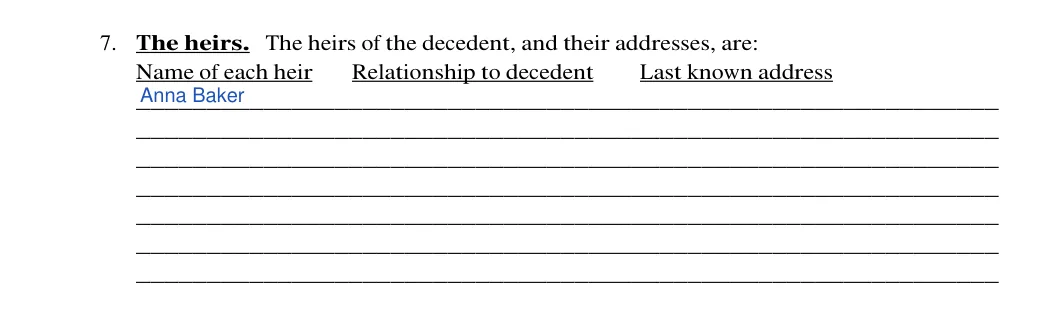
  9. Item 7: The heirs. For each heir, write the name, the relationship to the decedent and the last known address. If you also need proof of who the heirs are, see our affidavit of heirship. Heirs names indication part of Oregon sea form
    Oregon small estate affidavit: Name of each heir, filled with sample entries
    Step 9: sample entries, not a real document.
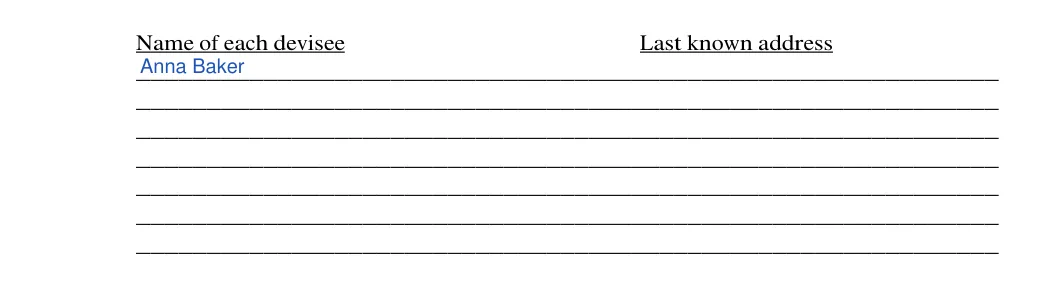
  10. Item 8: The devisees. If the decedent left a will, list each devisee and the last known address. If not, write "none", as the form says. Devisees listing part of a small estate affidavit document for Oregon
    Oregon small estate affidavit: Name of each devisee, filled with sample entries
    Step 10: sample entries, not a real document.
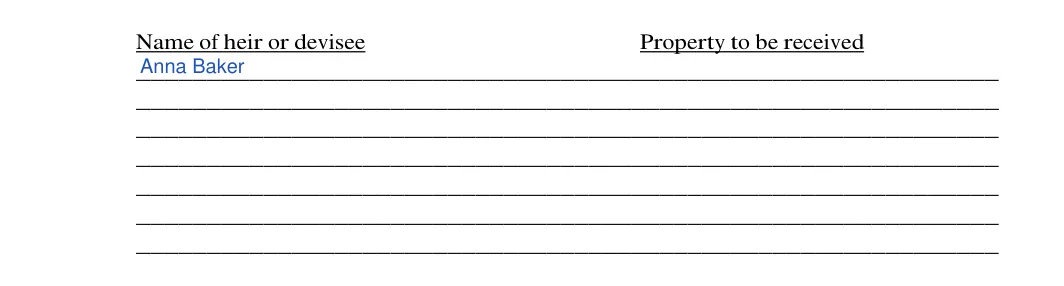
  11. Item 10: Who gets what. Under "Name of heir or devisee", list each person with the property that person is to receive. The form's note suggests "entire estate" or "1/3 of residue" where it fits. Read item 9, the notice to heirs and devisees, just above. Section for info about property assignment of Oregon small estate affidavit template
    Oregon small estate affidavit: Name of heir or devisee, filled with sample entries
    Step 11: sample entries, not a real document.
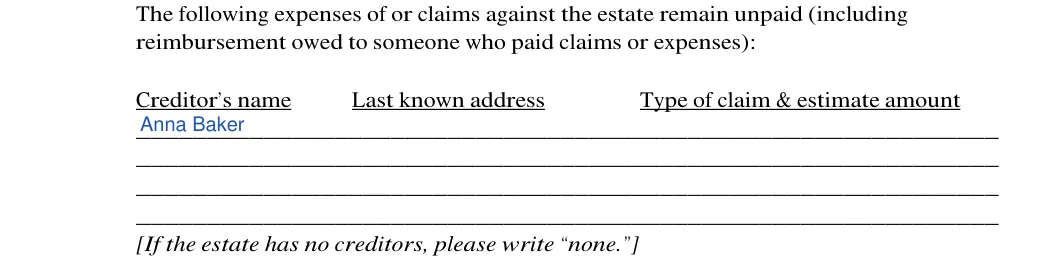
  12. Item 11: Creditors. List each unpaid creditor with the name, the last known address, and the type and estimated amount of the claim. Write "none" if the estate has no creditors. Creditors data indication section of Oregon document of small estate affidavit
    Oregon small estate affidavit: reimbursement owed to someone who paid claims or expenses), filled with sample entries
    Step 12: sample entries, not a real document.
  13. Item 12: Disputed claims. List any claims you dispute in the same three columns, or write "none". Then read items 13 to 15, which cover the notice to creditors, the notice to the State and claims that may be barred. They have no fields. A creditor whose claim is listed as disputed has four months to ask the court for a summary determination.[1.9] Part for specifying info about disputed claims of Oregon sea template
    Oregon small estate affidavit: Creditors name 1, Creditors name 2 and more, filled with sample entries
    Step 13: sample entries, not a real document.
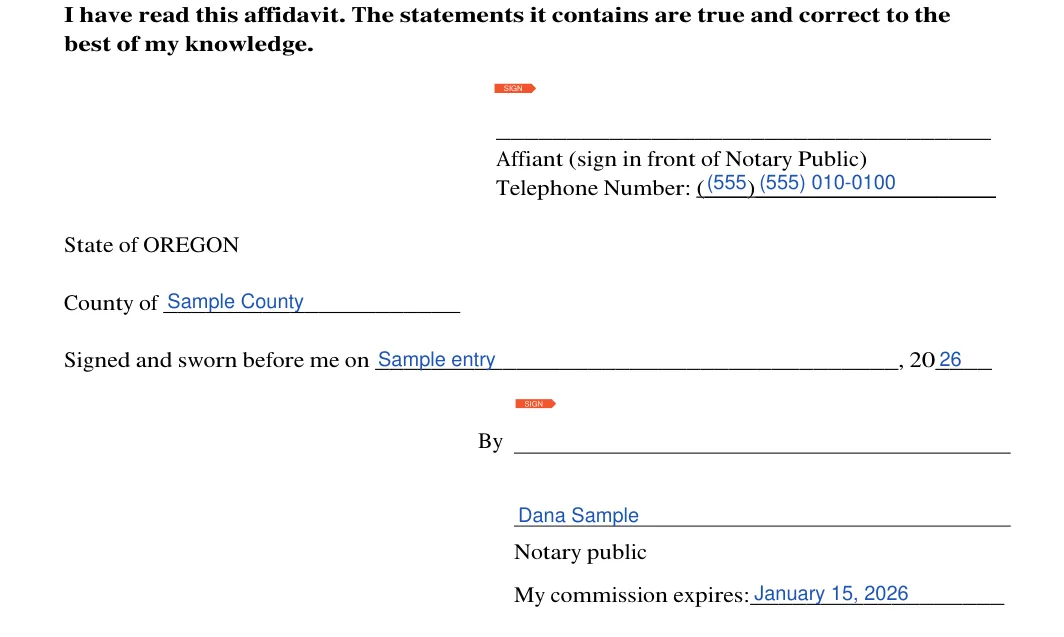
  14. Sign before the notary and add your telephone number. On page 5, sign on the affiant line, which the form marks "sign in front of Notary Public", and enter your telephone number. The notary block below it is for the notary or the court clerk to complete. You can sign the affidavit in front of a notary public or a court clerk, because the clerk of the probate court may also acknowledge it (ORS 114.515(8)).[1.11] Our Oregon notary acknowledgement page explains the notary side. Signing section of a form of small estate affidavit for Oregon Notarial verification section of Oregon template of small estate affidavit
    Oregon small estate affidavit: Affiant's signature, Telephone number area code and more, filled with sample entries
    Step 14: sample entries, not a real document.

Frequently Asked Questions

These answers come from the Oregon statute sections cited on this page. They cover appeals, liens, the deadlines for claims and the filing fee. Ask the probate court clerk about anything that is not covered here.

Can you appeal a summary determination in Oregon?

No. An order made on a summary determination may not be appealed. It can be enforced only by a petition for summary review under ORS 114.550.[1.9]

Is the small estate value reduced by liens in Oregon?

No. The fair market value of the entire interest in the property is used without reduction for liens or other debts.[1.2]

When must a claim be presented to the affiant in Oregon?

A claim is presented to the affiant within four months of the filing of the affidavit or an amended affidavit. It goes to the place the affidavit states for presenting claims.[1.5]

  • The address stated in the affidavit.
  • The email address stated in the affidavit.
  • The fax number stated in the affidavit.

How long does the affiant have to disallow a claim in Oregon?

The affiant has 60 days after the claim is presented. A claim that was not listed in the affidavit counts as allowed as presented unless the affiant mails or delivers a notice of disallowance in that time.[1.8]

Is there a filing fee for a small estate affidavit in Oregon?

Yes. The clerk of the probate court charges the fee set under ORS 21.145 for a simple estate affidavit. No fee is charged for an amended affidavit.[1.3] This page does not list an amount, so ask the clerk for the current fee.

How long must a creditor wait to become a claiming successor in Oregon?

A creditor has to wait 60 days. Only a creditor that has not been paid or reimbursed in full within 60 days after the decedent's death can qualify as a claiming successor.[1.1]

Does a creditor need the State Treasurer's authorization to file the affidavit in Oregon?

Sometimes. If a decedent dies intestate and without heirs, a creditor who is a claiming successor may not file unless the State Treasurer has given written authorization. The clerk of the probate court may not accept that creditor's affidavit without the authorization attached.[1.4]

Must a death record be filed with the small estate affidavit in Oregon?

Yes. The affiant files a certified copy of the death record of the decedent as a confidential document.[1.5]

Must the will be filed with the small estate affidavit in Oregon?

Yes, if the decedent died testate. The affiant files the original will at the same time as the affidavit, along with proof of the will. If the original will is filed in an estate proceeding in another jurisdiction, a certified copy is filed instead.[1.5]

Must a safe deposit box be inventoried before filing a small estate affidavit in Oregon?

Yes, when you know the decedent was the sole or last surviving lessee of the box or owned its contents. You may not file until you request an inventory of the box, and the affidavit must state the value of the contents.[1.7]

How long must the affiant keep records of the estate in Oregon?

The affiant keeps the records at least until the later of two years under ORS 114.550 or the end of any summary review proceeding under that section.[1.10]

Is a petition for summary determination heard by a jury in Oregon?

No. The court hears the petition without a jury, after notice to the creditor and the affiant. Any interested person may be heard.[1.9]

General information, not legal or tax advice.

Sources

  1. Oregon Revised Statutes, Chapter 114.
    • 1.1 Or. Rev. Stat. § 114.505
    • 1.2 Or. Rev. Stat. § 114.510
    • 1.3 Or. Rev. Stat. § 114.515
    • 1.4 Or. Rev. Stat. § 114.520
    • 1.5 Or. Rev. Stat. § 114.525
    • 1.6 Or. Rev. Stat. § 114.535
    • 1.7 Or. Rev. Stat. § 114.537
    • 1.8 Or. Rev. Stat. § 114.540
    • 1.9 Or. Rev. Stat. § 114.542
    • 1.10 Or. Rev. Stat. § 114.545
    • 1.11 Or. Rev. Stat. § 114.515(8)
  2. Oregon DMV Form 735-6797, Simple Estate Certification
    • 2.1 Form 735-6797
  3. Oregon Revised Statutes, Chapter 113
    • 3.1 Or. Rev. Stat. § 113.015
Published: Jul 9, 2022
Mara Erlach
Mara Erlach
Writer & Attorney
Mara has been practicing estate planning and trust law in California since 2003, taking pride in helping clients of all backgrounds and asset profiles form a complete and customized estate plan. Her specialties are: estate planning, wills and trusts, trust and probate administration.