
Updated:
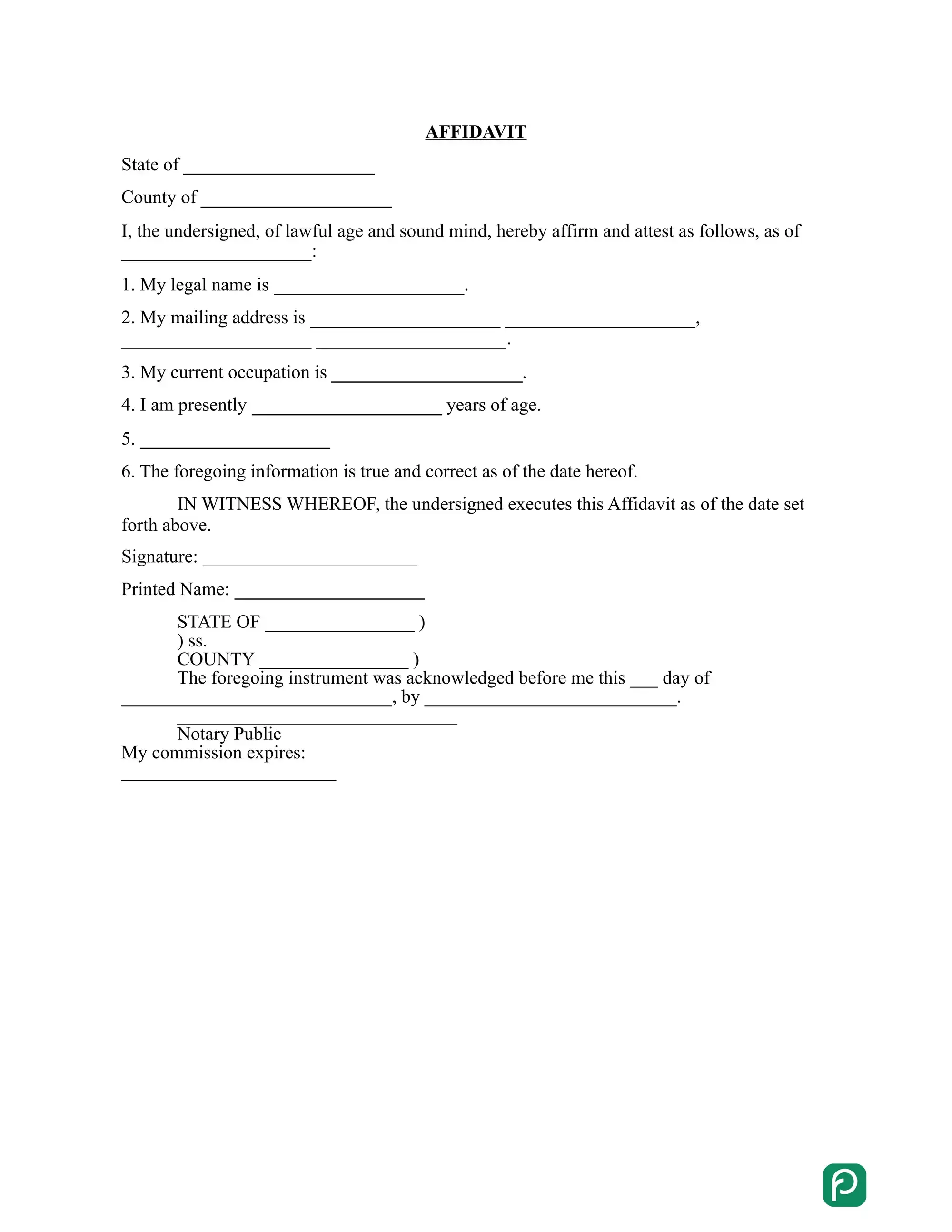
A Michigan affidavit is a written statement of facts sworn under oath. The signer, called the affiant, swears that each listed fact is true and personally known. The form is needed by anyone proving a fact in writing, especially for court or probate.
Key facts
Build Your Document
Answer a few simple questions to make your document in minutes
Save and Print
Save progress and finish on any device, download and print anytime
Sign and Use
Your valid, lawyer-approved document is ready
A Michigan affidavit is a written statement of facts made voluntarily and under oath by one person, the affiant. The affidavit puts facts such as a name change, a home address or an identity theft report into clear, written form.
Michigan affidavits provide evidence in civil court cases, in the probate of an estate and in everyday matters such as proof of a residential address or a marital status change.
An affidavit uses a few terms of art that appear on most forms, and each one names a part of the document or a person tied to it.
An affidavit of facts holds three core parts: the affiant's identity, numbered statements of fact, and a dated signature with the oath lines below it.
Each statement in the affidavit says one thing in plain words, so a reader can check it later against other papers. Short, specific sentences are easier to read and easier to check later. Compare the two examples below, which use made-up details.
Vague: Anna Baker has lived at the house for a long time.
Clear: Anna Baker has lived at 123 Main Street, Anytown, MI since June 2019.
An affidavit of facts should state what the affiant knows firsthand, the affiant's personal knowledge: what the affiant saw, heard or did. A guess or an opinion belongs outside the affidavit.
A Michigan affidavit of affixture states that a mobile home is affixed to the real property, and Mich. Comp. Laws § 125.2330i lists what the affidavit contains.
Under Mich. Comp. Laws § 125.2330i, the affidavit of affixture includes these items:
The affidavit of affixture comes with a fee in the amount section 30a prescribes for a certificate of title, under Mich. Comp. Laws § 125.2330i. Section 30a sets the amount, and this page states no figure for it.
The affidavit of affixture differs from a general affidavit in one way: its contents come from the statute, not from the affiant's own choice of facts. The legal description of the land and the home's serial number take the place of free-form statements.
The Michigan Property Transfer Affidavit (Form L-4260) comes from the Michigan Department of Treasury and reports a transfer of real property ownership. Michigan affidavit forms include affidavits of professional service, of descent, and of death.
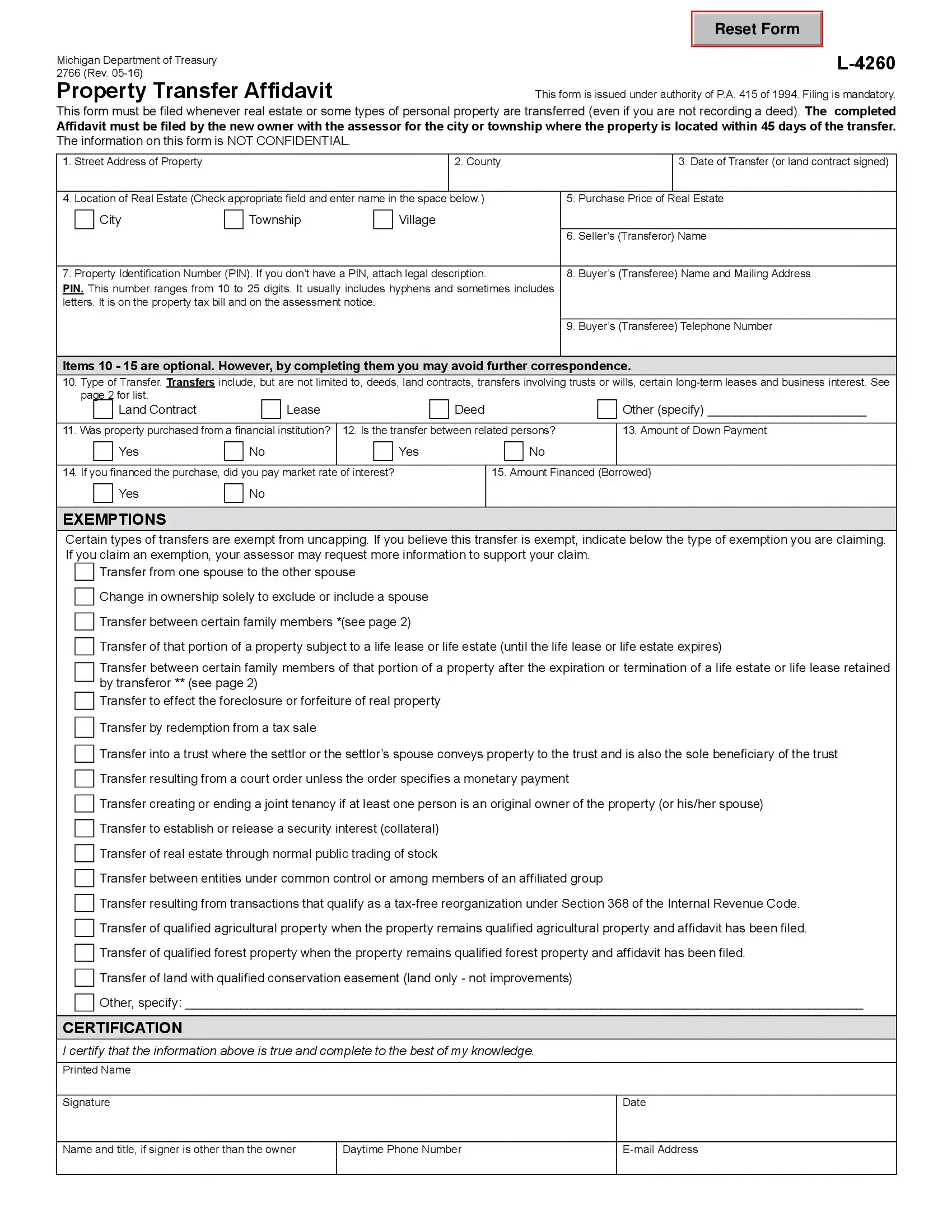
Michigan Property Transfer Affidavit is used to report real property ownership transfer. The form requires detailed information about the property being transferred, including the address, the date of transfer, and the names of the new and previous owners.
A Michigan affidavit is written in a fixed order: the affiant's identity first, then the numbered facts, then a check against papers, with the signature and jurat left for the oath.
The signature on a Michigan affidavit comes with an oath or affirmation that every statement is true, so the affiant signs last, after the final read.
This page holds no Michigan rule on who may give the oath for a general affidavit, so it names none.
The right Michigan affidavit depends on what the statement proves: personal facts, a sale of land, a mobile home on land or a small estate.
| Situation | Document | Where its contents come from |
|---|---|---|
| Facts for a court, an agency, an employer or a school | General affidavit (affidavit of facts) | The affiant's personal knowledge |
| A transfer of real property ownership | Property Transfer Affidavit (Form L-4260) | The Michigan Department of Treasury form |
| A mobile home affixed to real property | Affidavit of affixture | Mich. Comp. Laws § 125.2330i |
| Collecting the property of a deceased person with a small estate | Michigan Small Estate Affidavit | Its own page on this site |
An affidavit is made by writing the affiant's name, numbered facts and a dated signature line, then swearing to the facts the way the requesting office directs. The steps above list each action in order.
Our sources hold no Michigan notarization rule for a general affidavit, so this page states none. The court, agency or person who asked for the affidavit says how it is to be sworn, and those instructions decide.
An affidavit can point to attached papers, called exhibits, when each one carries a label such as Exhibit A and the statement that relies on it names that label.
No: the affidavit of affixture states that a mobile home is affixed to the real property under Mich. Comp. Laws § 125.2330i, while the Property Transfer Affidavit (Form L-4260) reports a transfer of real property ownership.
This page links to the Property Transfer Affidavit for Michigan, and the Michigan Small Estate Affidavit has its own page.
Check that every name, date and address is spelled the same way as on your IDs and other records. Read each statement once more to make sure it is accurate and complete.
General information, not legal or tax advice.
