
An Indiana firearm bill of sale is a written record of a firearm sale between a seller and a buyer. It names both parties, describes the firearm by make, model, caliber, and serial number, and states the price and how it was paid. You can complete it online for free.
Last Updated: October 2026. This guide is reviewed and updated regularly to reflect current Indiana law. If you notice an error or outdated information, please contact us.
Build Your Document
Answer a few simple questions to make your document in minutes
Save and Print
Save progress and finish on any device, download and print anytime
Sign and Use
Your valid, lawyer-approved document is ready
A firearm transaction in Indiana falls under both state and federal laws. Indiana sets a minimum age for receiving a handgun or machine gun. Federal law bars sales to certain persons and sets a background check duty for licensed dealers. The table below lists each rule and where it comes from.
| Subject | Rule | Source |
| Minimum age to receive a handgun or machine gun | 18 years of age | Ind. Code § 35-47-2-7[2] |
| Selling to a person under indictment for, or convicted of, a crime punishable by more than one year in prison | Unlawful when you know or have reasonable cause to believe it | 18 USC 922[1.1] |
| Dealer transfer to a person without a license | The dealer contacts the national instant criminal background check system before completing the transfer | 18 U.S.C. § 922(t)(1)[1.2] |
Indiana sets an age floor in its firearms chapter. The statute reads:
A person may not sell, give, or in any other manner transfer the ownership or possession of a handgun or machine gun to any person under eighteen (18) years of age
In plain words, you cannot sell or give a handgun or machine gun to anyone under 18.[2]
Federal law makes it unlawful to sell or otherwise dispose of a firearm or ammunition to certain persons. That applies when you know, or have reasonable cause to believe, that the person belongs to one of these groups.[1.1]
Federal law bars a licensed importer, manufacturer, or dealer from transferring a firearm to a person who holds no license, unless the licensee first contacts the national instant criminal background check system before the transfer is complete.[1.2] In that kind of transfer a background check is required, and the licensed dealer makes the contact.
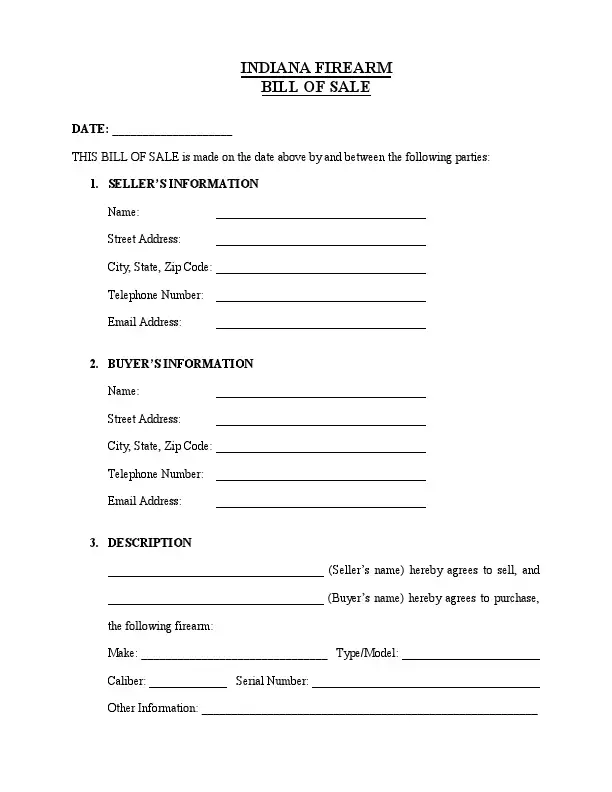
This free form records a firearm sale between a seller and a buyer. Build it online by answering a few questions, or download the blank PDF and fill it in by hand. You can also complete the PDF on your computer with our online PDF editor.
Need something else? Browse our Indiana bill of sale forms or read the bill of sale basics. For a version that is not specific to one state, use our general firearm bill of sale form.
Work through the form from top to bottom. Each step below matches a numbered part of it, from the date line on page 1 to the acknowledgment on page 5. Fill in the parts on the PDF, or answer the matching questions when you build it online.
Step 1: Date. Write the date of the sale on the DATE line at the top of page 1.

Step 2: 1. Seller's Information. Enter the seller's name, street address, city, state and zip code, telephone number, and email address.
Step 3: 2. Buyer's Information. Enter the same details for the buyer.

Step 4: 3. Description. Write the seller's and the buyer's names in the sentence that opens the section. Then list the firearm's make, type or model, caliber, serial number, and any other information.

Step 5: 4. Purchase Date, Purchase Price and Method. Enter the purchase date and the total price. Then mark one of the four payment options:
For a trade-in, also describe the buyer's firearm. Last, select how the price is paid:

Step 6: 5. Seller Disclosures. Read the seller's statements on page 2. Then add the seller's signature below them on page 3.
Step 7: 5. Buyer Disclosures. Read the buyer's statements on page 3. Then add the buyer's signature below them.
Step 8: 6. Miscellaneous Provisions. Read the terms on pages 3 and 4. They cover the seller's confirmation of ownership, the as-is sale, and the clause that makes this paper the only agreement between the two parties.

Step 9: 7. Signatures. On page 4, fill in the dates. The seller, the buyer, and a witness each add a signature and a printed name.

Step 10: Acknowledgment. Page 5 holds the acknowledgment, the block a notary completes. If you have it notarized, sign in front of the notary.

Both parties should keep a signed copy for their records.
Indiana law does not allow anyone to sell, give, or otherwise transfer a handgun or machine gun to a person under eighteen (18) years of age.[2] That makes 18 the minimum age to receive a handgun or machine gun from a seller. The statute names handguns and machine guns.
General information, not legal or tax advice.
