
A California motorcycle bill of sale is a written document that records the sale of a motorcycle between a seller and a buyer. It names both people, identifies the motorcycle and states the price and the date of sale. The California DMV accepts any bill of sale that identifies the vehicle.[3] Create yours online or download the free PDF.
Last Updated: October 2026. This guide is reviewed and updated regularly to reflect current California law. If you notice an error or outdated information, please contact us.

Build Your Document
Answer a few simple questions to make your document in minutes
Save and Print
Save progress and finish on any device, download and print anytime
Sign and Use
Your valid, lawyer-approved document is ready
The California DMV accepts any bill of sale that identifies the vehicle. A handwritten bill of sale is valid, as long as it carries the information the state requires.[3] So the safest bill of sale is one that describes the motorcycle clearly, names the seller and the buyer, and shows the price and the date.
The FormsPal template identifies the motorcycle with these lines:
It also records the seller, the buyer, the purchase date, the purchase price and how the price is paid. The price matters to the DMV. Under its use tax rules, each application subject to use tax must show the purchase price on the back of the Certificate of Title or include a bill of sale.[4]
Our general bill of sale guide explains the basics for any state. You can also browse our other California bill of sale forms.
A California bill of sale does not need a notary or a witness. The DMV manual says a bill of sale is not required to be notarized or witnessed.[2] Signing and mileage are separate points, and both are covered below.
The FormsPal template has an Odometer Reading line where the seller writes the mileage in miles. It also has signature lines for the seller and the buyer.
A certificate of ownership is the DMV document that shows who owns a motorcycle. A bill of sale is a separate record of the sale between you and the buyer.
California law has the DMV prescribe and provide the forms for applications and certificates of ownership. The statute says:[1]
The department shall prescribe and provide suitable forms of applications, certificates of ownership, registration cards, drivers' licenses, and all other forms requisite or deemed necessary for the purposes of this code
If you want a form for the sale itself, you can use our motorcycle bill of sale form. It works for the legal document you hand to the buyer.
The application to register a motorcycle asks for the owner's driver's license or identification card number only if the owner has one (Veh. Code § 4150.2(a)). A motorcycle license is not a condition of registering the motorcycle.[6]
| Document Name | California Motorcycle Bill of Sale Form |
| Other Name | California Bill of Sale for Motorcycle |
| Relevant Link | California Department of Motor Vehicles |
| Avg. Time to Fill Out | 11 minutes |
| # of Fillable Fields | 66 |
| Available Formats | Adobe PDF |
| Notary or Witness Required? | No[2] |
The steps below follow our California motorcycle bill of sale template, from the date at the top of page 1 to the acknowledgment on page 4. Fill in each part in the order the template shows it. You can create the form online, print the PDF and write it by hand, or fill in the PDF with our PDF editor.
Before you start, have these details ready:
The screenshots under each step show the FormsPal California motorcycle bill of sale template filled with sample entries in blue, so you can see where each answer goes. The names, addresses, dates and amounts are examples only.
Step 1: Date
Write the date on the DATE line at the top of page 1. The opening line says the bill of sale is made on this date between the parties listed below.

Step 2: 1. Seller's information
Enter the seller's name, street address, city, state and zip code, telephone number and email address.
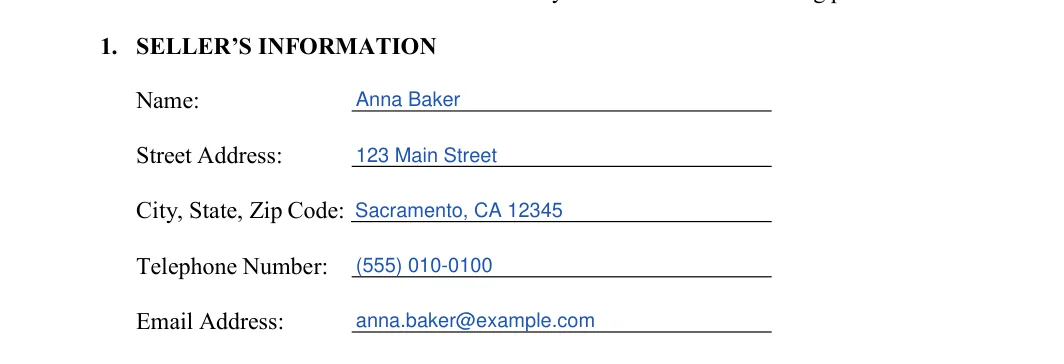
Step 3: 2. Buyer's information
Enter the buyer's name, street address, city, state and zip code, telephone number and email address.
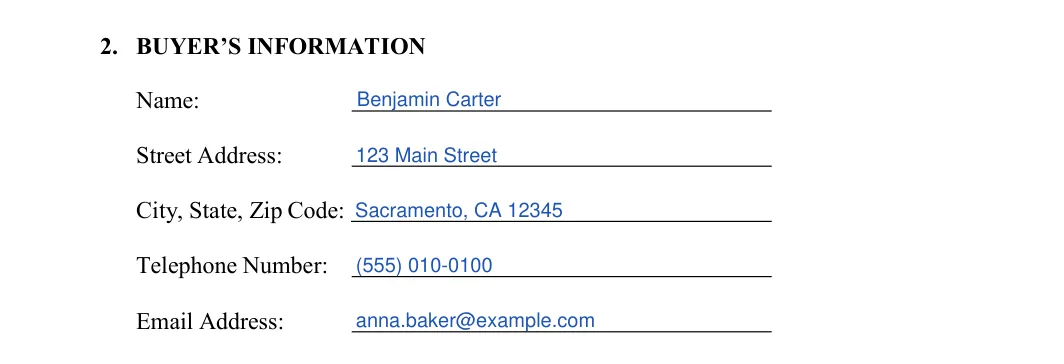
Step 4: 3. Motorcycle description: the parties
In the sentence that starts section 3, type the seller's name where it reads "agrees to sell" and the buyer's name where it reads "agrees to purchase".

Step 5: 3. Motorcycle description: the motorcycle
Fill in the Make, Model, Year, Odometer Reading (in miles), Color and VIN # lines for the motorcycle being sold.
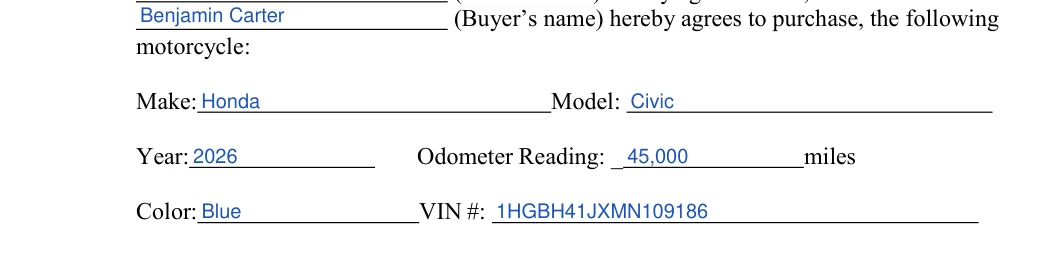
Step 6: 4. Purchase date and purchase price
On page 2, write the purchase date (the form has a blank for the day and one for the year after "20") and the total purchase price in U.S. dollars.
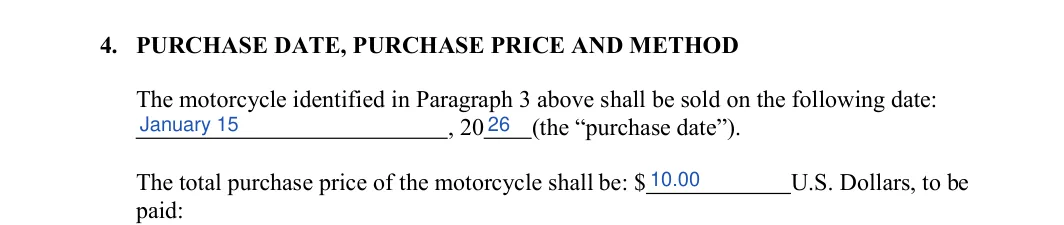
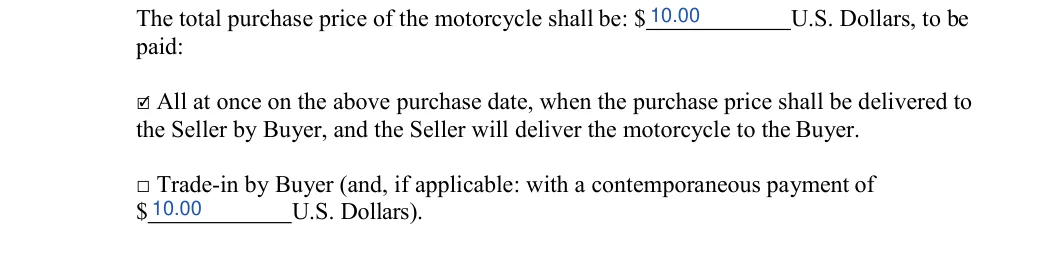
Step 7: Paid: all at once or trade-in
Under "to be paid", initial the box for the arrangement that applies. The first two boxes are "All at once" on the purchase date and "Trade-in by Buyer". For a trade-in, add the contemporaneous payment amount if there is one.
Step 8: Buyer's vehicle: make and model
Only for a trade-in, write the make and model of the buyer's vehicle on the lines under "Buyer's vehicle". Otherwise leave these lines empty.

Step 9: Buyer's vehicle: year and odometer reading
For a trade-in, write the year and the odometer reading in miles of the buyer's vehicle.

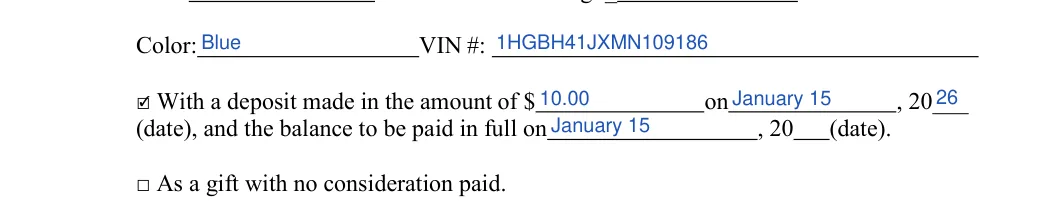
Step 10: Buyer's vehicle: color and VIN, then deposit or gift
For a trade-in, finish the buyer's vehicle with its Color and VIN #. Below it are the deposit option (deposit amount, deposit date and the date the balance is paid in full) and the gift option. Fill in and initial only the one that applies.
Step 11: How the price is paid
Initial one of the four choices: Cash, Check, Cashier's check or Money Order. If you pick Check, write the check number in the "check #" blank.

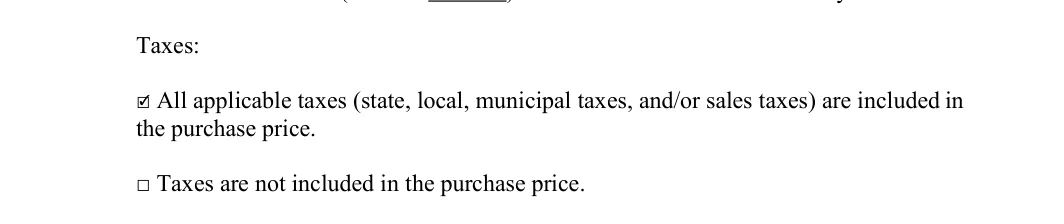
Step 12: Taxes
Initial one of the two Taxes lines: taxes are included in the purchase price, or taxes are not included.
Step 13: Section 5 and 6. Signatures
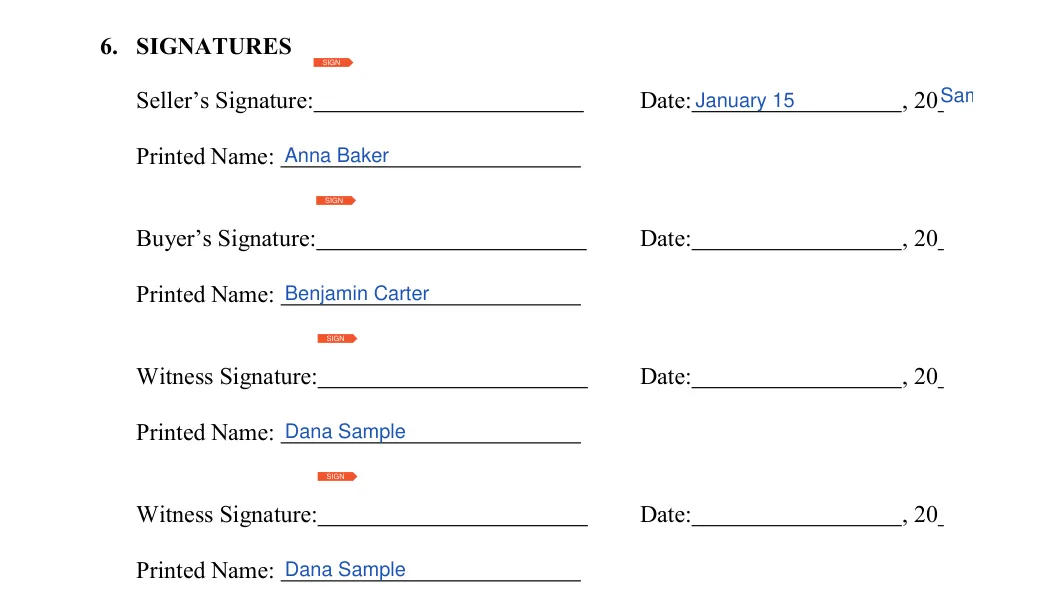
Read section 5, which runs from page 2 onto page 3 and has no fields to fill. In section 6, the seller and the buyer each sign, print their name and date their line. The form also has two witness lines, each with a signature, printed name and date.
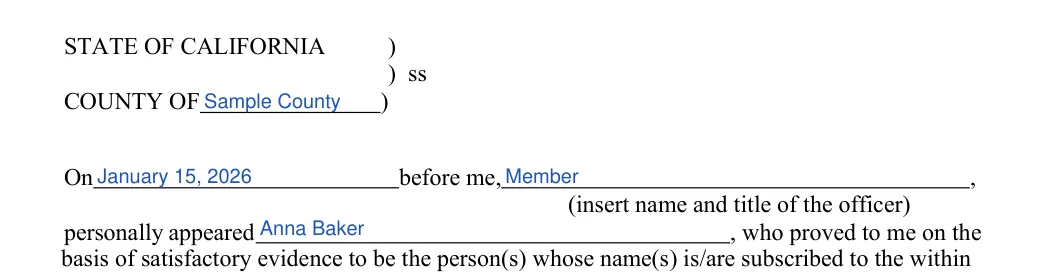
Step 14: Acknowledgment: state, county and officer
Page 4 is the acknowledgment. It has blanks for the county, the date, the name and title of the officer, and the name of the person who signed. If you use it, sign before the notary in the acknowledgment on page 4 and let the notary complete these blanks.
Step 15: Acknowledgment: officer's signature and seal
The Signature (seal) line at the bottom of page 4 is for the notary or other officer, who signs and adds the seal after the other acknowledgment blanks are completed.

These short answers come from the California DMV manual and the statutes listed in the Sources section at the end of this page. Each answer marks its source, so you can check the wording yourself.
Three points from the sources apply to the paperwork:
No. The DMV manual says a bill of sale is not required to be notarized or witnessed.[2]
The DMV says that any bill of sale that identifies the vehicle is acceptable.[3] The FormsPal template identifies the motorcycle by make, model, year, color, odometer reading and VIN.
General information, not legal or tax advice.
