
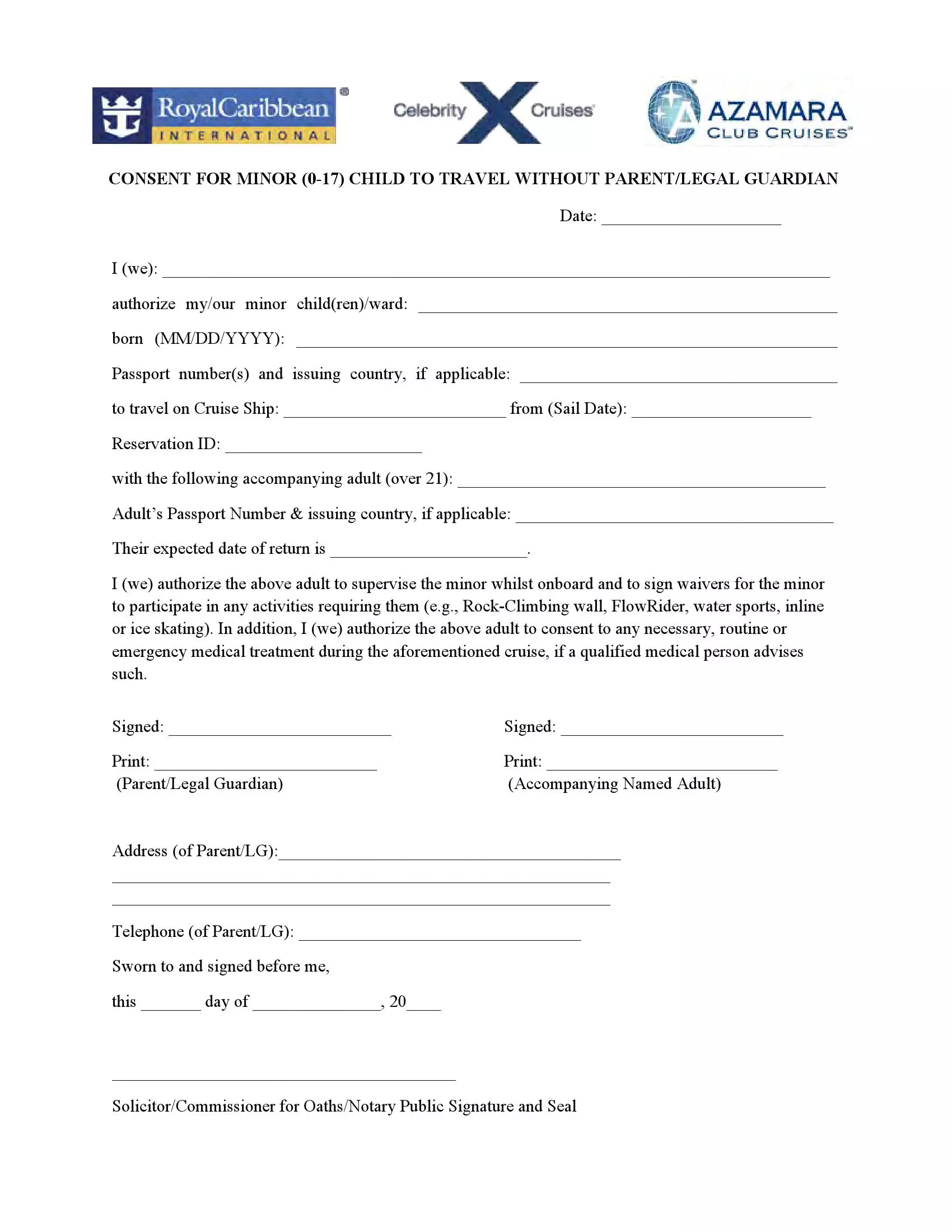
The Royal Caribbean parental consent form is an official document that gives a child who has not reached the age of majority a right to travel on a cruise ship without parents. However, this person must be accompanied by another adult over the age of 21 to whom the child’s parents transfer responsibility for the duration of the trip.
Last Updated: October 2026. This guide is reviewed and updated regularly to reflect current law. If you notice an error or outdated information, please contact us.
With the help of this document, the right of the accompanying adult to make important decisions in relation to the child is secured. For example, the accompanying person can sign waivers from the child’s participation in sports or gaming events on the ship, make decisions in emergency situations when there is a threat to the child’s health, and allow medical intervention instead of parents.
The Royal Caribbean parental consent form may be necessary in the case when a child who has not reached the age of majority travels independently on a cruise. In order for a person under the age of 18 to be allowed on the ship, at least one parent or legal representative is required to fill out the form.
Moreover, the Royal Caribbean parental consent form may be needed if the child is traveling with only one of the parents. Then the second parent must also sign a consent form for the transfer of decision-making rights regarding the child to one parent for the duration of the cruise.
For Caribbean cruises, there are strict rules regarding the travel of children. With some exceptions, children can travel with their parents to most tourist destinations from the age of six months.
In order to travel independently without accompanying parents, a person must be at least 21 years old (if the starting point of the trip is Asia, Europe, South America, Australia, or New Zealand) or 18 years old (if the starting point of the cruise is North America).
Therefore, if a child under the established age travels alone, then their parents are required to fill out the Royal Caribbean parental consent form and hand it over to the accompanying adult. The form must be signed and notarized in advance.
Please note that in this case, it will not be enough for an accompanying adult traveling with a child to provide a passport or a child’s birth certificate when boarding a cruise liner.
Gather a few details before you start, so you can fill in the whole form in one sitting. Most of them come from your cruise booking and from each child’s travel documents.
Work through the nine steps below in order and check each line before you move on. Every step shows the part of the form you are filling in, so you can match your own copy to the screenshot as you go.
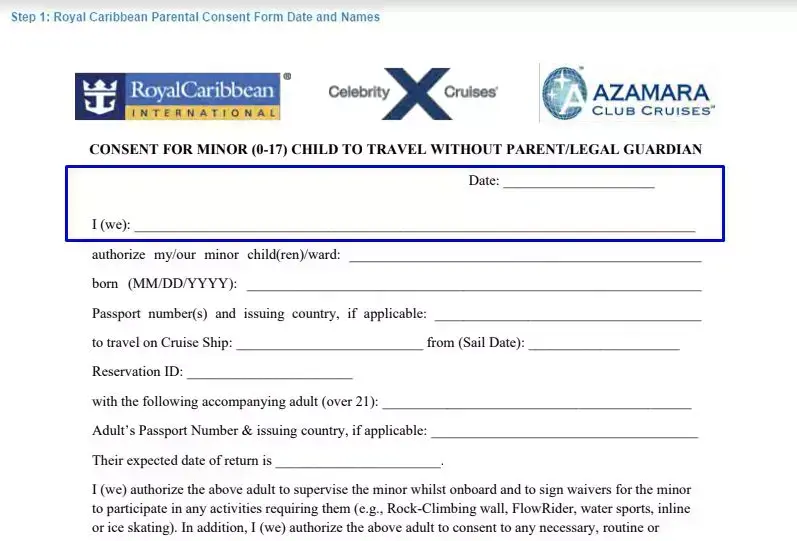
Enter the current date in the upper right corner of the form. Then enter your full name on the second line. If both parents are handing responsibility to a third person, each parent enters a name.
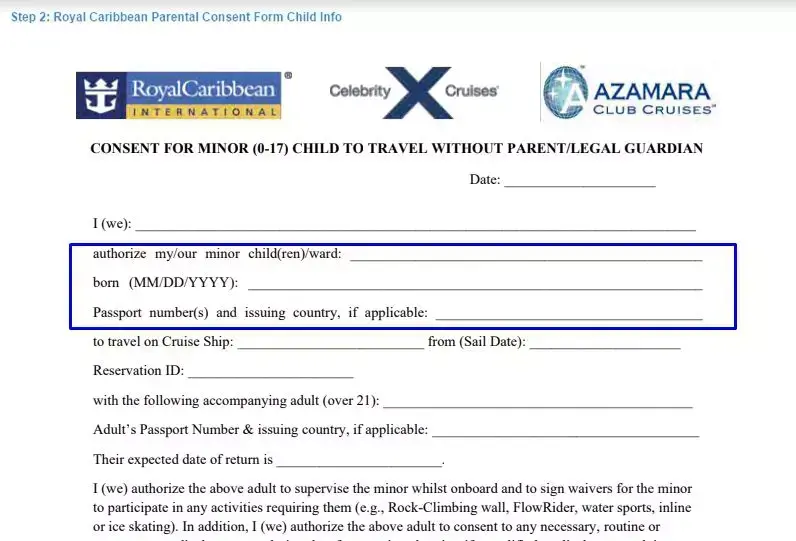
Fill in the child’s personal information. Write the full name of each child, the date of birth, and the passport or birth certificate number. Copy the numbers straight from the ID so that no digit is wrong.
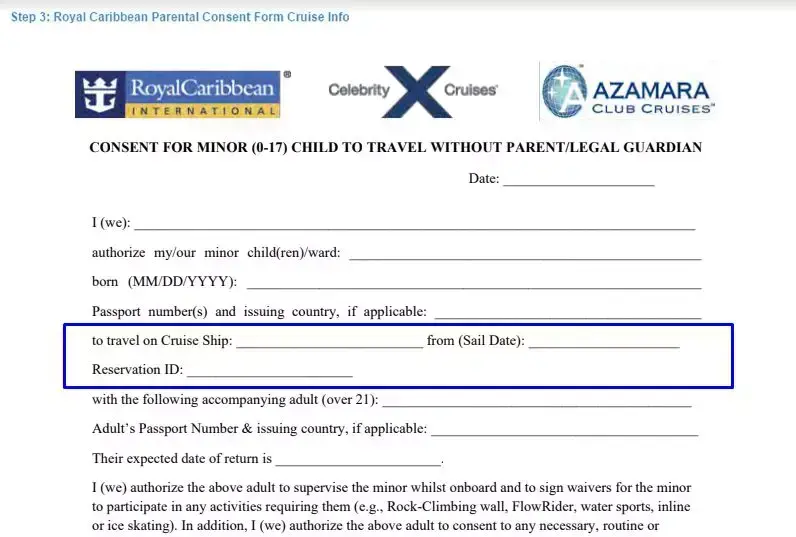
The next section of the form is devoted to information about the upcoming cruise. Fill in the cruise ship for which you have purchased tickets for your child, the departure date, and the reservation code on the next line.
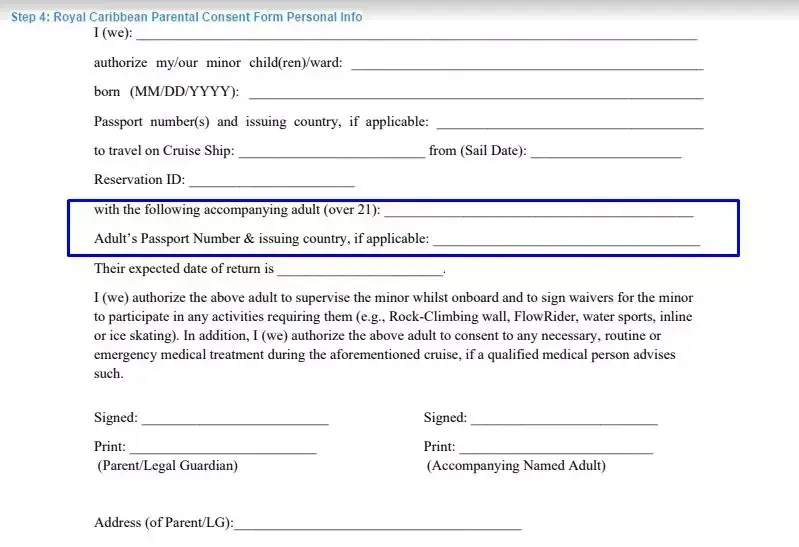
On the next two lines, write down personal information about the accompanying adult: full name and passport details.
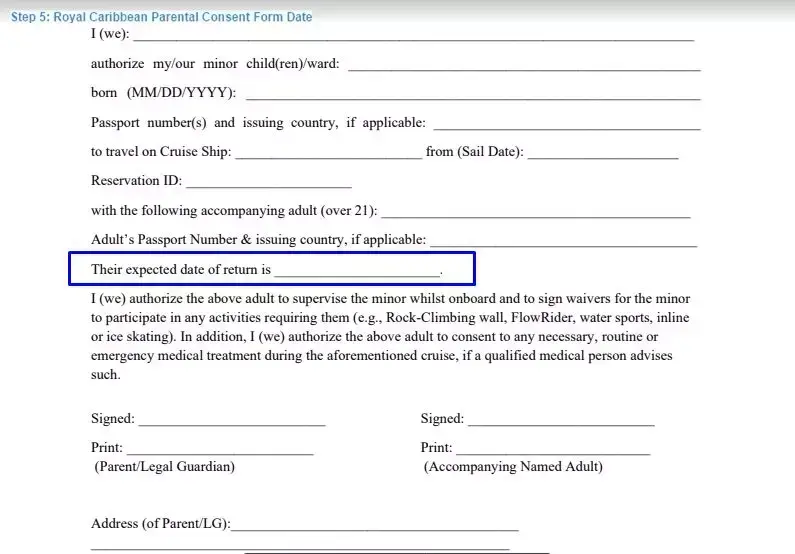
Next, enter the end date of the cruise and the date the child returns together with the accompanying adult.
Read the text to know what powers and rights you transfer to the accompanying adult for the duration of the cruise.
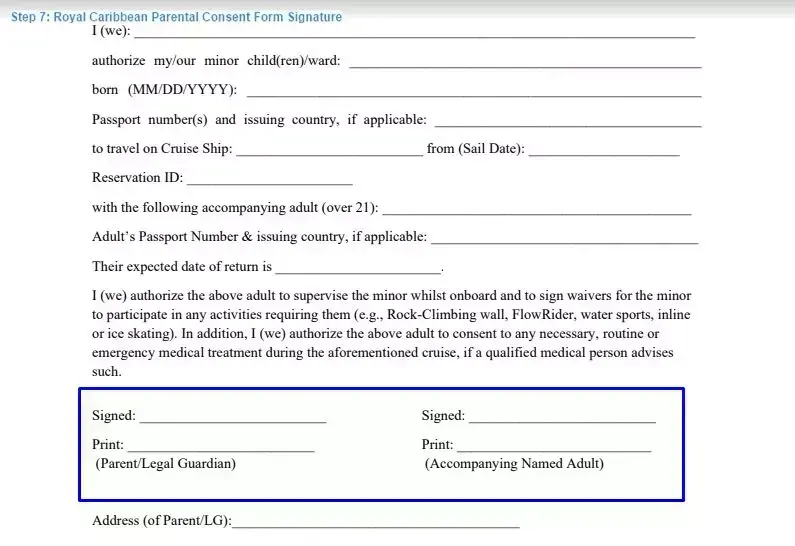
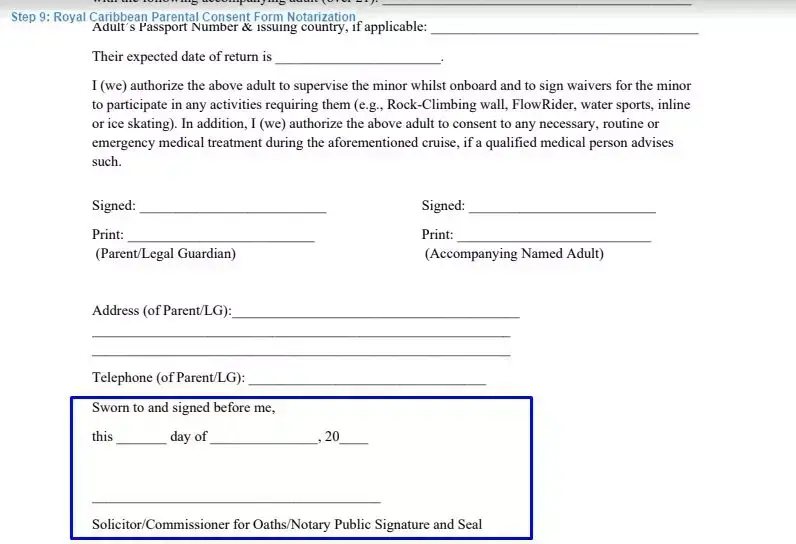
The form must be signed by the parent or legal representative of the child and the accompanying adult. Sign with a pen, using the same name you entered at the top of the form.
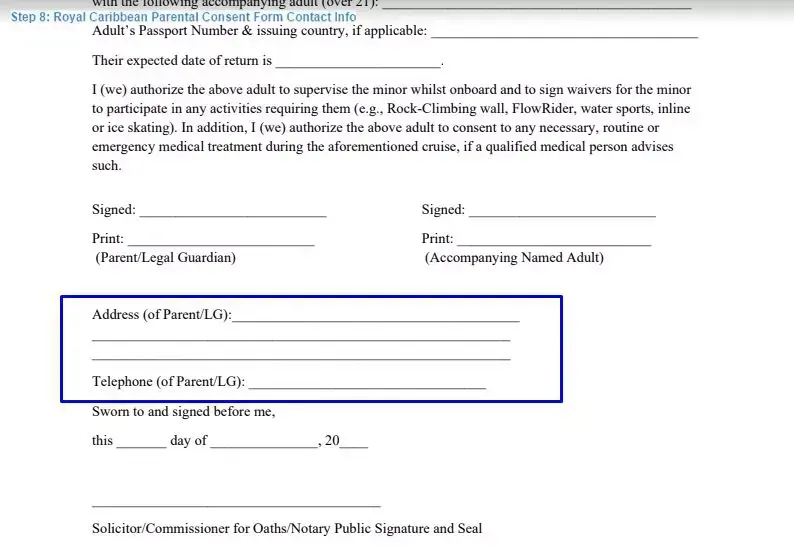
The parent is required to fill in their contact information so that in case of an emergency during the cruise, they can be contacted. Enter your address and phone number.
The completed form must be checked, approved, and signed by a notary. Keep the notarized original in a safe place and give the accompanying adult a copy.
When you finish, read the whole form once more and check these points:
This sample shows how the entries can look when the form is complete. Compare it with your own copy as you work through the steps. All names, dates, and numbers are made up.
| Where | What you enter | Sample entry |
|---|---|---|
| Step 1 | Date and parent | 03/15/2027, Anna Baker, 123 Main Street, Springfield |
| Step 2 | Child | Ben Baker, born 05/20/2015, passport number X1234567 |
| Step 3 | Cruise | Sample Voyager, departing 04/10/2027, reservation code ABC123 |
| Step 4 | Accompanying adult | Carol Baker, passport number Y7654321 |
| Step 5 | End of the cruise | Cruise ends and the child returns on 04/17/2027 |
Most errors on this form are small and easy to avoid. Run through this list once before you sign, and once more when you hand the form to the accompanying adult.
A few small habits keep the form clean and make the trip smoother for the child and the accompanying adult. Use them as a quick final check before the parents sign.
Parents and legal guardians often ask the same few questions about this cruise consent form. The short answers below point back to the steps above, so you can find the right part of the form quickly.
The accompanying adult is the person who travels with your child in place of the parents. You write that person’s name and passport details in Step 4.
Step 2 has the lines for each child’s name, date of birth, and passport or birth certificate number.
Step 3 covers the cruise section of the form. It has lines for the ship name, the departure date, and the reservation code.
Step 7 covers the signature lines and Step 9 covers the notary. Read both steps before you sign anything.
The form has lines for these details:
Read each line once more and use the checklist above. Then keep a signed copy with your travel papers.
General information, not legal or tax advice.
