
When companies need expert knowledge in a particular field, they might want to turn to a professional consultant. This person is authorized to provide advice, opinions, or analysis of a particular business matter and help companies resolve their issues within their organization or enhance their performance in general. Our free consulting contract template puts the terms in writing, online or as a PDF.
Last Updated: October 2026. This guide is reviewed and updated regularly to reflect current law. If you notice an error or outdated information, please contact us.
Build Your Document
Answer a few simple questions to make your document in minutes
Save and Print
Save progress and finish on any device, download and print anytime
Sign and Use
Your valid, lawyer-approved document is ready
A consulting contract should be involved in every situation where a company turns for help to a consulting specialist. Read more about this sort of contract in our article.
Retainer Agreement Template – A retainer agreement is a contractual agreement between a client and an individual or organization. The agreement outlines the scope of work to be performed and the fees to be paid.
A consulting agreement is a document that details the working relations between a client (typically a business) and a consultant who provides their services on a paid basis. Other names for this agreement are business consulting agreement and consulting contract.
The parties who agree to provide and get a professional consultation on specific business matters might have an oral consulting agreement, but ensuring that the arrangements are in written form will help both sides reach the desired results.
There are obvious advantages to hiring a consultant when a business needs outside informational help.
The FormsPal consulting contract template is a ready-made version of this agreement. It has lines for the services, the fee, the term, and the signatures, so you do not start from a blank page.
The need for a consulting agreement might arise in various spheres. A written agreement helps the consultant and the client keep track of the advice, the fees, and the timeline. Here are just some of them:
A consulting contract is meant to describe the project, services provided by the architect, and the price in a documented manner. This agreement typically goes along with drawings and plans required for the project. Another thing that should follow the consulting agreement is a retainer—a deposit made by the client before the project starts the architect most often retains that if the client cancels the project.
Commonly, starting entrepreneurs or long-existing businesses need unbiased recommendations on developing and managing their business. In this case, they might benefit from creating a consulting agreement. It will detail the actions taken by the consultant and the recommendations they provide for their clients. The consultant will most likely be paid by the hour, but they might also agree to get a certain percentage of the future profit of the company or entrepreneur.
The aim of the consulting agreement that has to do with healthcare is to outline the details of the cooperation of a healthcare agent and a health facility. The agent is typically hired to help improve the company’s performance and quality of services. In exchange, the consultant gets monetary compensation for their service.
Consultants might become of help for those who need advice regarding the acquisition, sale, or development of the property. It requires a specialist who has professional knowledge regarding the local real estate market. The difference between the real estate consultant and real estate agent is that a consultant shall not be paid a commission and is expected to be objective in providing advice regarding the local property market.
A consulting agreement is a standard document in the legal field. It details the arrangements between a lawyer or attorney and a client (usually a business owner) who needs legal advice.
There might be slight confusion in understanding who a contractor and a consultant are. In short, a consultant gives expert advice, while a contractor delivers a piece of work. The paragraphs and the list below show how the two roles compare.
A consultant is typically a self-employed person who provides expert information in a particular field. They usually take specific training to be able to provide professional advice in the field of their expertise. They might work independently, at a consultancy firm, or as consultants within the company they work for (then this specialist becomes an ‘internal consultant’).
Their work results are information and intellectual property that might have both oral and written forms. Usually, consultants provide their services without the involvement of third parties (unless it is stated in a contract that they can delegate their services to someone else).
When it comes to contractors, these are self-employed individuals who typically work on a project-to-project basis. The main difference is that a client usually expects specific material results from an independent contractor, for example, fixing plumbing, legal help, medical treatment, gardening services, etc.
The other differences between the two roles come down to three points:
Hiring a contractor for other work instead? See our independent contractor agreement and construction contract template.
Here are some necessary elements that every consulting agreement should have. A clear agreement names the parties, describes the work and the pay, and says how the relationship ends or how a dispute is handled. The sections below cover each element in turn.
The contract should mention the names of the individuals entering the consulting agreement.
The first thing to outline is the scope of work. It entails a detailed description of the services under this agreement. Plenty of details in the description will ensure that there won’t be disputes regarding the quality of the services in the future.
The second detail is deliverables. If the consultant plans to provide any reports, summaries, or strategy documents, they should be mentioned in the contract.
Another thing to consider is exclusions. It will help the client understand what they should not expect from the consultant.
The last conditions are fees and timeframe. The contract should explicitly state the time of starting and finishing the consultancy and the compensation guaranteed by the client.
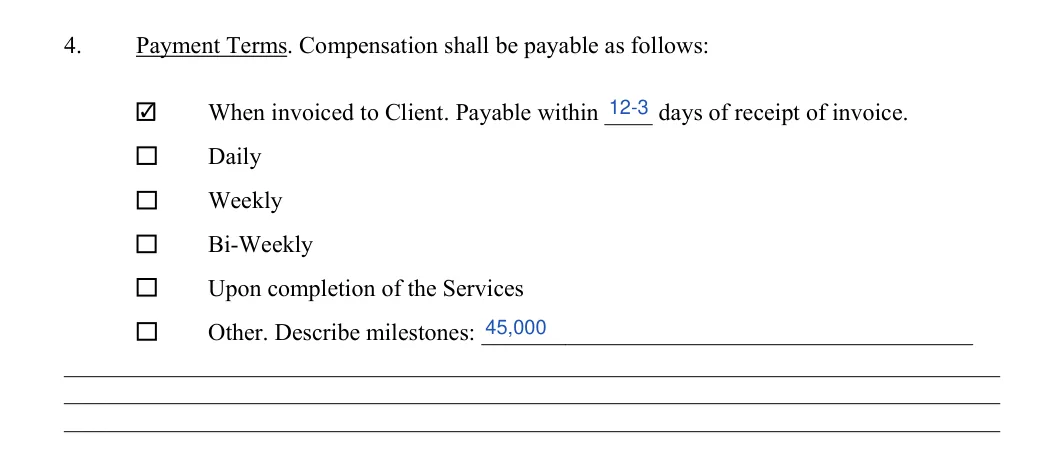
The consulting agreement template should contain the conditions of payment promised to be made by the client for the consultant’s services. This piece should be clear and not leave any room for possible disputes. The terms that need to be included in the first place are the amount of compensation and when the payment is due.
Another thing to mention is the form of payment. The consultor might get paid a fixed fee by the hour or with a deposit called a retainer.
If the consultant wants to add an extra layer of protection, they might specify that the provision of services will be suspended if the client does not pay the correct amount of fees or pays nothing at all.
Any consultant who provides their services on a professional basis has a specific base of their unique strategies, techniques, statistics, and other instruments that they use in their work. This refers to intellectual property with a particular value that needs to be protected. It should concern both already existing intellectual property that the consultant owns and the one that will be created within the project.
The contract should also handle who will own the existing intellectual property after the consultant provides their services.
Suppose the business owner is cautious about revealing their confidential information. In that case, they should specify in the consulting agreement that the data they expose to the consultant is sensitive, and the consultant cannot disclose it to any third parties.
Along with the confidential information, the client might want to protect their client base and state that using a non-compete provision. It should tell that the consultant cannot engage in a competing business and cannot attract the client’s customers within a particular time after the agreement is implemented.
Even with the clearest provisions in the consulting agreement, there still might be some issues the parties might face in the future. This is why it is vital to write down reasonable methods of solving disputes between the consultant and the client. This way, it will ensure that the parties might use negotiation and further mediation options before one of them decides to turn to the court.
Even considering there is never a 100% guarantee of the consultant’s results, the client still wants to get a certain assurance of them getting the needed advice. Usually, a client who orders consulting services relies on the information given to them by the consultant. This makes it essential to write in the contract the clause that would set the liability for the consultant for the quality of their services.
At the same time, it is necessary to limit the responsibility of the consulting specialist so that the client cannot claim an unreasonable amount from the consultant if the latter breaches the contract.
Moreover, the contract should outline what liability is set for the consultant in case of situations out of their control, for instance, the client’s actions or third parties.
In this part of the contract, it should be said that the consultant has to present their valid licenses and consulting certifications to perform consulting services.
The consulting agreement might detail whether or not the consultant will require professional insurance. As applicable, this insurance might include coverage for professional liability/errors and omissions, general liability, business interruption, vehicle coverage, worker’s compensation, and crime.
This section of the document should state that all the documents taken by the consultant from the client in the course of their work should be returned to the client when the document terminates or upon the client’s demand.
Even when not planned, certain circumstances might make one of the parties want to terminate the consulting agreement. The clause about the termination of this agreement should detail:
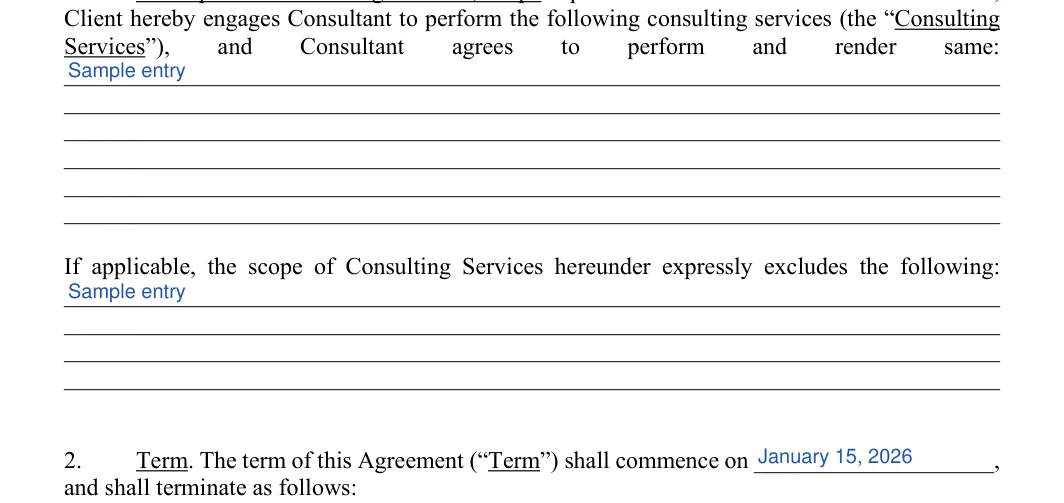
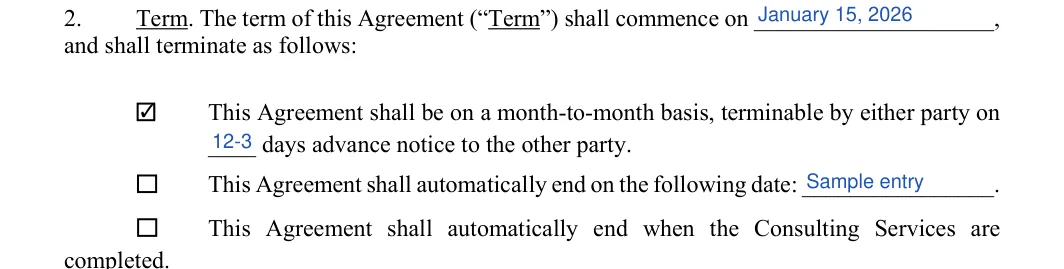
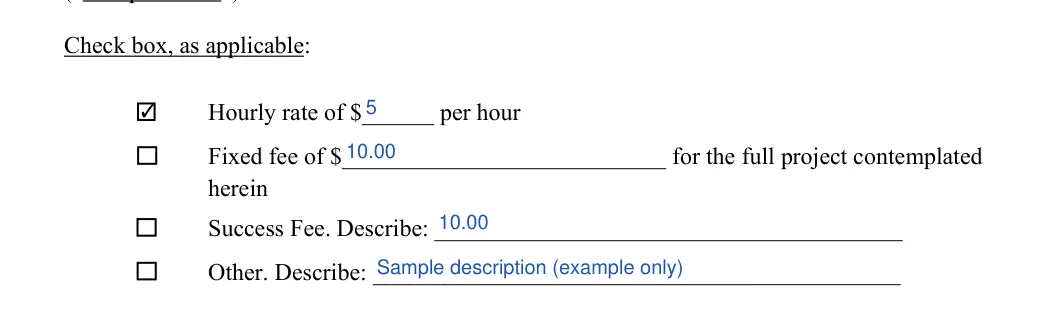
Follow these steps to complete the FormsPal consulting contract template. They go in the same order as the form, from page 1 to page 6, so you can work through it without skipping around. Each step names the part of the form it covers. Some parts of the form are already printed in full and need no entry, so they have no step.
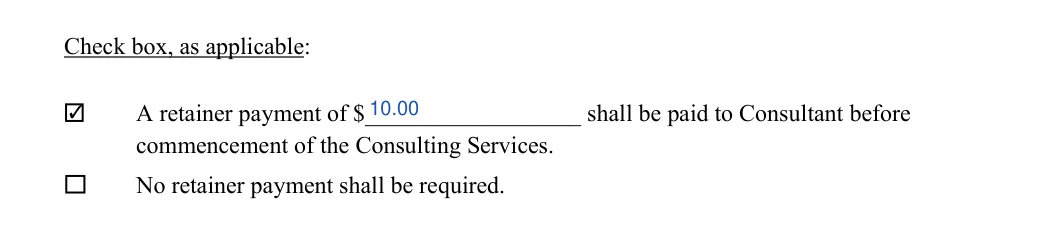
The screenshots under each step show the FormsPal Consulting Contract template filled with sample entries in blue, so you can see where each answer goes. The names, addresses, dates and amounts are examples only.







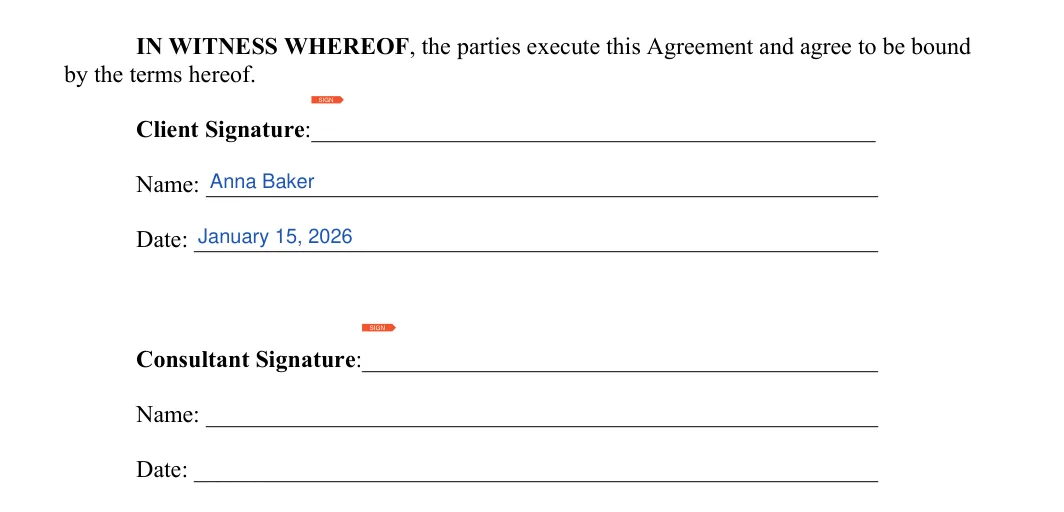
Once the form is filled in, a short final check helps both sides start from the same page. These three steps cover reviewing the draft, signing it, and keeping the copies where you can find them later.
These answers cover common questions about hiring a consultant and about the FormsPal consulting contract template. They explain how a consultant is paid, what a retainer is, and which details the template asks you to fill in.
Yes. Click Create My Document to fill it in online, or download the PDF and complete it by hand. You can also use the FormsPal PDF editor to fill in the downloaded PDF on your screen.
It asks for the date and the names of the Client and the Consultant. It also has lines for the services, the start date, how the term ends, the compensation, the retainer, and the payment terms. Further choices cover noncompetition and insurance proof, followed by additional terms, the governing-law state, contact details, and the signatures.
There are at least three reasons why a consultant might want to consider incorporating:
There is no standard pricing model for the services of a consultant; it is entirely up to the parties. The method should be outlined in a consultant contract and might include payment by the hour, by project, or payment in the form of a retainer.
By retainer, one means a certain amount of money (deposit) that is paid in total upfront before using the services of a consultant. It lets the consultant get started on the work and ensure they will be paid for their services. However, when consultation requires fewer hours than initially expected, a retainer can be refunded for the time that is not used.
General information, not legal or tax advice.
