
Updated:
A contract for services is a client's agreement with a service provider. The agreement sets out the work, the payment, the timeline and how either side can end it. Clients, freelancers and contractors use it, especially before paid work starts. On this page you can fill in the service agreement template online, download it as a PDF and follow a step-by-step guide to each part, with a filled-in example and answers to common questions.

Build Your Document
Answer a few simple questions to make your document in minutes
Save and Print
Save progress and finish on any device, download and print anytime
Sign and Use
Your valid, lawyer-approved document is ready
A contract for services is a written agreement between a client and a service provider. It sets out the work, the payment and the timeline, so both sides know what to expect.
The provider can be a freelancer, a consultant or a company. The template works the same way for each: you enter who does the work, who pays and what the job covers.
People call this document by several names, such as a service agreement or a service contract. The FormsPal template on this page is a general service agreement for single jobs and ongoing services, from web design to cleaning.
The two phrases look alike, and searchers often mix them up. This page covers hiring an outside provider for a job. If you are hiring a staff member rather than an outside provider, an employment contract fits better.
You need a service agreement when a client hires a freelancer, an independent contractor or an outside company for paid work and both sides want the terms in writing. It is most useful before the work starts, while the price and the scope are still open to discussion.
Common cases include:
A nanny, babysitter or caregiver who works in the family's home is a different case. IRS Publication 926 says "The worker is your employee if you can control not only what work is done, but how it is done", so such a worker is often a household employee rather than a service provider, whatever an agreement calls them.
For a short, simple job, a written agreement can still save an argument later. It gives both sides a shared text to check when memories of a conversation differ.
A service agreement protects the provider's pay and the client's expectations by putting both in writing. The provider gets a clear rate, a payment schedule and a defined scope, so extra work beyond the agreement can be priced separately.
The client gets a description of the work, a timeline and a way to end the deal if the work stops or falls short. Both sides can point to the agreed terms when either of them wants to change something midway.
A contract for services should include the parties, the term, the scope of work, the pay and the payment schedule, and the conditions for ending the agreement. Confidentiality, ownership of the work and insurance are common additions.
Use this list as a checklist before you sign:
Leave out a clause that does not fit your job. If the provider works on an open-ended basis, for example, there is no end date to write in.
The parties part names the client and the service provider: a person by full name, a business by its legal name. The term part says when the work starts and how the deal ends, with the choices shown in the steps below.
The scope field is where you describe the services, either as a list of tasks or as the finished result. The more specific the list, the fewer questions later. A web designer, for instance, can write how many rounds of edits the price covers and bill further rounds apart.
The pay fields let you choose an hourly rate, a fixed price or another basis. The schedule fields let you pick when invoices go out: daily, weekly, on completion or on another plan. You can add a line on late payments if you both want one.
The confidentiality clause lists the information the provider agrees to keep private, such as client lists, prices or business plans. Add it when the provider will see private details of the client's business. For a stand-alone promise of secrecy, a non-disclosure agreement covers it in more detail.
The ownership clause says who keeps the designs, text, code or other products made during the job. Naming an owner is not enough on its own: copyright "vests initially in the author or authors of the work" (17 U.S.C. § 201(a)), and in the case of a work made for hire, the employer or other person for whom the work was prepared is considered the author (17 U.S.C. § 201(b)).
To move the rights from the provider to the client, write the transfer into the clause and have the provider sign it. Under 17 U.S.C. § 204(a), a transfer of copyright ownership, other than by operation of law, is not valid unless it is in writing and signed by the owner of the rights conveyed or that owner's duly authorized agent.
The termination clause lets you write when each side may end the deal early and what is paid at that point. A provider may ask for the option to stop work when a payment is late; a client may ask for the option to end the deal when the work runs late.
Service agreements come in several types that differ by how long the relationship lasts and how detailed the terms are. The general template on this page suits most single jobs and ongoing services.
| Type | What it covers | Typical use |
|---|---|---|
| General service contract | Work, pay, term and termination for a single provider | Cleaning, repairs, design, tutoring |
| Consulting services agreement | Advice or expertise, often billed by the hour | Business, IT or marketing consultants |
| Independent contractor agreement | A self-employed worker's duties and pay | Freelancers working for a company |
| Master service agreement (MSA) | Shared terms for a series of future projects | Long-term business partners |
| Service-level agreement (SLA) | Measurable service levels and what happens when they are missed | IT support, hosting, outsourced services |
A master service agreement sets the general terms once, such as business ethics, intellectual property rights, access levels, dispute resolution and payment terms. Each later project then needs only a short order that names the work and the price.
To fill out the service agreement template, enter the parties, the term and scope, the pay and payment schedule, the insurance choice, the place whose rules govern the contract, contact details and signatures, in that order. The steps below follow the FormsPal service agreement template you can download as a PDF on this page. Each step matches one part of the form, and the screenshots show where the answers go. To fill in the PDF yourself, you can use the FormsPal PDF editor, or build the document online with the button at the top of the page.
The screenshots under each step show the FormsPal Service Agreement template filled with sample entries in blue, so you can see where each answer goes. The names, addresses, dates and amounts are examples only.

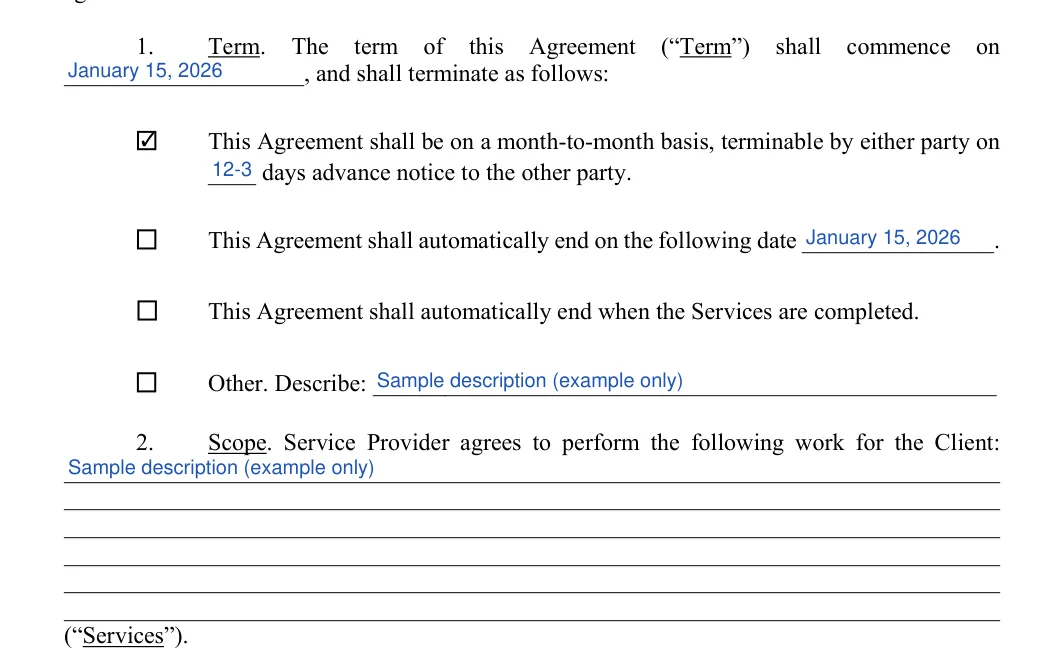
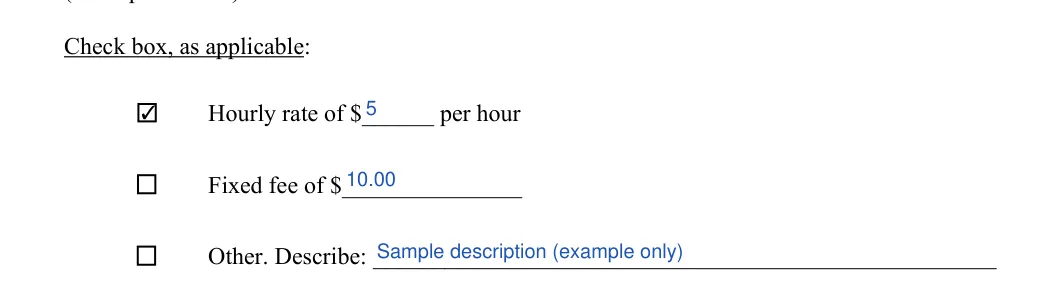
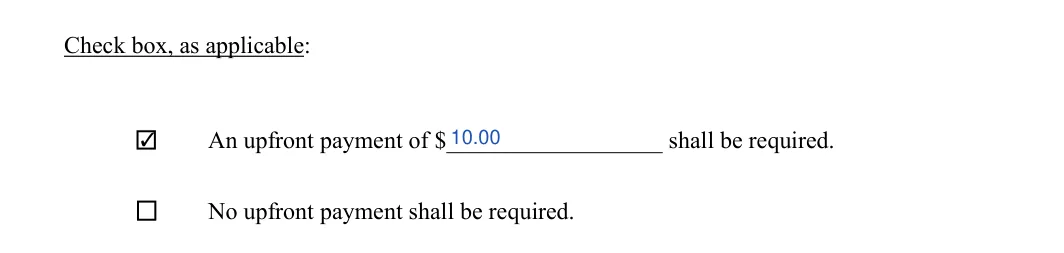
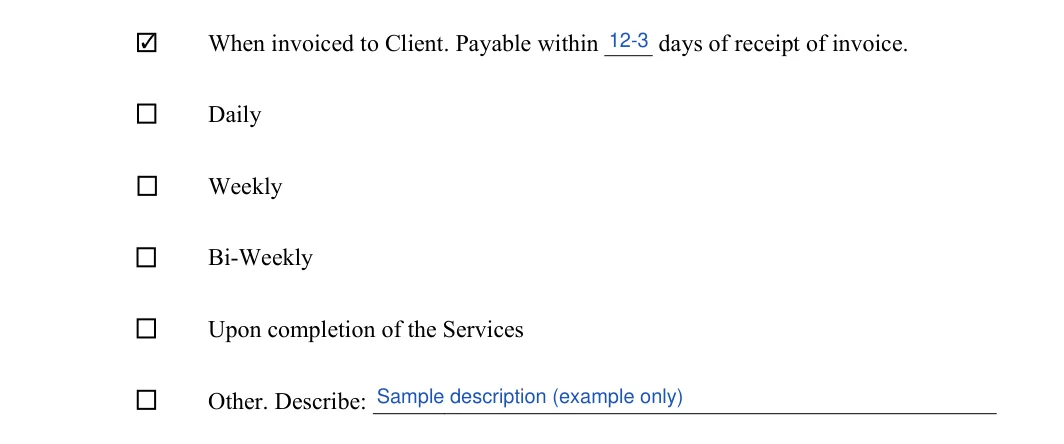



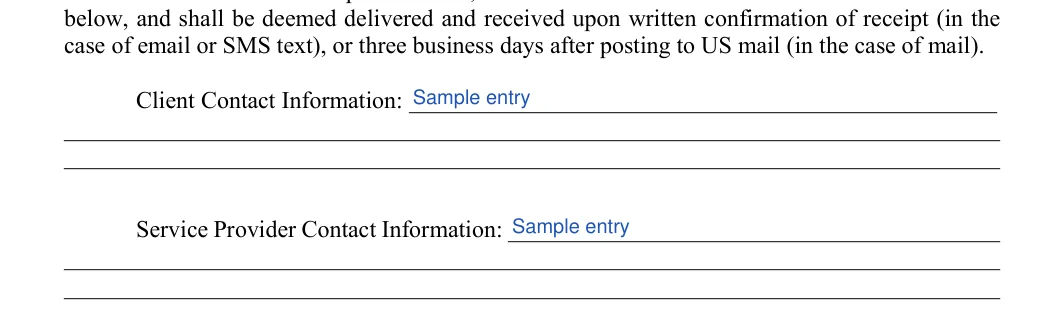
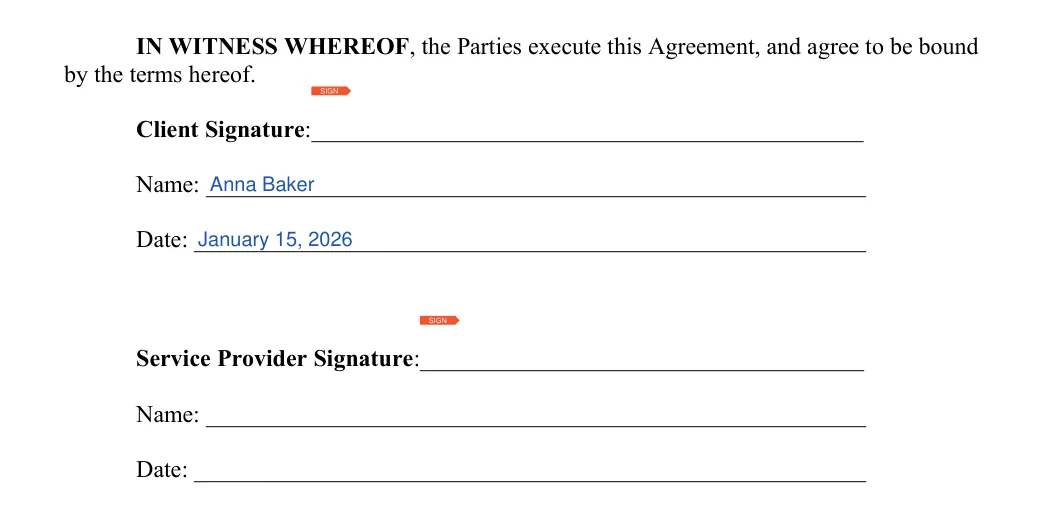
A contract for services example shows how the main blanks read once filled in. The entries below are made up for illustration; replace every name, date and price with your own.
Sample entries, not a real agreement.
Notice how the scope names the deliverables and caps the edits. A vague scope, such as "design work as needed", leaves both sides guessing about when the job is done.
To write a simple contract for services, agree the terms with the provider first, then fill in a service agreement template, review it together and sign it. The steps below cover the work before and after the form itself.
After both sides sign, keep a signed copy of the agreement for each side and store the file where you can find it quickly.
These answers cover the questions people ask most about service contract templates and how to use them.
Yes, you can fill in this contract for services template online and download it as a PDF from this page. The builder asks for each part in turn and puts your answers into the finished agreement.
A service provider is any person or business hired to do work for a client on agreed terms. Examples include freelancers, consultants, tradespeople and small companies offering dog walking, make-up, design, writing, editing or programming.
A written service agreement is much easier to rely on than a verbal agreement, because both sides can read the same terms. With a spoken deal, each side has only its memory of what was said, and the versions can differ. Writing the terms down helps settle misunderstandings much faster.
A service agreement covers a single job or service, while a master service agreement sets shared terms for many future projects between the same parties. Under a master service agreement, each new project gets a short order that names its own work and price.
Yes, a service agreement can set out the terms for an independent contractor hired for a defined job, but signing it does not by itself make the worker an independent contractor. On its page Independent contractor (self-employed) or employee?, the IRS says that for an employee "What matters is that you have the right to control the details of how the services are performed", and that "no one factor stands alone in making this determination". For a fuller set of contractor terms, see the independent contractor agreement.
Read the finished agreement together with the other party and fill in any blank you skipped. Print two copies, then sign and date both. Each side keeps one signed copy.
General information, not legal or tax advice.
