
A 7 day notice to vacate, also called a 7-day notice to quit, is a legal document served by a landlord on the tenant, informing about a violation made by the latter. The notice allows the tenant to fix the infraction within a certain period of days, failing which the landlord may proceed with the eviction.
Last Updated: October 2026. This guide is reviewed and updated regularly to reflect current law. If you notice an error or outdated information, please contact us.
Build Your Document
Answer a few simple questions to make your document in minutes
Save and Print
Save progress and finish on any device, download and print anytime
Sign and Use
Your valid, lawyer-approved document is ready
Usually, the notice to quit is sent for non-payment of rent, lease violation, or illegal activities at the leased premises.
The landlord must send the notice as soon as the due date passes or once they become aware of the violations or illegal activities happening at the premises. The notice can only be sent for past violations or past dues and cannot be sent for payments that have not become due yet.
A seven-day notice is allowed under the state laws of Alabama, Alaska, Delaware, Florida, Iowa, Kentucky, Maine, Michigan, Nebraska, New Hampshire, New Mexico, and North Carolina.
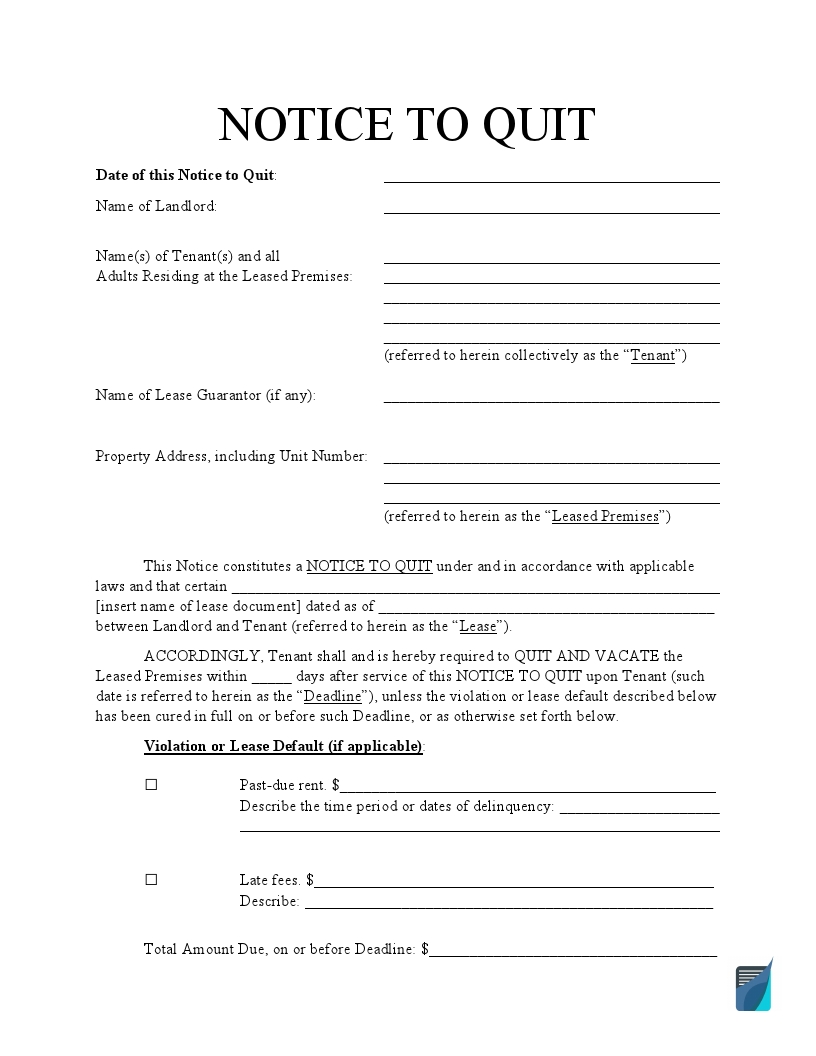
The 7-day eviction notice to quit is also called a 7-day notice to vacate or a seven-day eviction notice. A landlord fills it in, signs it and serves it on the tenant. FormsPal’s version is a fillable PDF with 47 fields, and the table below shows the document at a glance.
| Document Name | 7-Day Eviction Notice to Quit Form |
| Other Names | 7-Day Notice to Vacate, Seven-Day Eviction Notice |
| Avg. Time to Fill Out | 11 minutes |
| # of Fillable Fields | 47 |
| Available Formats | Adobe PDF |

A 7-day notice to vacate tells the tenant what went wrong and what to do about it. The form has a section for each of three common reasons, and each section asks for the details that apply.
The reason you choose decides which follow-up action appears in the notice, so pick the one that matches your situation.
The table below uses made-up names and addresses to show what a filled-in 7-day notice looks like. Replace each entry with the details from your own lease and payment records before you serve the notice.
| Part of the form | Example entry |
|---|---|
| Notice period | 7 |
| Landlord | Daniel Moore |
| Tenant | Anna Baker |
| Property address | 123 Main Street, Apartment 4 |
| Reason for the notice | Unpaid rent for the current month |
| Total amount due | $950.00 |
| Mode of delivery | Handed to the tenant in person |
FormsPal’s customizable and easy-to-understand eviction notice template can be filled out by following the steps below. Keep your lease, the tenant’s full name, the property address and the amount owed nearby before you start. If you downloaded the PDF, you can fill it in with the PDF editor.
Here, the notice period is seven days. Enter the number “7” in all blanks where “_ Day Notice” is written.
Enter the date of the notice. This date is very important as the period of seven days will be calculated from the next day. This period does not include weekends and public holidays.
All the details mentioned below should be consistent with the information provided in the original agreement.
If the reason for sending the 7-day quit form is the conduct of illegal activities by the tenant, select the first option. Mention what illegal activity has been taking place; you can also mention how you came to know about the same and what kind of proof you have.
In the next part relating to follow-up action, again select the first option and demand eviction of the tenant within a fixed number of days.
If the reason is a violation of rental terms, briefly describe the violation and refer to the rental terms prohibiting it. For example, if there’s a violation of the “no pets policy” mentioned in the agreement in clause 6, refer to clause 6.
The next part relating to the follow-up action mentions how and when the tenant should address the violation.
If the reason is non-payment of rent by the tenant, mention the past due date, the total amount due, and the late rent fees, if applicable.
The following part relating to the follow-up action again mentions the total amount due and the fixed date by which the dues should be cleared.
Enter all the relevant details relating to the service of the eviction notice. If the 7-day eviction notice is being sent on behalf of the landlord, mention the authorized agent details. Then, select the mode of delivery of the notice to quit and enter the name and details of all the persons to whom the notice to quit is being sent.
The final step includes signing the quit form, entering the state and county name, and getting the form notarized as per the state laws.
A short check before you serve the notice saves time later and keeps the paperwork consistent. Go through these steps in order, and keep a copy of every page you hand over to the tenant or send by mail.
A 7-day notice is one of several notice lengths. In 45 of the 50 jurisdictions FormsPal’s verified state data covers (49 states and DC), the law sets a notice period for unpaid rent.
In 37 of the 50 jurisdictions FormsPal’s verified state data covers, the period is counted in days and runs from 3 to 14 days, depending on the jurisdiction. In 4 of the 50 jurisdictions FormsPal’s verified state data covers, it is counted in business days and runs from 3 to 7 business days, depending on the jurisdiction.
The notice period also changes with the reason for the notice:
To count the days of a notice period, use the deadline calculator.
After the eviction notice is delivered and the tenant makes full payment, the landlord will have to accept the same, and eviction cannot continue. If the tenant makes an incomplete payment, then the landlord may either accept or decline at their own discretion.
Once accepted, even incomplete payment made by the tenant will be considered as partial compliance with the eviction notice, and the landlord may not be able to ask for a vacation of leased premises.
Similarly, for violations of the agreement, if the tenant cures the defect within seven days, then a demand to vacate cannot be made. However, if no or partial compliance is made, court action can be taken at the landlord’s discretion.
If the tenant does comply, an “unlawful detainer” lawsuit may be filed with the court.
Once the notice is served, the tenant has a few choices. Each one leads to a different next step for the landlord.
Yes. The form has options for unpaid rent, lease violations and illegal activity. In 32 of the 50 jurisdictions FormsPal’s verified state data covers, the law gives the tenant a chance to cure a lease violation after notice. Where that cure period is counted in days, it runs from 3 to 30 days.
Serving a notice means delivering it to the tenant. The form asks you to pick the mode of delivery and to list each person who receives the notice. In 35 of the 50 jurisdictions FormsPal’s verified state data covers, the law has rules on how the notice must be written and served, so check the local rule before you deliver it.
In 37 of the 50 jurisdictions FormsPal’s verified state data covers, the law bars a landlord from evicting a tenant without a court order, a practice known as self-help eviction. Read the rule for your location before you take any step after the notice period ends.
The form asks for the following details:
FormsPal lists an average of 11 minutes for the 47 fillable fields. Having the lease and the payment records in front of you makes it faster.
General information, not legal or tax advice.
