Free Utah Notary Acknowledgement Form

A Utah notary acknowledgement is a certificate that a notary public completes to record that a signer personally appeared, proved who they are, and acknowledged signing a document. Utah Code § 46-1-6.5 sets out sample wording for this certificate, and a correctly completed certificate in substantially that form is enough to complete the notarization.[1.2] This page shows the Utah wording, explains each part of the template, and lets you build your own copy online.

Last Updated: October 2026. This guide is reviewed and updated regularly to reflect current Utah law. If you notice an error or outdated information, please contact us.
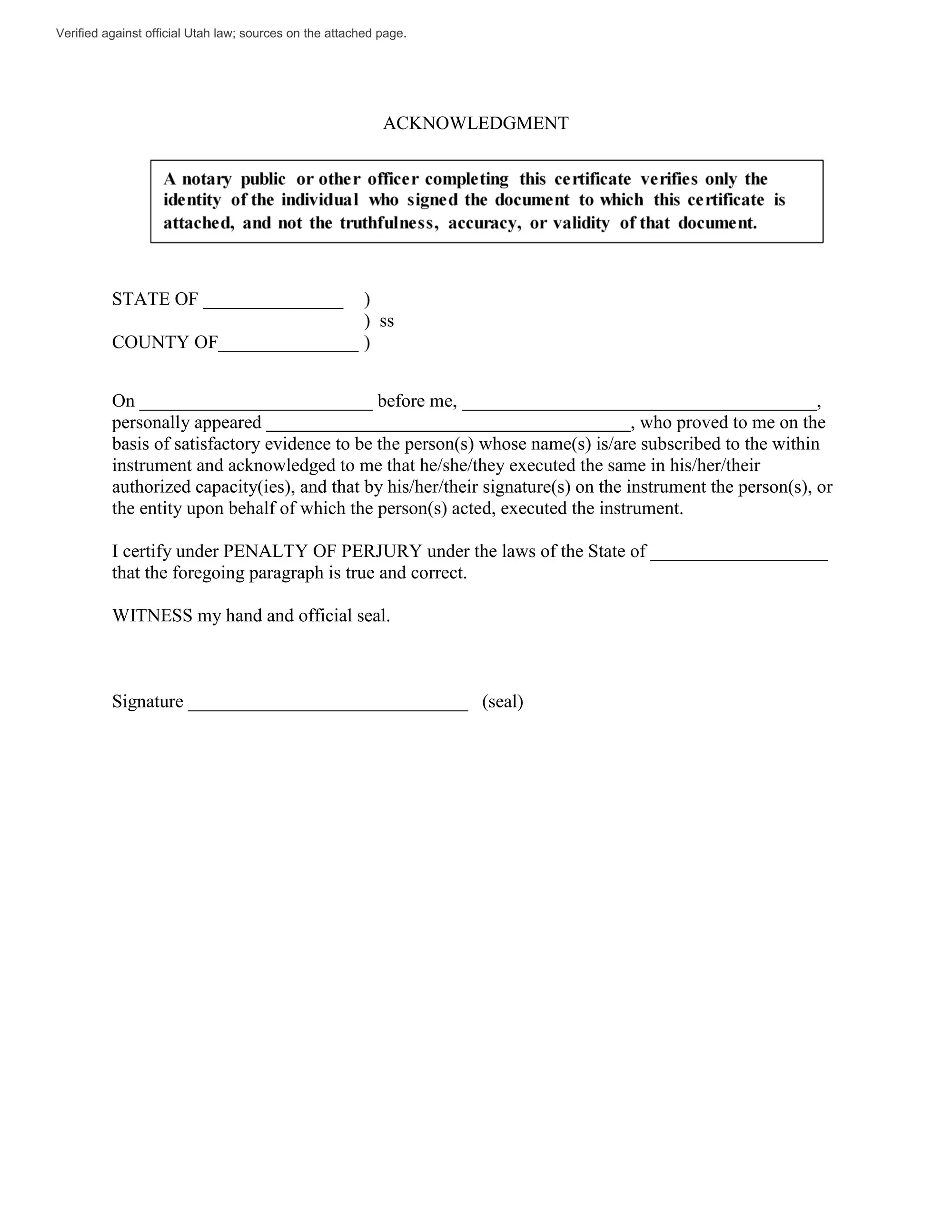
Utah notary acknowledgement form preview

Create a Personalized Utah Notary Acknowledgement Form online in under 5 minutes!

Build Your Document

Answer a few simple questions to make your document in minutes

Save and Print

Save progress and finish on any device, download and print anytime

Sign and Use

Your valid, lawyer-approved document is ready

Unless a statutory exception applies, a Utah will must be in writing, signed by the testator, and signed by at least two individuals who witnessed the testator sign the will or acknowledge it.[4.1] A document is entitled to be recorded with the county recorder when it carries a certificate of acknowledgment, proof of execution, or jurat signed and certified by the officer.[5.1]

What Is the Utah Notary Acknowledgement Certificate?

The Utah notary acknowledgement certificate is the sample wording that Utah Code § 46-1-6.5 sets out for notarial certificates. A correctly completed affidavit in substantially that form, included in or attached to a document, is sufficient for the completion of a notarization under the Notaries Public Reform Act.[1.2] The individual acknowledgment wording reads as follows.

State of Utah § County of ____________ On this (date) day of (month), in the year (year), before me (name of notary public), a notary public, personally appeared (name of document signer), proved on the basis of satisfactory evidence to be the person(s) whose name(s) (is/are) subscribed to in this document, and acknowledged (he/she/they) executed the same. ( Notary's Official Seal) ____________________________________ Notary Signature

Utah Code § 46-1-6.5

Subsection (3) confirms that an affidavit for an acknowledgment in substantially that form is sufficient under Subsection (1).[1.1] In plain words, the certificate records four things:

  • The place and date: the state, the county, and the day, month, and year.
  • The people: the notary public and the document signer, each named.
  • The identification: the signer proved who they are on the basis of satisfactory evidence.
  • The acknowledgment: the signer acknowledged signing the document.

The same section also gives wording for these certificates, each in its own form.[1.2]

CertificateWhat the certificate records
AcknowledgmentThe signer personally appeared before the notary, proved who they are on the basis of satisfactory evidence, and acknowledged signing the document.
JuratThe named person subscribed the document and swore to it before the notary on a stated date.
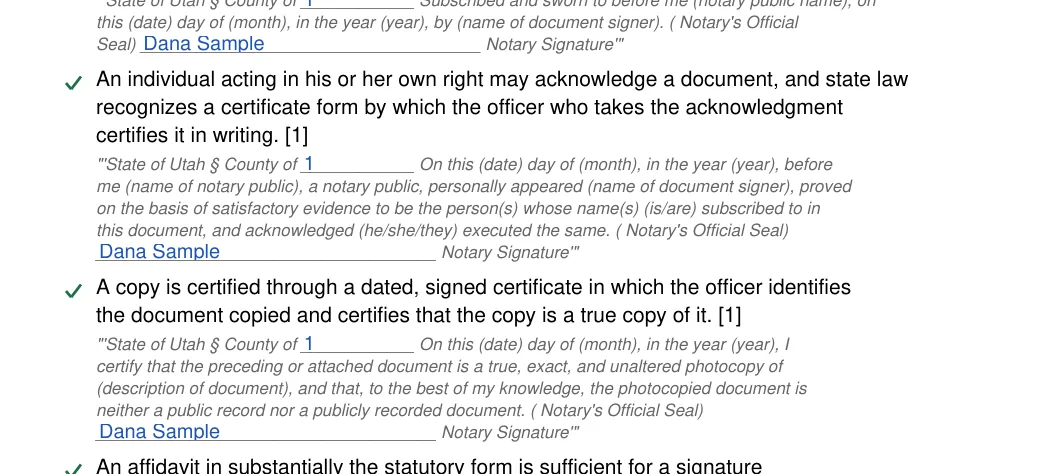
Copy certificationOn a stated date, the notary certifies that the preceding or attached document is a true, exact, and unaltered photocopy of the described document, and that, to the best of the notary's knowledge, the photocopied document is neither a public record nor a publicly recorded document.
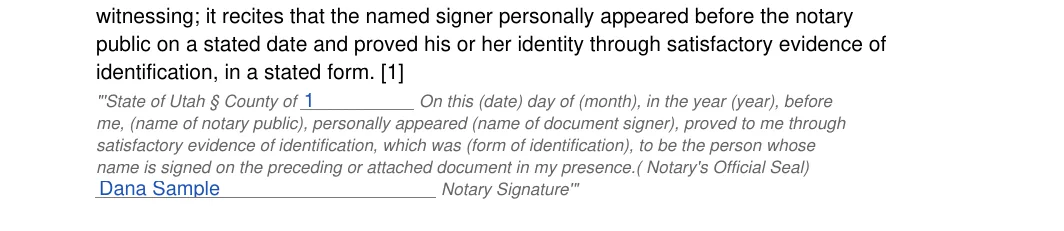
Signature witnessingThe named signer personally appeared and proved who they are through satisfactory evidence of identification, stated on the certificate, to be the person whose name is signed on the preceding or attached document in the notary's presence.

How to Notarize a Document in Utah

Getting a document notarized in Utah usually takes one short visit to a notary public. The steps below walk you through that visit. The next section shows how the FormsPal form is filled in.

  1. Choose a notary in Utah. Many banks, credit unions, shipping stores and private offices have a notary on staff. Pick one by location, hours and price, and call ahead to check that the notary is available.
  2. Do not sign the paper in advance. You can fill in the rest of the document before the visit to save time. Many notaries prefer to watch you sign, so leave the signature line blank unless the notary tells you otherwise.
  3. Bring a photo ID. The acknowledgment certificate records that you were proved on the basis of satisfactory evidence to be the person whose name is signed on the document.[1.2] Bring a current photo ID, such as a driver's license or passport, to show who you are. Under Utah Code 46-1-2, satisfactory evidence of identity includes valid identification with your photograph, signature and physical description issued by the United States government, any state or a foreign government, or the oath or affirmation of a credible person who is personally known to the notary and who personally knows you.[2.1]
  4. Acknowledge your signature. The certificate records that you personally appeared before the notary and acknowledged that you signed the document.[1.2] If you have not signed yet, sign in front of the notary.
  5. Let the notary complete the certificate. The notary completes the certificate, which in the Utah sample wording ends with the notary's official seal and signature.[1.2]
  6. Pay the fee and take both papers. Notaries usually charge a fee for their service, so ask about it when you call. Leave with the original document and the completed acknowledgment, and give both to the office that asked for the notarization.

A Utah notary who holds a remote notary certification under Section 46-1-3.5 may perform a remote notarization while physically located in Utah.[3.1]

How to Fill Out the Utah Notary Acknowledgement Form

The FormsPal Utah notary acknowledgement template has two pages of certificate wording. You complete the blank lines for the county, the names and the date, and the notary completes the signature and seal. Work through the parts below in the order the form follows them.

The screenshots under each step show the FormsPal Utah notary acknowledgement template filled with sample entries in blue, so you can see where each answer goes. The names, addresses, dates and amounts are examples only.
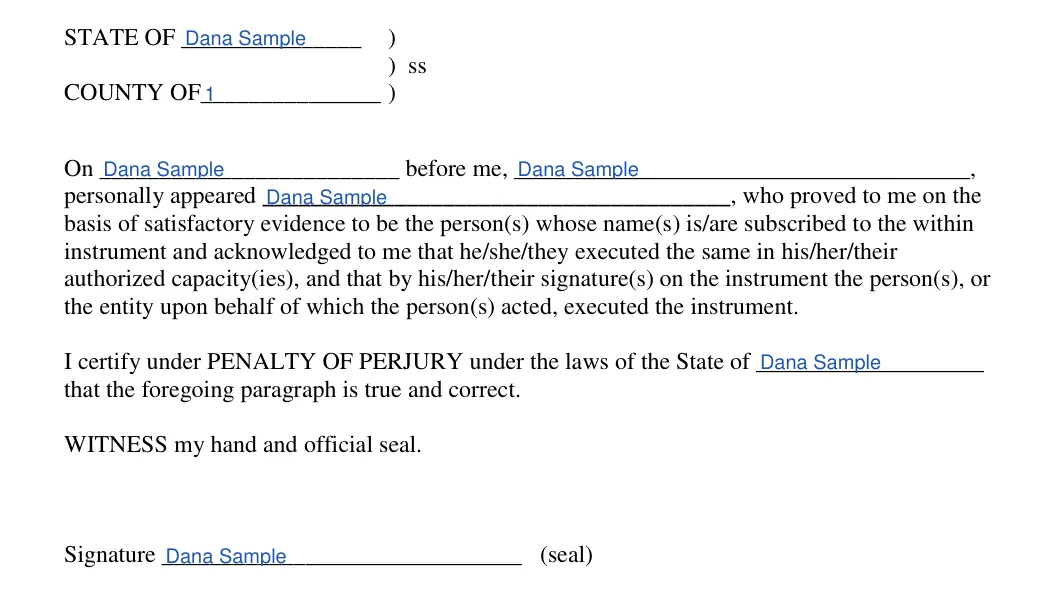

Fill in the names, the county and the date before you meet the notary. Leave the notary's signature and seal lines empty, because those belong to the notary.
  1. Page 1: the acknowledgment block. Fill in the state and county lines, the date after “On”, the notary’s name after “before me”, the signer’s name after “personally appeared”, and the state in the “under the laws of the State of” line. The Signature (seal) line under “WITNESS my hand and official seal” is for the notary, so leave it empty.
    Utah notary acknowledgement: Notary acknowledgement ut.1.state of, Notary acknowledgement ut.2.county of and more, filled with sample entries
    Step 1: sample entries, not a real document.
  2. Page 2: the jurat block. Use the “State of Utah, County of” line and the Seal box in the “Subscribed and sworn to before me” block when the document is signed under oath. Enter the county and leave the seal and signature to the notary.
    Utah notary acknowledgement: Notary acknowledgement ut.8.state of utah county of, Notary acknowledgement ut.9.seal, filled with sample entries
    Step 2: sample entries, not a real document.
  3. Page 2: the acknowledgment and photocopy blocks. In the acknowledgment block that includes the words “acknowledged (he/she/they) executed the same”, complete the county and wording lines. Use the photocopy block, the one that ends “neither a public record nor a publicly recorded document”, only when a copy is being certified. Fill in only the block that matches your document.
    Utah notary acknowledgement: Notary acknowledgement ut.10.state of utah county of, Notary acknowledgement ut.11.this document and acknowledged he she th and more, filled with sample entries
    Step 3: sample entries, not a real document.
  4. Page 2: the signature witnessing block. Fill in the county and the wording lines if the notary is witnessing your signature. Enter the type of identification on the “form of identification” line.
    Utah notary acknowledgement: Notary acknowledgement ut.14.state of utah county of, Notary acknowledgement ut.15.name is signed on the preceding or attac, filled with sample entries
    Step 4: sample entries, not a real document.

Frequently Asked Questions

The answers below come from Utah Code § 46-1-6.5, the section of Utah law that sets out the certificate wording a notary can use. They cover the acknowledgment certificate, the oath for a jurat, and the statement a remote notarization must include.

Does Utah provide a statutory individual acknowledgment certificate form for a notary acknowledgement?

Yes. Utah Code § 46-1-6.5 gives sample wording for an individual acknowledgment certificate. It records that the signer personally appeared before the notary, proved who they are, and acknowledged signing the document.[1.2]

What oath does a Utah notary have the signer take for a jurat?

Before the notary witnesses the signature for a jurat, the notary must ensure that the signer takes an oath or makes an affirmation. The question is: “Do you swear or affirm under penalty of perjury that the statements in your document are true?”[1.2]

What must the certificate say when a Utah notarization is done remotely?

A remote notary must ensure that the notarial certificate used for a remote notarization includes a statement that the remote notary performed the notarization remotely.[1.2]

General information, not legal or tax advice.

Sources

  1. Utah Code 46-1-6.5(3) §§ Utah Code 46-1-6.5(3), 46-1-6.5.
    • 1.1 Utah Code 46-1-6.5(3)
    • 1.2 § 46-1-6.5
  2. Utah Code 46-1-2
    • 2.1 § 46-1-2
  3. Utah Code Title 46, Chapter 1
    • 3.1 Title 46, Chapter 1
  4. Utah Code 75-2-502. Accessed October 18, 2026.
    • 4.1 § 75-2-502(1)
  5. Utah Code 57-3-101. Accessed October 18, 2026.
    • 5.1 § 57-3-101(1)
Published: Jul 10, 2022
Mara Erlach
Mara Erlach
Writer & Attorney
Mara has been practicing estate planning and trust law in California since 2003, taking pride in helping clients of all backgrounds and asset profiles form a complete and customized estate plan. Her specialties are: estate planning, wills and trusts, trust and probate administration.