
Updated:
Get Form Now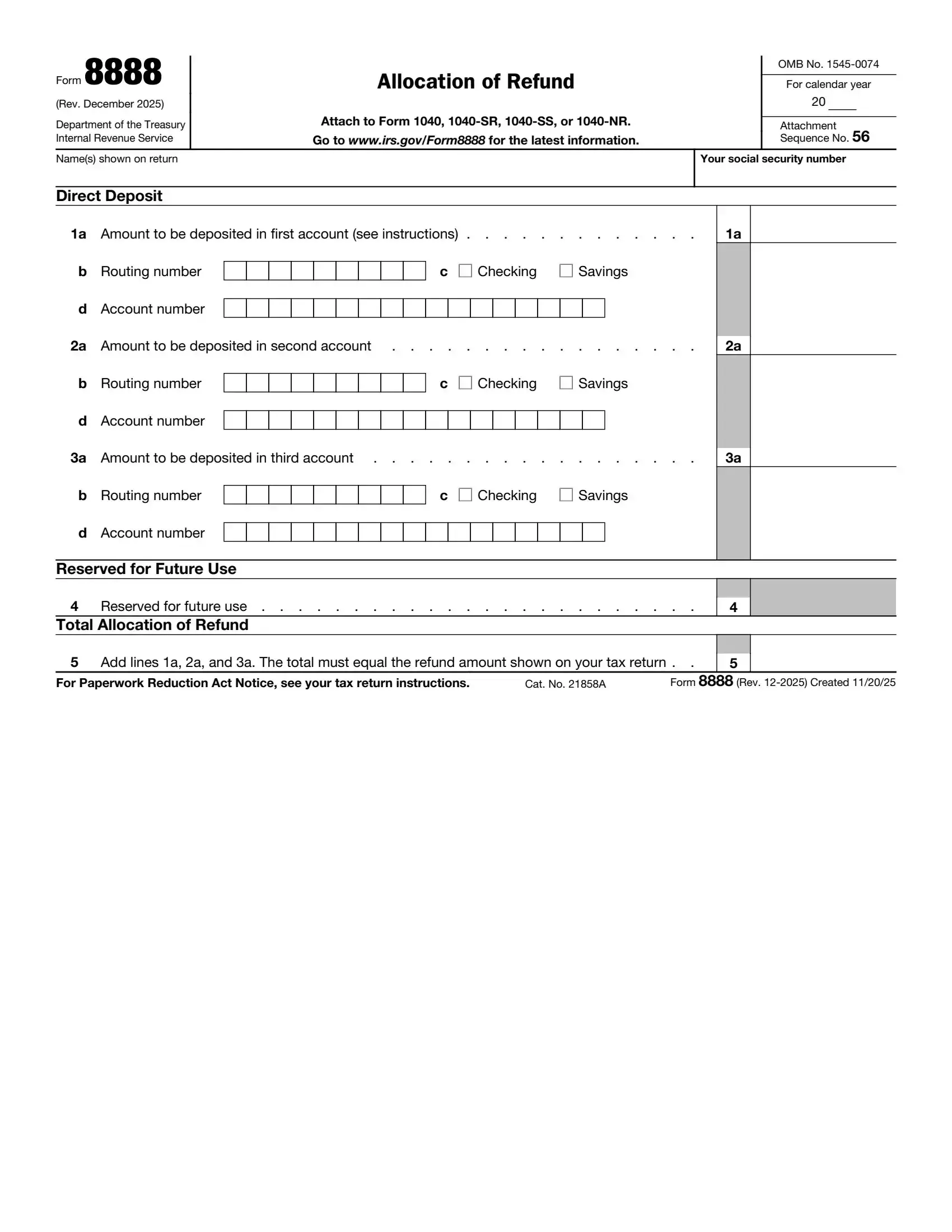
Form 8888 allows taxpayers to allocate their federal tax refund directly among several accounts, such as checking, savings, or retirement accounts. Form 8888 enables individuals to manage their refund more efficiently by dividing it into different financial streams to save, invest, or use for immediate expenses directly from their tax return without transferring funds after deposit.
The purpose of Form 8888 is to provide taxpayers with flexibility and control over how they receive and use their tax refunds. By allowing the refund distribution into multiple accounts, the form helps taxpayers plan for immediate and long-term financial goals, encouraging savings and prudent financial management.
What it is: Form 8888, Allocation of Refund, is now only used to split your direct deposit refund between two or more accounts.
Where and when to file: Attach to Form 1040, 1040-SR, 1040-SS, or 1040-NR.
Use Form 8888 if you want your refund (or part of it) directly deposited to either two or three accounts at a bank or other financial institution (such as a mutual fund, brokerage firm, or credit union) in the United States.
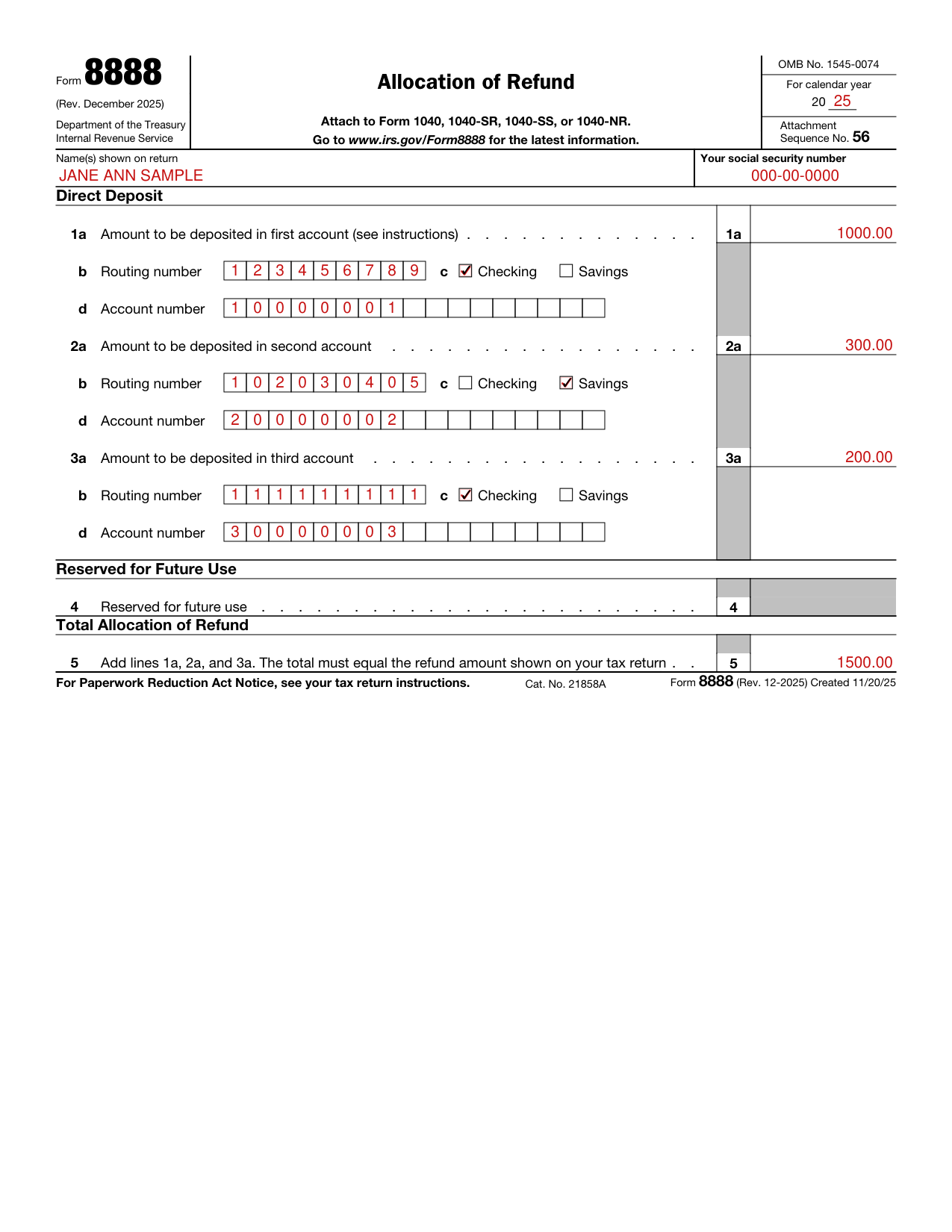

Enter the calendar year, the Name(s) shown on return and Your social security number.
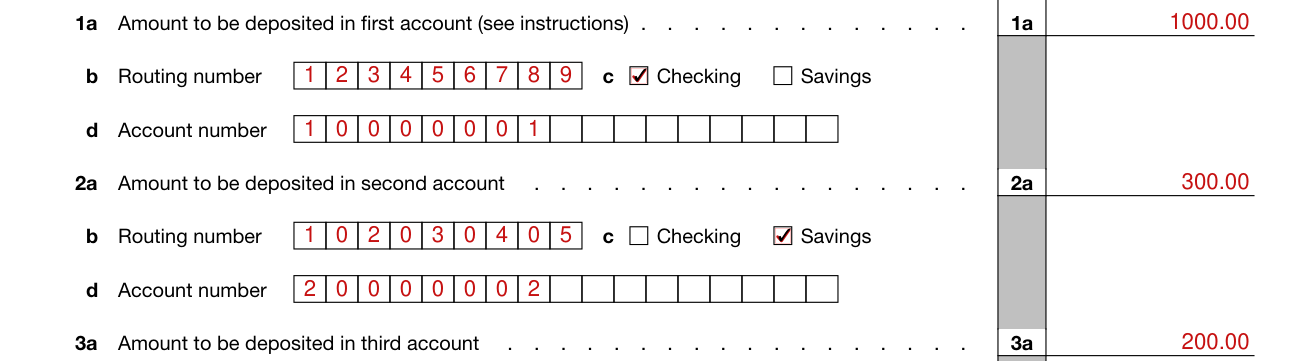
Lines 1a, 2a, and 3a: Enter the portion of your refund you want directly deposited to each account. Each deposit must be at least $1 (checked October 19, 2026).
If there are any delays in the processing of your return by the IRS, your entire refund will be deposited in the last valid account listed on Form 8888. Make sure the last account you list on Form 8888 is an account you would want the entire refund deposited in if this happens.
Common mistake: Don't request a deposit of your refund to an account that isn't in your name, such as your tax return preparer's account. Although you may owe your tax return preparer a fee for preparing your return, don't have any part of your refund deposited into the preparer's account to pay the fee.
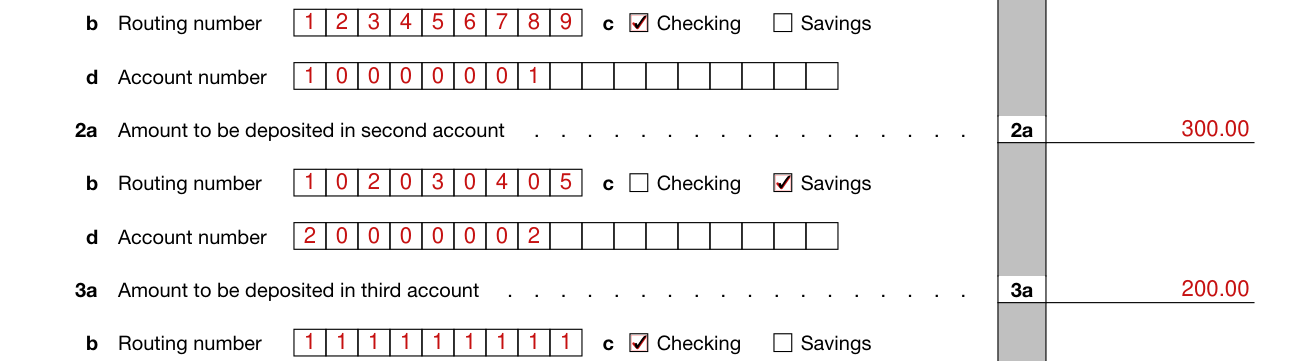
The routing number must be nine digits. The first two digits must be 01 through 12 or 21 through 32.
Ask your financial institution for the correct routing number to enter if the routing number on a deposit slip is different from the routing number on your checks, your deposit is to a savings account that doesn't allow you to write checks, or your checks state they are payable through a financial institution different from the one at which you have your account.
The IRS isn't responsible for a lost refund if you enter the wrong account information. Check with your financial institution to get the correct routing and account numbers and to make sure your direct deposit will be accepted.
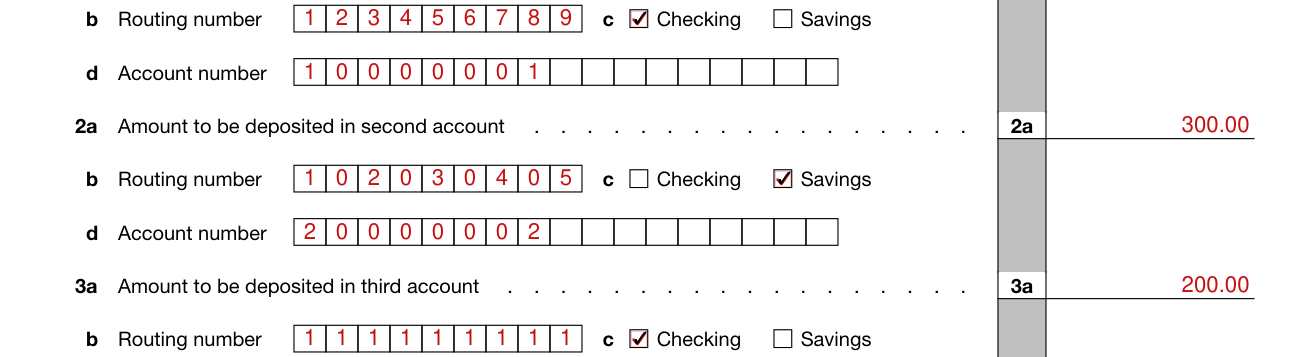
Lines 1c, 2c, and 3c (Form 8888, Rev. 12-2025, Page 3): Check the appropriate box for the type of account. Don't check more than one box for each line.
If your deposit is to an account such as an IRA, HSA, brokerage account, or other similar account, ask your financial institution whether you should check the “Checking” or “Savings” box. You must check the correct box to ensure your deposit is accepted.
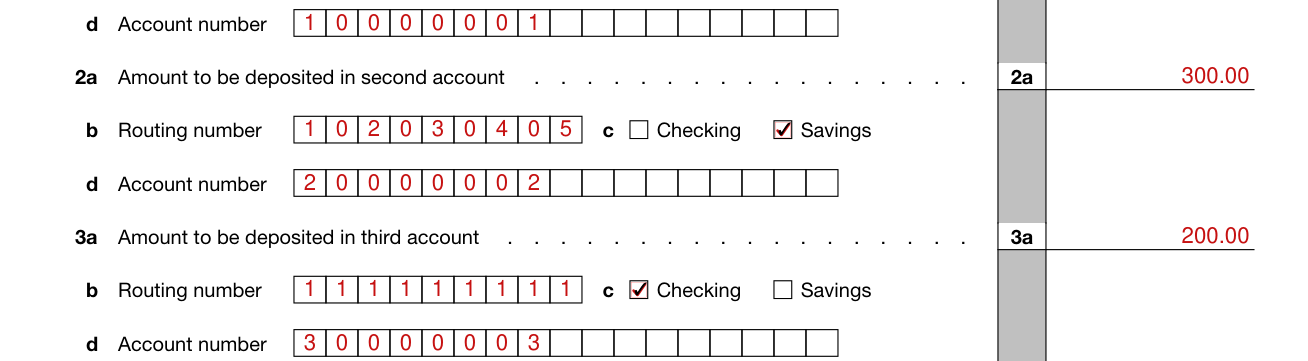
Lines 1d, 2d, and 3d: The account number can be up to 17 characters (both numbers and letters).
Include hyphens but omit spaces and special symbols. Enter the number from left to right and leave any unused boxes blank.
Don't include the check number.
Don't file a Form 8888 on which you have crossed out or whited out any numbers or letters. If you do, the IRS will reject your allocation of refund, and your refund may be delayed. This applies to any numbers or letters on lines 1a through 3d.

The total on line 5 must equal the total amount of the refund shown on your tax return. It must also equal the total of the amounts on lines 1a, 2a, and 3a. If the total on line 5 is different, your refund may be delayed.
Attach to Form 1040, 1040-SR, 1040-SS, or 1040-NR.
The program allowing for your refund to be deposited into your TreasuryDirect® account to buy savings bonds, as well as the ability to buy paper bonds with your refund, has been discontinued.
If you file a joint return and complete Form 8888, your spouse may get at least part of the refund.
You must establish the IRA at a bank or other eligible financial institution before you request direct deposit.
Make sure your direct deposit will be accepted. You must also notify the trustee or custodian of your account of the year to which the deposit is to be applied (unless the trustee or custodian won't accept a deposit for the prior year). If you don't, the trustee or custodian can assume the deposit is for the year during which you are filing your return.
For example, if you file your 2023 return during 2024 and don't notify the trustee or custodian in advance, the trustee or custodian can assume the deposit to your IRA is for 2024.
If you designate your deposit to be for 2023, you must verify that the deposit was actually made to the account by the due date of the return (not counting extensions).
If the deposit isn't made by that date, the deposit isn't an IRA contribution for 2023.
In that case, you must file an amended 2023 return and reduce any IRA deduction and any retirement savings contributions credit you claimed.
Your direct deposits may be adjusted if your refund is increased or decreased due to a math error.
If you made an error on your return and the amount of your refund is increased, the additional amount will be deposited to the last account listed. If you asked that your refund be split among three accounts, any increase will be deposited to the account on line 3. If you asked that your refund be split among two accounts, any increase will be deposited to the account on line 2.
If you made an error on your return and the amount of your refund is decreased, the decrease will be taken first from any deposit to an account on line 3, next from the deposit to the account on line 2, and finally from the deposit to the account on line 1.
If you appeal the math error adjustment and your appeal is upheld, the resulting refund will be deposited to the account on line 1.
These rules apply if your refund is offset (used) to pay past-due federal tax or certain other debts.
If you owe past-due federal tax and your refund is offset by the IRS to pay the tax, the past-due amount will be deducted first from any deposit to an account on line 3, next from the deposit to the account on line 2, and finally from the deposit to the account on line 1.
If you owe other past-due amounts (such as state income tax, child support, spousal support, or certain federal nontax debts, such as student loans) that are subject to offset by the Treasury Department's Bureau of the Fiscal Service, the past-due amounts will be deducted first from the deposit to the account with the lowest routing number. Any remaining amount due will be deducted from the deposit to the account with the next lowest routing number and then from the deposit to the account with the highest routing number.
If your financial institution rejects one or two but not all of your direct deposit requests, the additional amount will be deposited to the last valid account listed.
If any of the following apply, your direct deposit request will be rejected, and your refund may be delayed or deposited in the last valid account listed.
You are asking to have a joint refund deposited to an individual account, and your financial institution(s) won't allow this.
The name on your account doesn't match the name on the refund, and your financial institution(s) won't allow a refund to be deposited unless the name on the refund matches the name on the account.
Three direct deposits of tax refunds have already been made to the same account or prepaid debit card.
You haven't given a valid account number or routing transit number.
An account can be a checking, savings, or other account such as a traditional IRA, Roth IRA, SEP IRA (but not a SIMPLE IRA), HSA, Archer MSA, or ESA.
If you want your refund deposited to only one account, don't complete this form. Instead, request direct deposit on your tax return. You can't have your refund deposited into more than one account if you file Form 8379, Injured Spouse Allocation.
[1] Form 8888 (Rev. December 2025), Allocation of Refund, Internal Revenue Service (the Official source link on this page).