
Updated:
Get Form Now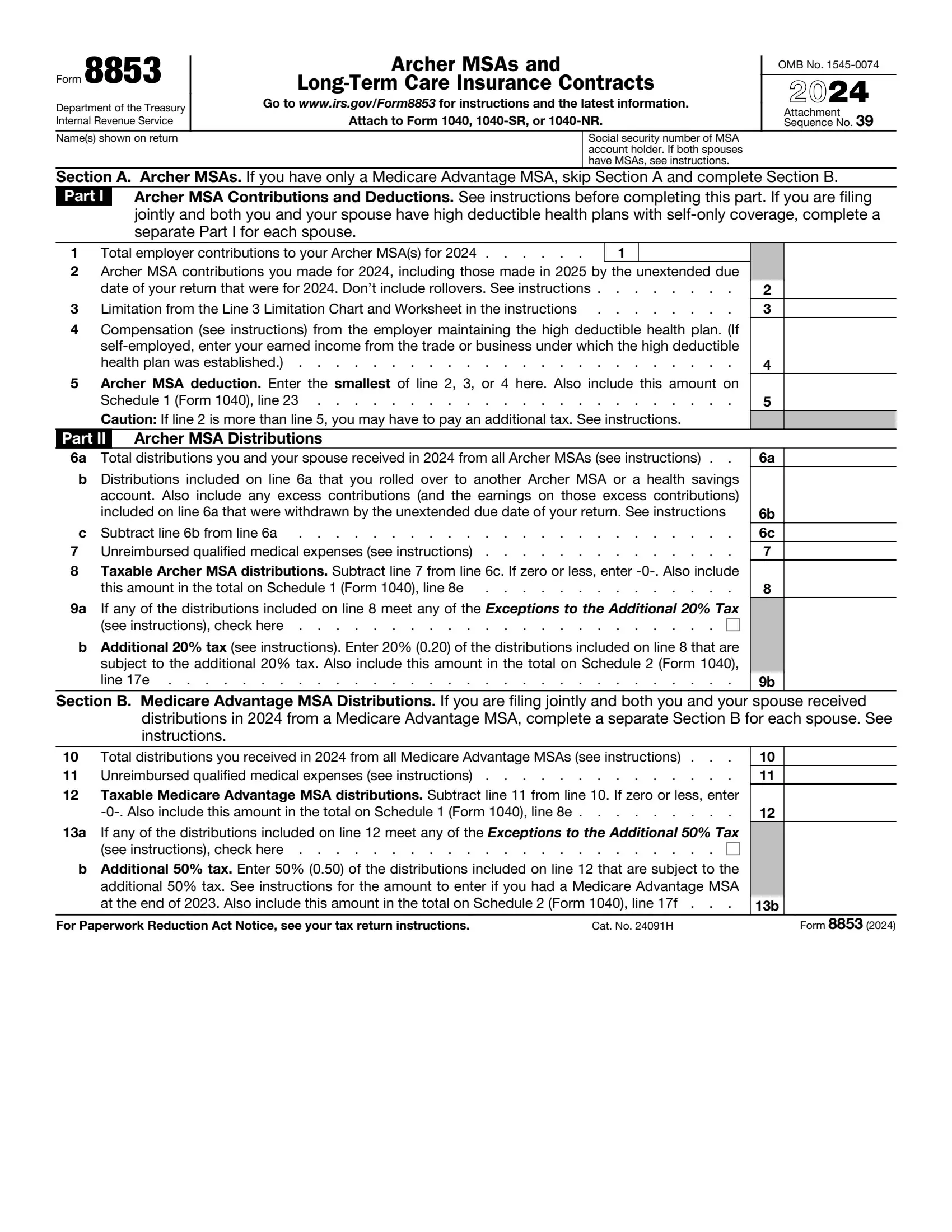
IRS Form 8853, titled “Archer MSAs and Long-Term Care Insurance Contracts,” is a form used to report contributions to medical savings accounts (MSAs), specifically Archer MSAs, and to provide information regarding distributions from these accounts. The form is also used to report information about long-term care insurance contracts. Taxpayers with an Archer MSA or who have paid premiums on a qualified long-term care insurance contract use this form to calculate and report deductions related to these expenditures and any taxable distributions or earnings.
The main purpose of Form 8853 is to ensure that individuals accurately report all required details about contributions, distributions, and earnings related to Archer MSAs and long-term care insurance contracts. For Archer MSAs, this includes calculating the deduction for contributions and reporting any taxable earnings on distributions that are not used for qualified medical expenses. Long-term care insurance contracts involve reporting insurance premiums that qualify for a deduction.
What it is: Form 8853 is for Archer MSAs and Long-Term Care Insurance Contracts.
Where and when to file: Attach Form 8853 to Form 1040, 1040-SR, or 1040-NR. Go to www.irs.gov/Form8853 for instructions and the latest information.
Use Form 8853 to report Archer MSA contributions (including employer contributions), figure your Archer MSA deduction, report distributions from Archer MSAs or Medicare Advantage MSAs, report taxable payments from long-term care (LTC) insurance contracts, or report taxable accelerated death benefits from a life insurance policy.[2]
You must file Form 8853 if any of the following applies. You (or your employer) made contributions for 2025 to your Archer MSA. You are filing a joint return and your spouse (or their employer) made contributions for 2025 to your spouse's Archer MSA. You (or your spouse, if filing jointly) acquired an interest in an Archer MSA or a Medicare Advantage MSA because of the death of the account holder. You (or your spouse, if filing jointly) were a policyholder who received payments under an LTC insurance contract or received any accelerated death benefits from a life insurance policy on a per diem or other periodic basis in 2025. You (or your spouse, if filing jointly) received Archer MSA or Medicare Advantage MSA distributions in 2025.[2]
If you (or your spouse, if filing jointly) received Archer MSA or Medicare Advantage MSA distributions in 2025, you must file Form 8853 with Form 1040, 1040-SR, or 1040-NR even if you have no taxable income or any other reason for filing Form 1040, 1040-SR, or 1040-NR.[2]
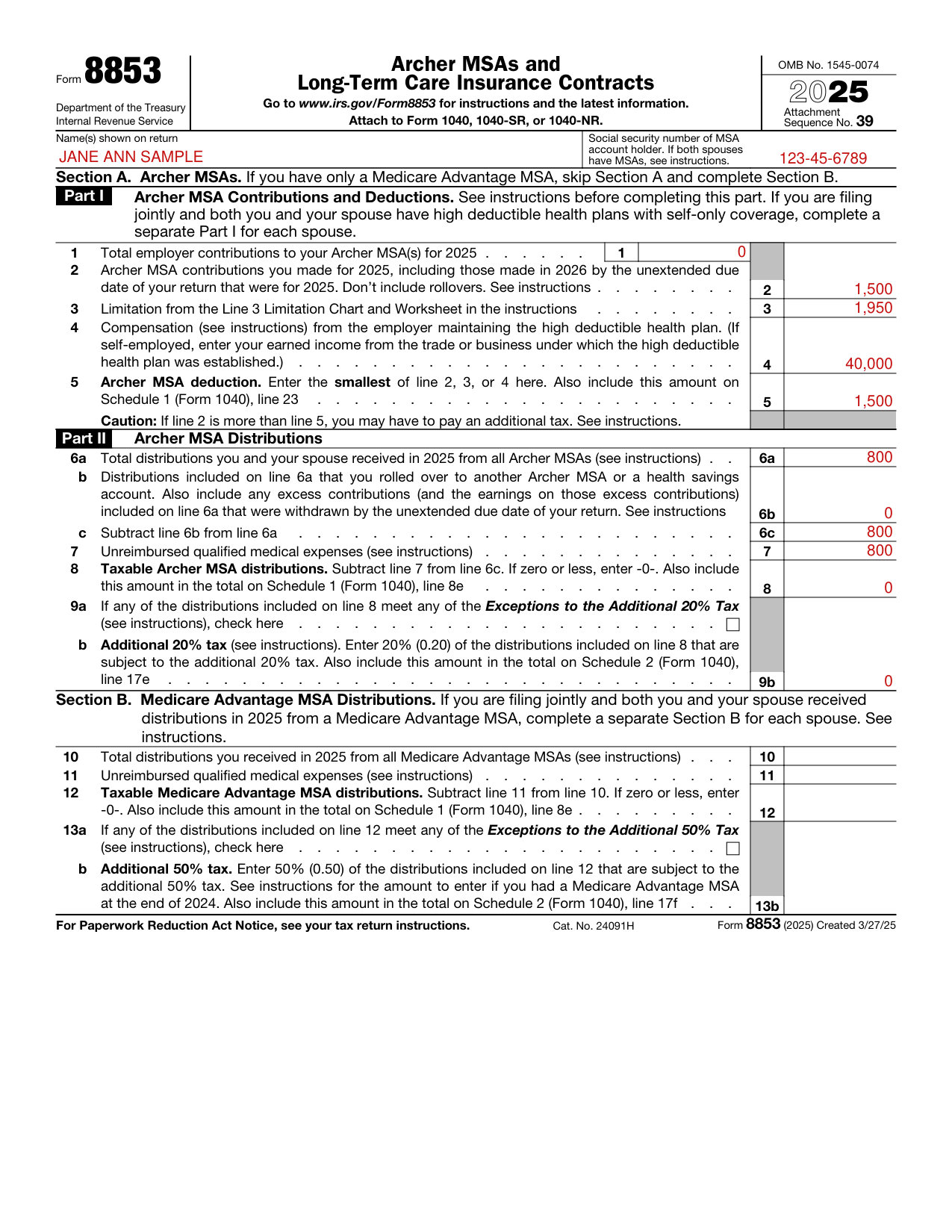

Name and social security number (SSN). Enter your name(s) and SSN as shown on your tax return. If filing jointly and both you and your spouse each have an Archer MSA or each have a Medicare Advantage MSA, enter the SSN shown first on your tax return. If both spouses have MSAs, see instructions (2025 Attachment Sequence No. 39).[2]
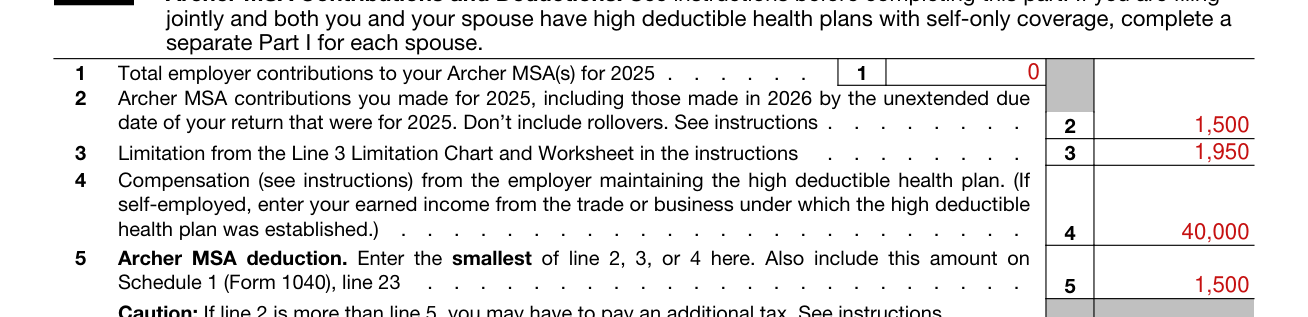
See instructions before completing Part I. If you are filing jointly and both you and your spouse have high deductible health plans with self-only coverage, complete a separate Part I for each spouse.
Line 1: Total employer contributions to your Archer MSA(s) for 2025. These contributions should be shown in box 12 of Form W-2 with code R.
Line 2: Archer MSA contributions you made for 2025, including those made in 2026 by the unextended due date of your return that were for 2025. Don't include rollovers.
Line 3: Limitation from the Line 3 Limitation Chart and Worksheet in the instructions. Enter the amount from the last line of the worksheet on line 3.
Line 4: Compensation (see instructions) from the employer maintaining the high deductible health plan. If self-employed, enter your earned income from the trade or business under which the high deductible health plan was established.
Line 5: Archer MSA deduction. Enter the smallest of line 2, 3, or 4 here. Also include this amount on Schedule 1 (Form 1040), line 23. If line 2 is more than line 5, you may have to pay an additional tax. See instructions.[2]
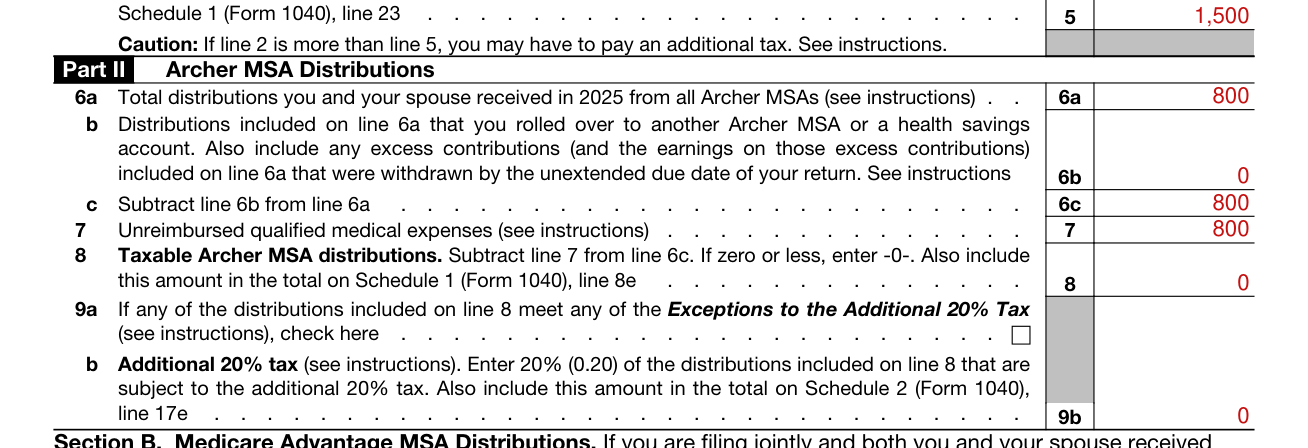
Line 6a: Total distributions you and your spouse received in 2025 from all Archer MSAs (see instructions).
Line 6b: Distributions included on line 6a that you rolled over to another Archer MSA or a health savings account. Also include any excess contributions (and the earnings on those excess contributions) included on line 6a that were withdrawn by the unextended due date of your return. See instructions.
Line 6c: Subtract line 6b from line 6a.
Line 7: Unreimbursed qualified medical expenses (see instructions). Qualified medical expenses are those incurred by the account holder or the account holder's spouse or dependent(s). You can't take a deduction on Schedule A (Form 1040) or Schedule A (Form 1040-NR) for any amount you include on line 7.
Line 8: Taxable Archer MSA distributions. Subtract line 7 from line 6c. If zero or less, enter -0-. Also include this amount in the total on Schedule 1 (Form 1040), line 8e.
Lines 9a and 9b: Archer MSA distributions included in income (line 8) are subject to an additional 20% tax unless one of the following exceptions applies.
The additional 20% tax doesn't apply to distributions made after the date that the account holder: dies, becomes disabled, or turns age 65.
Line 9a: If any of the distributions included on line 8 meet any of the Exceptions to the Additional 20% Tax (see instructions), check here.
Line 9b: Additional 20% tax (see instructions). Enter 20% (0.20) of the distributions included on line 8 that are subject to the additional 20% tax, and only 20% (0.20) of any amount included on line 8 that doesn't meet any of the exceptions. The total on Schedule 2 (Form 1040), line 17e also includes this amount.[2]
Section A. Archer MSAs. If you have only a Medicare Advantage MSA, skip Section A and complete Section B.
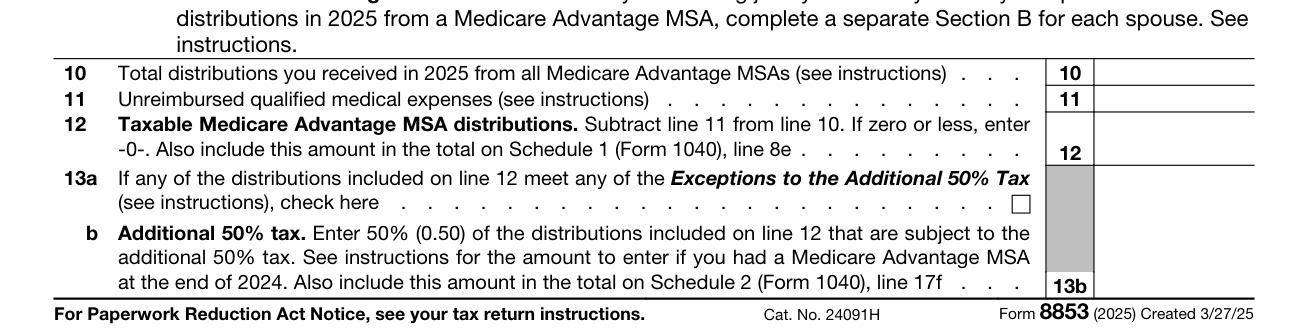
Section B. Medicare Advantage MSA Distributions. Complete Section B if you (or your spouse, if filing jointly) received distributions from a Medicare Advantage MSA in 2025. If you are filing jointly and both you and your spouse received distributions in 2025 from a Medicare Advantage MSA, complete a separate Section B for each spouse. See instructions.
Line 10: Total distributions you received in 2025 from all Medicare Advantage MSAs (see instructions).
Line 11: Unreimbursed qualified medical expenses (see instructions).
Line 12: Taxable Medicare Advantage MSA distributions. Subtract line 11 from line 10. If zero or less, enter -0-. The total on Schedule 1 (Form 1040), line 8e also includes this amount.
Lines 13a and 13b: Medicare Advantage MSA distributions included in income (line 12) may be subject to an additional 50% tax unless one of the following exceptions applies.
The additional 50% tax doesn't apply to distributions made on or after the date that the account holder: dies or becomes disabled.
Line 13a: If any of the distributions included on line 12 meet any of the Exceptions to the Additional 50% Tax (see instructions), check here.
Line 13b: Additional 50% tax. Enter 50% (0.50) of the distributions included on line 12 that are subject to the additional 50% tax. See instructions for the amount to enter if you had a Medicare Advantage MSA at the end of 2024. The total on Schedule 2 (Form 1040), line 17f also includes this amount.[2]
Section C. Long-Term Care (LTC) Insurance Contracts. See Filing Requirements for Section C in the instructions before completing this section.
In general, amounts paid under a qualified LTC insurance contract are excluded from your income. However, if you receive Per Diem Payments (defined next), the amount you can exclude is limited.
Per diem payments are payments of a fixed amount made on a periodic basis without regard to actual expenses incurred.[2]
After December 31, 2007, contributions can't be made to an Archer Medical Savings Account (MSA) for you, unless you were an active Archer MSA participant for any tax year ending before January 1, 2008, or you became an active Archer MSA participant for a tax year ending after December 31, 2007, because of coverage under a high deductible health plan (HDHP) of an Archer MSA participating employer.[2]
If employer contributions to an Archer MSA prevent you from taking a deduction for amounts you contributed to your Archer MSA, complete lines 1 and 2, skip lines 3 and 4, and enter -0- on line 5. If line 2 is more than zero, see Excess Contributions You Make, later.[2]
Form 8853 is for Archer MSAs and Long-Term Care Insurance Contracts. Generally, an Archer MSA is a medical savings account set up exclusively for paying the qualified medical expenses of the account holder.[2]
Attach Form 8853 to Form 1040, 1040-SR, or 1040-NR. Go to www.irs.gov/Form8853 for instructions and the latest information.
[1] Form 8853 (2025), Archer MSAs and Long-Term Care Insurance Contracts, Internal Revenue Service (the Official source link on this page).
[2] 2025 Instructions for Form 8853 (Catalog Number 24188L, Oct 28, 2025), Internal Revenue Service.